
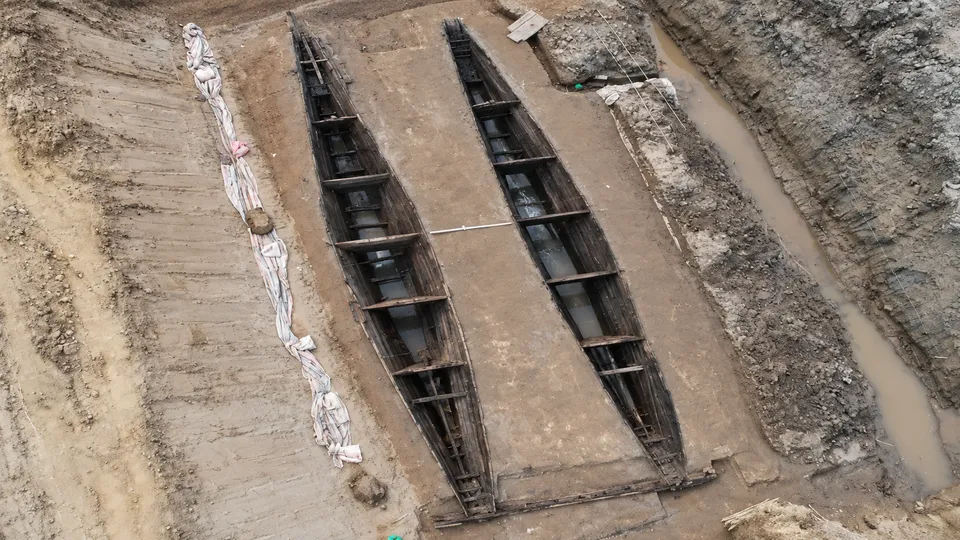
Every empire, every village, every household leaves behind what it ate. Kings are remembered in stone; ordinary lives are remembered in seeds. In a former fish pond in the Cong Ha area of Bac Ninh Province, in northern Vietnam, archaeologists have now counted more than five thousand of them — seeds, fruit stones and stalks pressed into the timbers of two wooden boats that have lain in waterlogged mud for roughly two thousand years.
As Arkeonews reported, the find is the largest archaeobotanical assemblage of its kind tied to the late Đông Sơn period, and it was presented in connection with Vietnam’s 61st National Archaeology Conference, held in Hanoi on October 15–16, 2026. The question it raises is an old one, as old as rivers: who was moving what, and between whom?
Two hulls under a fish pond
The Ha Man boats surfaced during work to renovate a fish pond in early 2025. Emergency excavations began that March and uncovered two closely associated wooden hulls, each more than 16 meters long and about two meters wide. Their builders used no metal nails; the planks were joined with mortise-and-tenon joints, wedges and wooden pegs. The two hulls were connected — which led specialists to ask whether they once formed a double-hulled vessel carrying a larger wooden platform above.
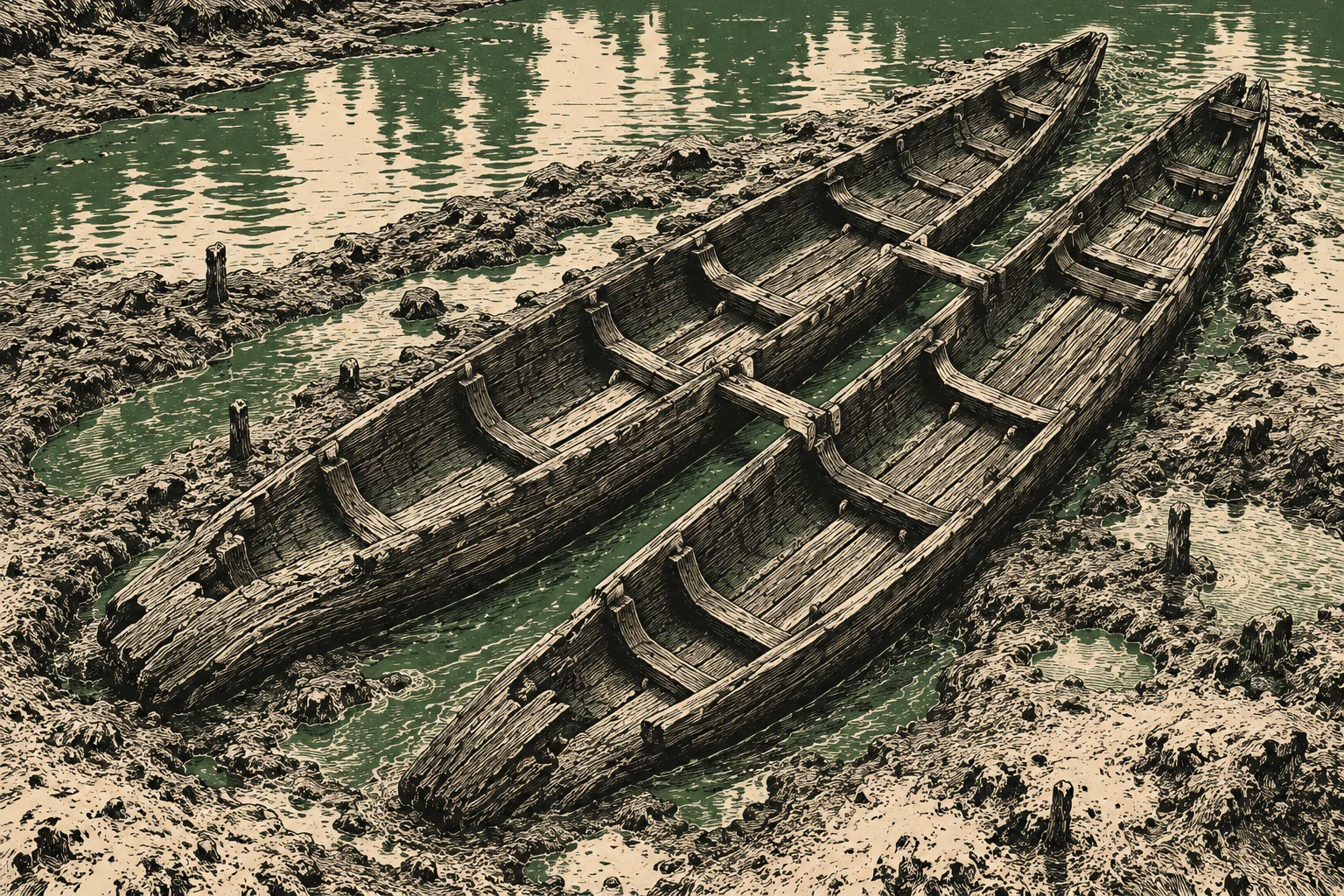
The dating overturned expectations. Construction techniques had first suggested a medieval origin, perhaps somewhere between the 11th and 14th centuries. But radiocarbon analysis of wood samples, reported by archaeologist Nguyen Quang Mien in November 2025, placed the structure around the second century AD — the late Đông Sơn period. Three pottery fragments from the boats resemble ceramics from the Đường Mây site at Cổ Loa, a settlement tied to that culture and dated to roughly 2,500 to 2,200 years ago. The resemblance, the researchers caution, is a connection, not a proof of age.
A cargo of apricots and upland nuts
A team that included Dr. Nguyen Thi Mai Huong of the Institute of Archaeology, part of the Vietnam Academy of Social Sciences, sieved sediment from inside and around the hulls — material from 12 compartments, washed through meshes of about 2 to 4 millimeters. The tally: 5,084 seed and fruit fragments that remain unidentified, plus hundreds of identifiable or partly identifiable specimens spanning at least 20 plant taxa. Among them were 171 apricot and plum specimens, 129 of Dracontomelon — the sour sấu fruit Hanoians still pickle — 53 chinaberry, 43 legumes, 31 Canarium and 30 jujube, along with chestnut fruit stalks, gac seeds, screw pine, Chinese honeysuckle and mango.
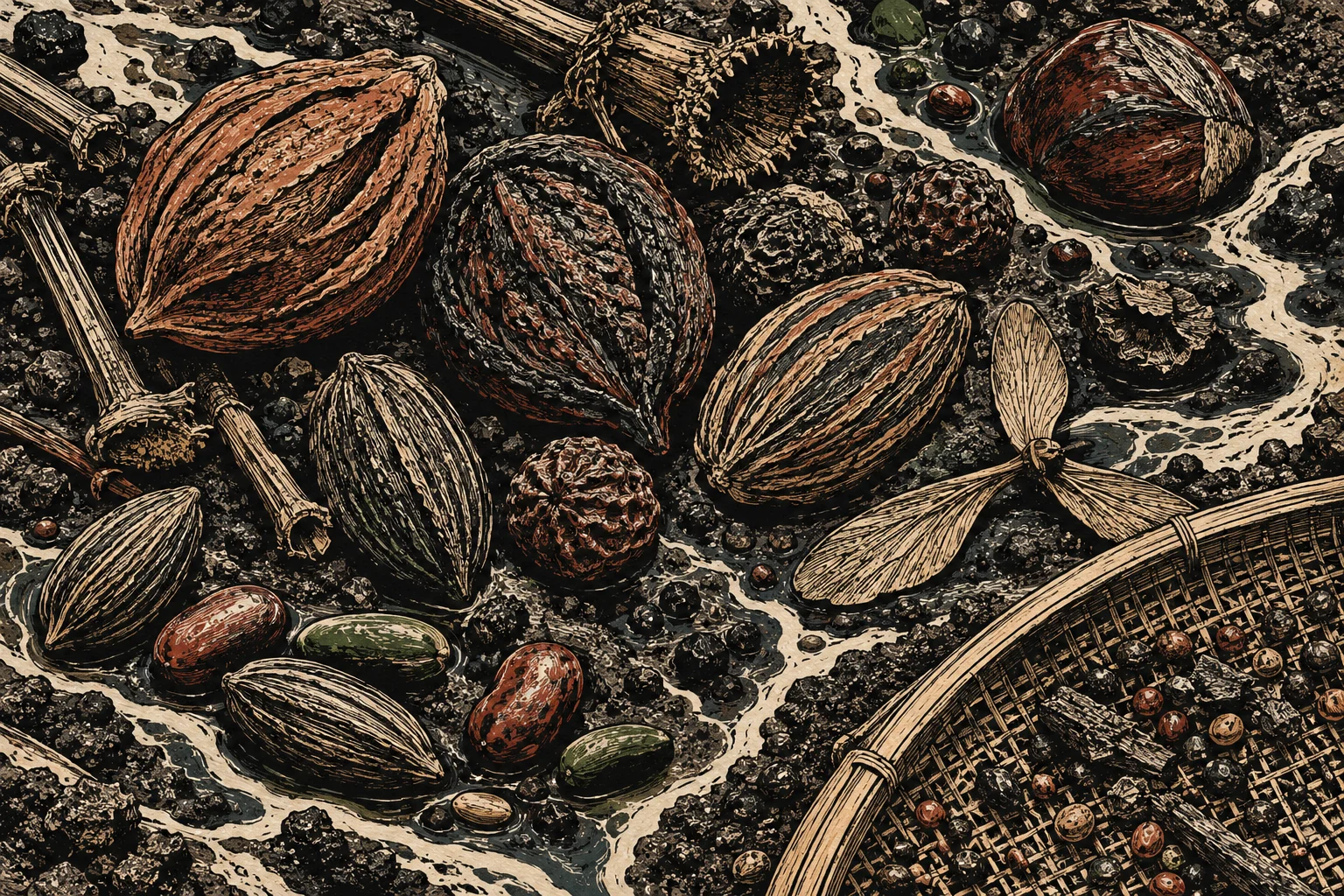
Some fruits kept their stalks through twenty centuries of burial; the Chinese honeysuckle fruits still show their three-winged shape. Huong attributes the preservation to charring combined with prolonged waterlogging in oxygen-poor mud — clay sealing out the decay that would normally erase such delicate evidence entirely.
What the distribution suggests
The seeds were not scattered evenly, and that may be the point. Concentrations rose toward the rear compartments of the first hull, while the second hull held both more material and more variety — one compartment alone yielded over 1,700 seed and fruit fragments and 255 unidentified wood pieces. Gac, screw pine and Chinese honeysuckle appeared only in the second structure. Researchers are weighing whether particular compartments served as storage for goods in transit.
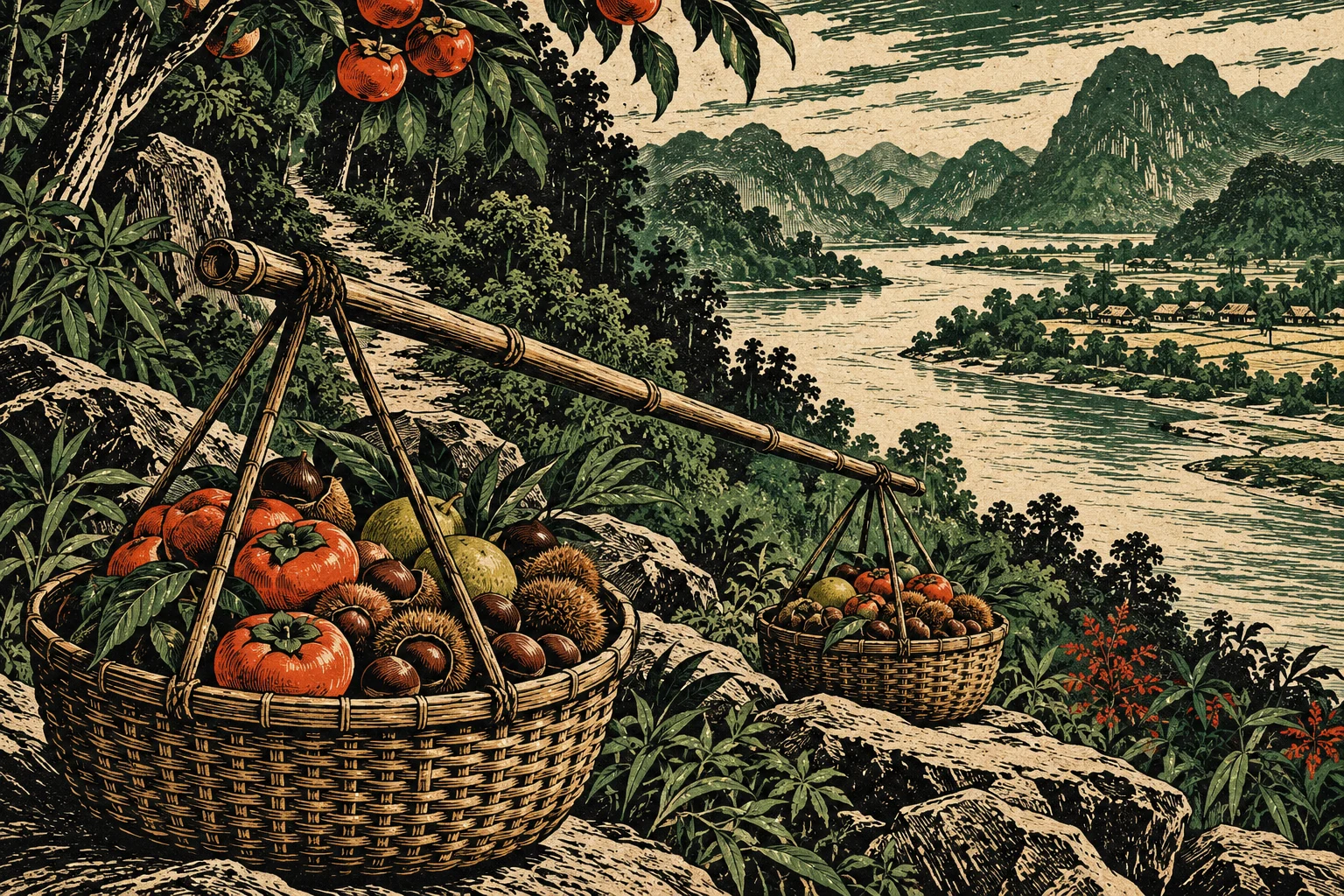
Then there is the geography written into the plants themselves. The boats lay in the lowlands of the Thai Binh River basin — yet chestnut and Canarium point toward upland and foothill country. The team lists Canarium, chestnut stalks, Chinese honeysuckle and gac among the remains that could represent transported products, which would imply exchange between mountain communities and the settlements along the waterways. But discipline prevails over romance: silk-cotton tree thorns, vines and driftwood may have settled naturally, and the apricots, plums, jujubes and legumes could equally have been cargo, the crews’ own food, or simply what the river dropped in.
Boat, platform — or altar?
What the structure was for remains genuinely contested. Shipbuilding specialist Do Thai Binh reads it as two connected hulls that may have supported a platform exceeding 100 square meters, poled or rowed through sheltered river waters. Nguyen Viet, director of the Southeast Asian Prehistory Centre, doubts it was a boat at all: the bottoms are too flat, inclined at only about 10 degrees, and no propulsion gear has been identified. It may, he suggests, have been a floating installation moored to a bank. A ceremonial role has also been floated, though the evidence does not establish it. And the answer decides the meaning of the seeds: cargo moving through an ancient river network, or the rubbish and stores of a place that never moved.
The team’s next steps are exacting: identify more of the unknown fragments, and — crucially — date the seeds and fruits themselves by accelerator mass spectrometry, with stable isotope analysis and pollen studies to follow. The wood has been dated; the cargo has not yet been shown to be the wood’s contemporary. Until it is, the boats of Bac Ninh keep their secret, the way rivers keep all secrets — in the mud, in layers, in patience.