
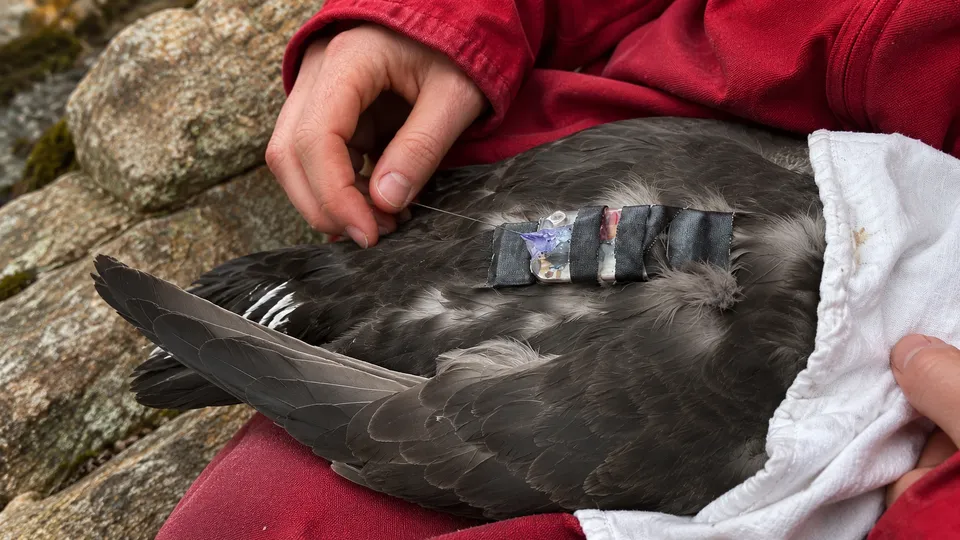
Seabirds fitted with tiny audio recorders picked up the engine hum of fishing boats and other vessels that never appeared on public tracking systems, University of Oxford researchers reported on Wednesday in the journal Science Advances.
The gap was widest for northern gannets. At least 32 percent of the vessel sounds captured by seven gannets in the North Atlantic came from boats with no matching signal on the Automatic Identification System, or AIS, and the researchers estimated the true share was closer to 57 percent, according to the study. Four Balearic shearwaters, a critically endangered species, were tagged in the Mediterranean. At least 12 percent of the vessel sounds they recorded came from untracked boats, and the estimate there was 20 percent, according to a release from the American Association for the Advancement of Science.
“The fact that we found at least one third, and probably more than one half, of the audio detections being unseen was pretty surprising,” Dr. Jonathan Rutter, a postdoctoral research fellow at Oxford who led the study, said in a call with 404 Media’s Becky Ferreira. He said the number was easy to misread. “This is not the same thing as saying that half of vessels are unseen; it’s half of the time that gannets go to vessels, those vessels are unseen.”
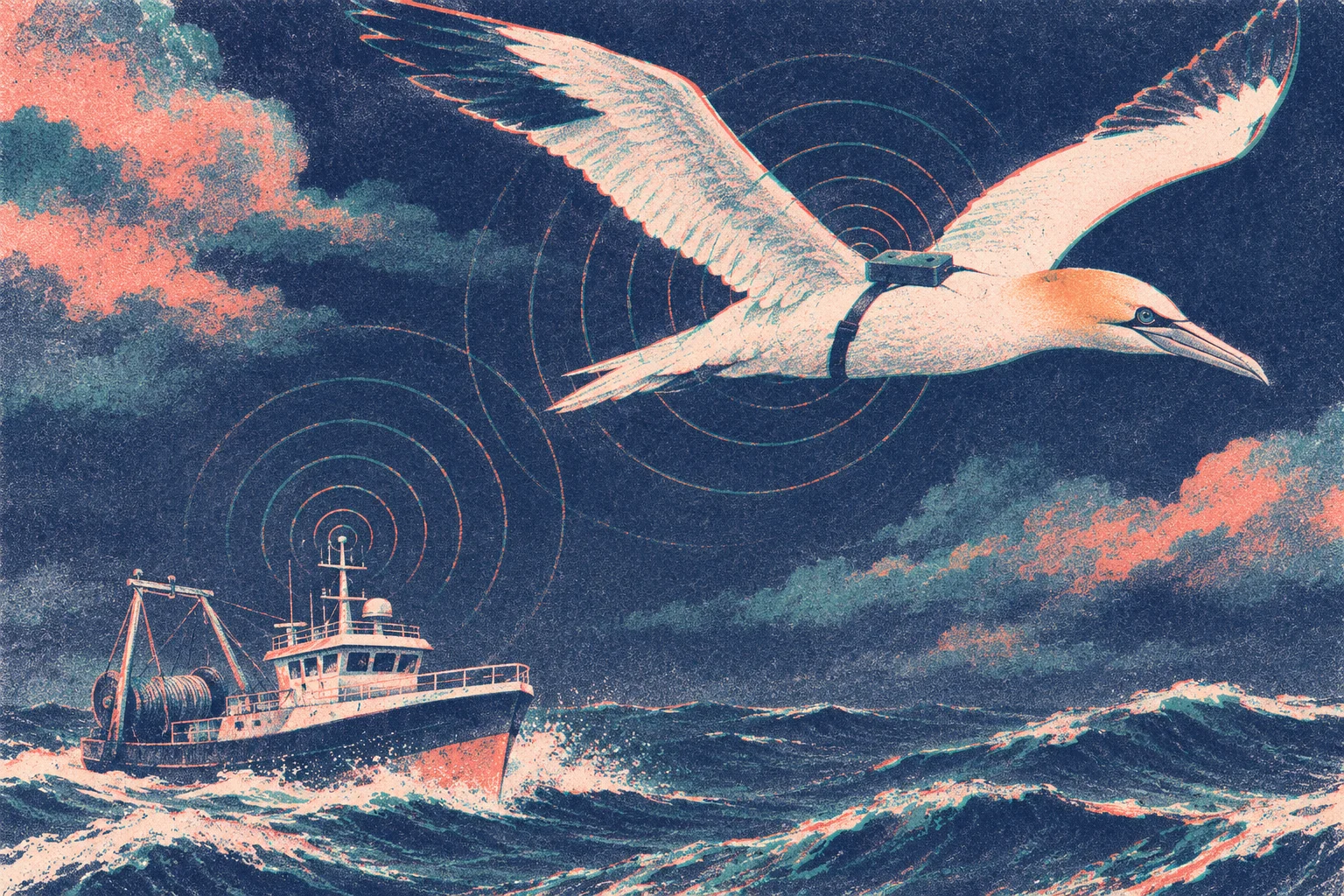
The gannets came from Grassholm Island in Wales, and earlier video logger work showed they deal almost exclusively with large trawlers, boats that are required to broadcast on AIS, Dr. Rutter told Gizmodo in an email. “This was a far higher proportion of unseen fishing than we expected, and it could reflect some combination of poor satellite reception or deliberate AIS disabling,” he said. The shearwaters, he said, were probably often visiting small Mediterranean boats that aren’t legally obliged to carry trackers.
The study wasn’t built to find out why any one vessel went dark. AIS broadcasts a ship’s identity, position, course and speed, much as flight trackers do for planes, and crews can turn it off for legitimate reasons, like avoiding pirates, or to hide illegal fishing.
“There are lots of reasons that AIS can be off, and we want to emphasize that illegal fishing is a possibility, but that is not actually what we’re showing,” Dr. Rutter told 404 Media. “It’s showing that there’s a lot we’re not seeing.”
Untracked ships are common. About three-quarters of the world’s industrial fishing vessels and a quarter of its transport and energy vessels don’t broadcast their locations publicly, Gizmodo reported.
The team attached recorders and GPS trackers to the birds’ backs and tails for one to two weeks at a time. A computer model adapted from an existing vessel-detection tool picked out the low-frequency engine hum, and the researchers checked each detection against AIS and, where available, vessel monitoring system records. They then estimated how far each bird was from the nearest tracked ship to judge whether that ship could have made the sound, according to Oxford’s account of the work on Phys.org. The gannets spent an average of 68 minutes a day near vessels, at least 22 of them near untracked ones.
A single Westland petrel was tagged in the South Pacific. Its geolocation device was damaged, so the team couldn’t work out how many of its encounters were with unseen ships, though its audio caught landing and takeoff sequences previously seen in albatrosses.

The work is aimed at bycatch. Seabirds follow boats for discarded fish and bait, and many die snagged on baited hooks or tangled in lines. “If we only consider boats that appear on tracking systems, we risk overlooking areas where birds may be exposed to dangerous fishing activity,” Dr. Rutter said in a statement from Oxford. The recordings can’t show whether any single encounter killed a bird.
Some birds come out ahead. Stephen Votier, a professor at Heriot-Watt University and a co-author, said gannets use fishing vessels as a food source. “For these birds, boats may be more of a dinner bell than a warning signal,” he said.
The authors urged “caution in the use of animals as a fisheries surveillance tool, lest fishers come to mistrust scientists and/or marine animals themselves.” Oxford said the goal was not to identify or follow individual vessels in real time. Dr. Rutter said his group is already developing a second method that reads the birds’ movements to tell when one is following a ship.
“They’re going out every day and just visiting boats all the time, and that shows the impact that we have on them as humans is really changing their feeding ecology,” he told 404 Media.