
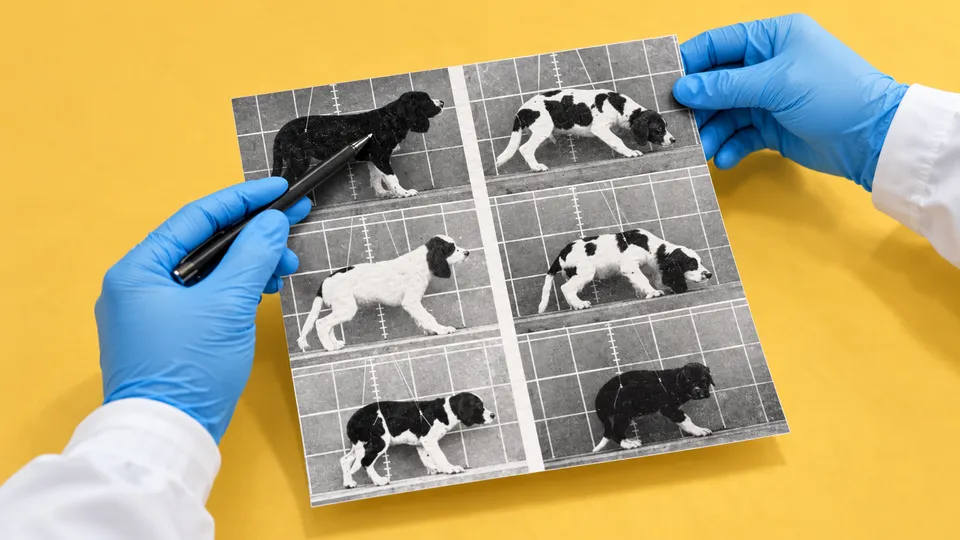
Beginning in the late 1940s, researchers at a purpose-built facility on a farm in Maine spent 13 years recording the lives of more than 500 puppies, part of an immense experiment to breed a hyper-intelligent “super dog.” They failed. The findings still changed the science of dog behavior, and they helped bury eugenics for good.
The project, nicknamed the School for Dogs, was born of a golden age in American science, when postwar money flowed freely and large sums were signed over with few questions. The funding, $632,000 from the Rockefeller Foundation, or close to $9 million today, came with an agenda. Alan Gregg, the director of the foundation’s Division of Medical Science, was among the prominent academics still in thrall to eugenics even after its role in Nazi atrocities during the Holocaust had discredited it. He believed that “delinquents, the criminal insane, the emotionally unstable, the psychopathic personalities” could be explained by bad genes, and that man had “as much to gain intellectually by wise matings as by $800,000 high schools,” as he put it in a 1945 letter. A brilliant dog, bred on purpose, would make the case that intelligence was inherited. The foundation did not reply to the BBC’s request for comment.
Dogs seemed the perfect test subject: what other single species contains both the Great Dane and the Pomeranian? John Paul Scott, an animal behavior geneticist, led the work with John Fuller, a physiologist, studying cocker spaniels, beagles, Shetland sheepdogs, basenjis and wire-haired fox terriers. From birth, every puppy’s development was logged: its first startle response, its first solid food, its first playfight with a sibling, its first tail wag. At five weeks the testing began, mazes with food hidden inside, problems repeated to see whether performance improved, measures of dominance, emotional reactivity and aptitude for training.
The results did not oblige the benefactor. Some breeds did better on some tests, but none did better across all of them, and the researchers concluded that no breed could be called more intelligent than another. Temperament, too, bent to circumstance. Fox terriers showed a greater capacity for violence, as dogs bred for the hunt, but context mediated it heavily. “The same breed might be fearful in one situation and confident in another,” Mr. Scott and Mr. Fuller wrote in their 1965 book. “Basenjis were fearful of strange situations but not at all fearful of other dogs.”
They drew the human conclusion themselves. “As far back as the Greeks... people have dreamed of godlike or heroic figures who combined the physical strength of a gorilla with the intelligence of an Einstein, the musical gifts of Beethoven with the beauty of a Greek God,” they wrote. The dog data showed why that dream fails: in a social animal, useful traits are spread across the group by design. Bold dogs see off danger. Timid ones raise the alarm. “The super-man is not to be found as an individual but as a well-developed human society.”
By then the two men had moved to a different question, what early experience does to a dog, at a time when Freud’s theories of childhood held sway and John Bowlby was developing his ideas of attachment. Puppies were raised alone in open fields behind fences eight feet high, with food and water passed through so they never saw a person or another dog. Varying the length of the isolation fixed a critical period of four to 12 weeks. A pup that met a person inside that window could still be socialized normally. “If you don’t allow them to form attachments at this time, then you can never get a very satisfactory dog,” Mr. Scott told the oral archivist Susan Mehrtens in 1986. “Without any contact with people... they became, by the time of 14 or 15 weeks of age, just like little wild animals.”
Around 1958 the experiment wound down. The Rockefeller Foundation declined to renew its funding once it was clear that no super dog would come bounding out of the gates, and the dogs were dispersed to laboratories in the United States and Europe.
“This lasted years, it involved hundreds of dogs,” said Clive Wynne, the director of the Canine Science Collaboratory at Arizona State University. “They had acres of facilities, they had dozens of staff. It’s what we call ‘big science.’” His verdict on the methods is plainer still: “Nowadays, if you’re going to study people’s dogs, you better not do anything to their dog that you wouldn’t do to their child.”