
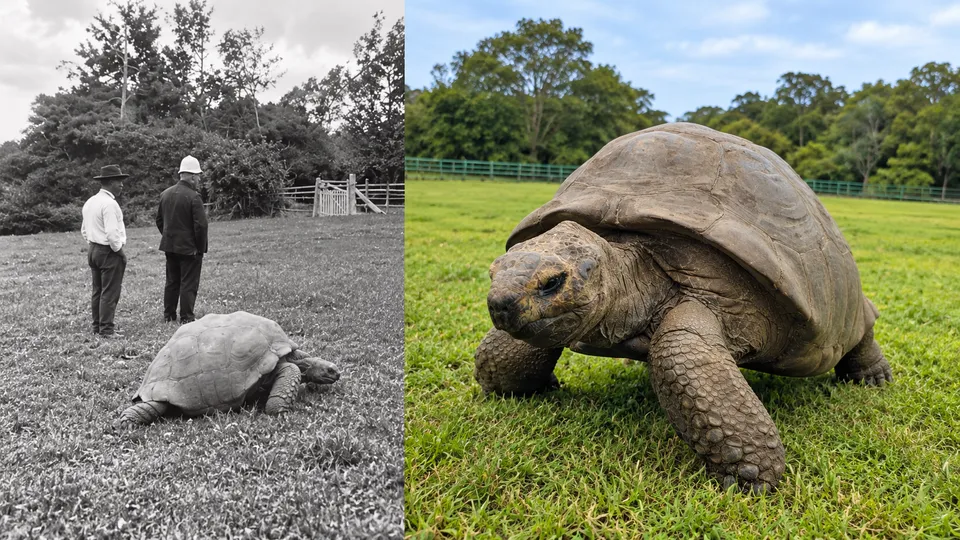
Scientists who sequenced the genome of Jonathan, a giant tortoise thought to be about 194 and the oldest known living land animal, reported on Wednesday that some of his genes have aged hardly at all.
The study in Science Advances found that Jonathan, who lives on the South Atlantic island of Saint Helena, carries unique variants in 287 genes when compared with other Aldabra giant tortoises, some of them involved in DNA repair. In 272 of his genes, many of them tied to mitochondria, the parts of a cell that make energy, the chemical tags that turn genes on and off were as orderly as a youngster’s, Scientific American reported.
“If I had to define what aging is, it’s increasing entropy,” said Stephen Clark, the study’s senior author and chief scientist at the Kallel Foundation, a longevity nonprofit in Nashville. The tags, called methyl groups, drift with age and attach haphazardly from cell to cell. Across most of Jonathan’s genome that disorder was higher than in tortoises aged 12 and 90, as expected. Not everywhere, though.
“The biggest lesson we learned is that he appears to have kept his mitochondria very young,” Dr. Clark, a neuro-oncologist, told Ed Cara of Gizmodo. He said the team compared Jonathan with tortoises from 5 to 91 years old. In some mitochondrial genes Jonathan’s pattern matched the 5-year-old’s, while the 91-year-old’s looked much older. No one had compared an animal’s epigenome across a gap of 189 years, he said.
Dr. Clark suspects a feedback loop, since keeping the tags in order takes energy and mitochondria supply it. “Mitochondria that make energy are being kept pristine, so they keep making energy that keeps them pristine,” he said.
Jonathan hatched around 1832 in the Seychelles and was taken to Saint Helena as a gift to the British governor. A photograph that researchers date to around 1882 shows him fully grown. He still lives at the governor’s residence, Plantation House. The paper puts the upper limit of an Aldabra tortoise’s life span at 93.68 years, which makes Jonathan roughly a century older than his species usually gets. Yale Environment 360, in its account of the study, gave his age as 192. He is blind, but his hearing is intact, Dr. Clark said.
Getting his DNA took years. Dr. Clark first approached Jonathan’s caretakers in 2017, Becky Ferreira of 404 Media reported. Early samples came back incomplete, and the work was held up by the Covid pandemic and by new rules on access to the tortoise. Saint Helena officials wouldn’t allow a blood draw. So his veterinarian, Joe Hollins, pretended to feed him, wedged his mouth open with a hard glove and scraped cells from his cheek. “It was quite tricky and dangerous,” Dr. Clark said. The U.S. Space Force carried the samples to Florida.
Cheek cells yield short pieces of DNA contaminated with bacteria, so the researchers filled gaps with the genome of Tank, a 36-year-old Aldabra. “The result is a Frankenstein sequence, roughly 95 percent Jonathan,” Dr. Clark said. Any unique variants hiding in the borrowed stretches would have been missed.
Joanna Bagniewska, a zoologist at the University of Oxford who was not involved in the study, said the officials had reason to refuse. “Considering Jonathan’s iconic status on Saint Helena, were anything to happen to the tortoise, it could lead to resentment toward researchers in general,” she said.
“We found that the gene regulators involved in energy production and DNA repair have remained incredibly stable in Jonathan over almost two centuries,” Justin Gerlach, a co-author and biologist at the University of Cambridge, said in a statement released by the university. It is the first time anyone has studied the epigenome of a giant tortoise, the team said.
João Pedro de Magalhães, who studies comparative genomics at the University of Birmingham in England and was not part of the work, said the authors had found “new candidate genes associated with longevity.” He added a hedge: “In the long term, perhaps we may find ways in which this knowledge could be applied to improve human health.”
Jonathan is famous enough to have been reported dead. On April 1, an account posing as Dr. Hollins announced his death and asked for cryptocurrency donations, and several outlets ran the news before the vet and the governor said he was alive, according to reports at the time. Popular Science dated the hoax to June.
Dr. Clark said the next step was to look for drugs that act on DNA methylation to keep human mitochondria younger, work he said depends on philanthropic money. He also said the team can’t yet tell whether the tidy genes keep Jonathan alive or are a byproduct of something else. “We can’t really put a flagpole in something and say, ‘Oh, this is why he lived this long,’” he said. “This work is just the first step.”