
Australian researchers reported this week that a honey bee’s stinger keeps injecting venom after the bee has flown off because it works as a two-piston pump, according to a study in the Proceedings of the National Academy of Sciences.
The team, from Macquarie University and the University of New South Wales, had bees sting a clear gel that mimics human skin. That let them film the stinger of Apis mellifera, about 2 millimeters (0.08 inch) long, pumping venom on its own for the first time, phys.org reported. The paper is titled “The honey bee stinger: An unusual pump with collapsible double pistons.”
A worker bee that stings drives the stinger into its target and then flies away, leaving it behind. Biologists call that autotomy. The abandoned stinger keeps boring into the tissue and pumping venom under its own power.
“We’ve known since as early as 1910 that the venom sac of a honey bee stinger empties into a chamber with little pumping elements called valves, but until now we didn’t know exactly how they work,” said Dr. Fiorella Ramirez-Esquivel of Macquarie University, the lead author.
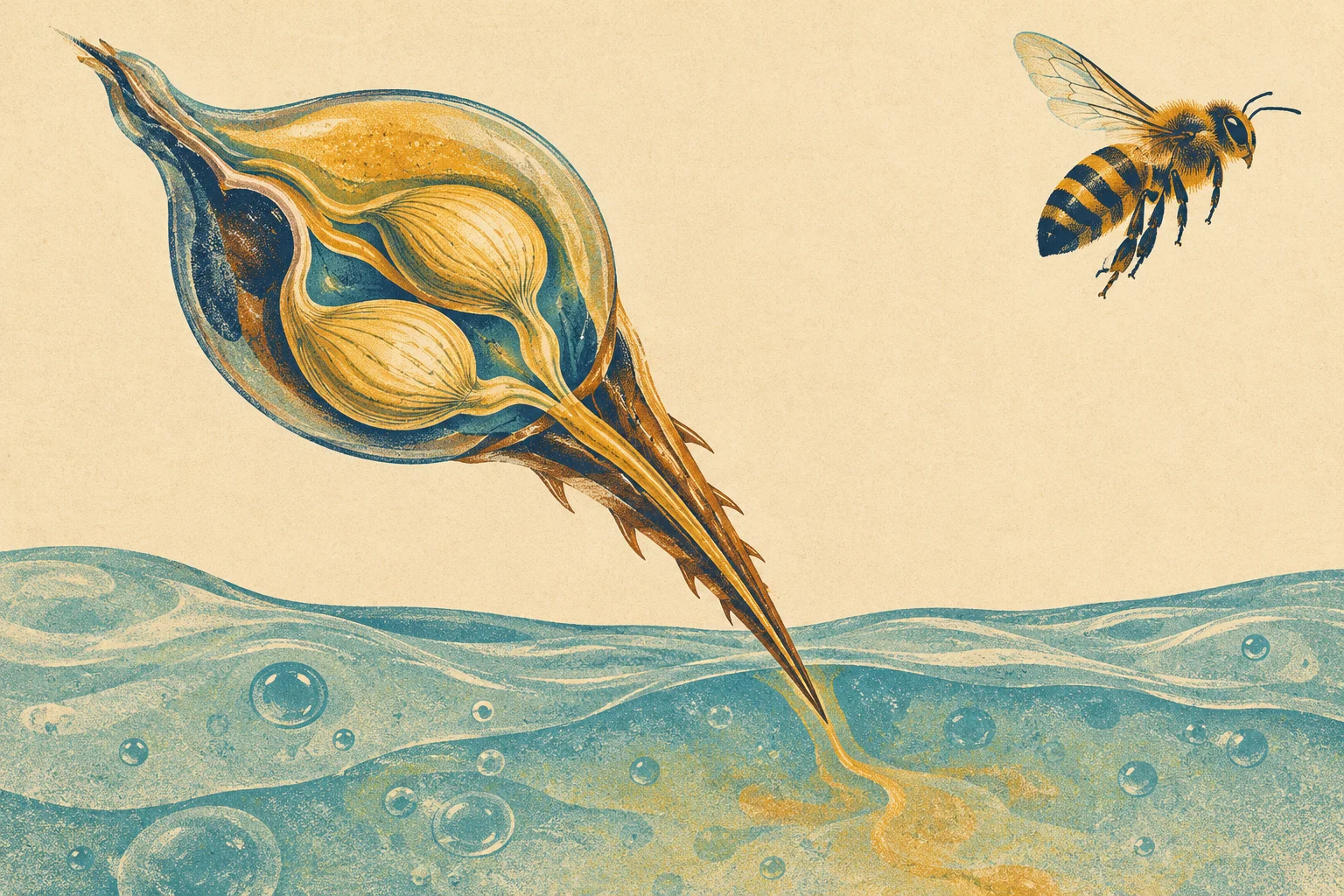
The stinger holds a venom sac, a pumping chamber, muscles and nerves. Two pointed lancets slide back and forth on a set of rails called the olistheter, the way a reciprocating saw blade moves. That motion works the stinger deeper into the skin and also drives the pump. A valve attached to each lancet sits inside the chamber.
On the downstroke, each valve inflates like a parachute and seals against the chamber, pressing down on the venom and pushing it out, Jennifer Ouellette wrote in Ars Technica. On the upstroke it deflates. Because the two lancets move in opposite directions, the valves have to get past each other.
“Finally, and perhaps most dramatically, as the valves meet in the middle of the stroke, they change shape again to push past each other,” Dr. Ramirez-Esquivel said.
The opposing strokes mean one valve is pushing venom while the other refills, so the flow doesn’t stop, and the collapsing on the return stroke limits backflow. “The unique geometry of the valves is the key; they act as collapsible pistons and - by pumping in opposite directions - they’re able to deliver a continuous flow of venom,” she said. The extra complexity of a double piston, she said, is “the key to the stinger being able to deliver venom continuously in a compact, autonomous unit.”

To check what the video showed, the researchers took micro-CT scans and used them to 3D-print a scaled-up model of the bulb chamber and lancets. They filmed it and went through the footage frame by frame. The printed pump moved the same way the real stingers did.
The work took five years, Dr. Ramirez-Esquivel told the Australian Associated Press. “It’s been a monumental effort,” she said. Catching bees and pulling out stingers with forceps was fiddly work. She was stung once, after she missed a bee with her jar, and called the bee’s response “very fair.”
Some questions are still open. The model worked only with a highly elastic polymer valve and low friction between the valves, so the authors want a closer look at what the real valves are made of. It also isn’t known whether capillary action matters at this scale. It could help draw venom into the canal, or the venom may have to work against it as it pulls fluid up from the tissue.
Engineers have already borrowed the stinger’s structure for microneedles, tissue transport devices and drills. The authors said the pump could inform engineered micropumps for minimally invasive medical and microfluidic devices. “People have suggested to us that it could be useful in designing something like an insulin pump,” Dr. Ramirez-Esquivel told the AAP.