
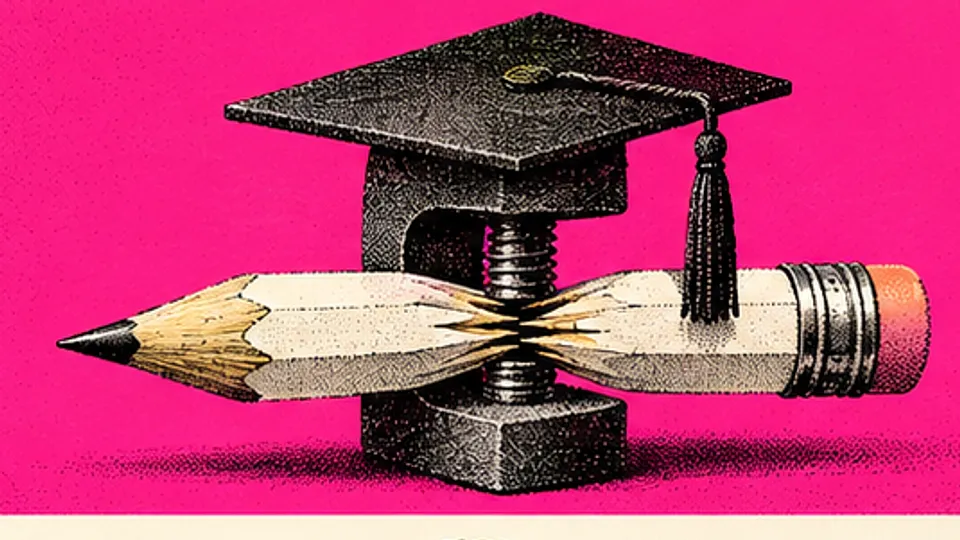
Public records obtained by 404 Media show school and university administrators across the United States moving against student newsrooms that report on Gaza, Jeffrey Epstein and other subjects the institutions would rather not be tied to. Often the target is not the students but their faculty advisers.
The records surfaced as reporters at The Cornell Daily Sun won recognition for breaking the “Cornell Seven” story, a lawsuit filed last month in New York’s trial court in which a Jane Doe accuses current and former Cornell students of drugging and sexual abuse. The student journalists told The Cut that a vague university and campus police statement from nearly two years ago had raised more questions than it answered.
The Student Press Law Center, a nonprofit that advises student newsrooms, said it fielded nearly 1,000 hotline inquiries in 2025 from 46 states and Washington, D.C. Overall calls are down, the group said, but inquiries about censorship rose 17 percent from the year before.
In Colorado, a high school social studies teacher emailed a student publication’s adviser to call an opinion piece titled “Why Is Gaza Important?” “published with factually inaccurate and racist information.” In the same email he wrote, “I’m not going to start listing the inaccuracies along with the omissions.” The adviser was soon reassigned to another role in the district.
In California, a high school principal told a journalism adviser to delete the name of a woman threatening to sue the district for defamation after students posted an Instagram carousel about how many times their county appeared in the Epstein files. The principal had not established any factual error, and there was none, according to 404 Media. When the adviser said the students would first seek legal guidance from the Student Press Law Center, the principal wrote, “I can’t remove the name without your help.” She stepped down during the last school year.
Mike Hiestand, a lawyer at the Student Press Law Center who has advised student newsrooms for decades, said administrators often target advisers because it works. “School officials, they see employees as kind of an easy target over whom they have some authority,” he told 404 Media, and some “take advantage of that bond and definitely go after advisors.” Censors, he said, “want to be called everything but a censor.”
Records from Pensacola State College show that last spring an administrator tried to block funding for a journalism professor to print students’ portfolio assignments because at least one story involved reporting on the L.G.B.T.Q. community. The campus relented. “The proper role of administration is to facilitate rather than impede the completion of legitimate classroom projects,” an administrator later wrote to the professor.
A Maryland district memo directing principals to read and approve every story before publication used similar language, with the chief of schools citing a duty “to guide the work of our students.” Internal correspondence obtained by 404 Media suggested the point was “really to be sure an administrator could initial any printed posters, review school apparel, and scan over the yearbook” for violations of the student handbook.
Mr. Hiestand was blunter about that argument. “Every principal and every superintendent in the country seems to think that they are qualified editors,” he said.
Marie McMullan, program manager and counsel for the Student Press Legal Hotline at the Foundation for Individual Rights and Expression, said this year has been a consequential one for students running their school publications. “I always just worry about making sure that student journalists know their rights so that they can assert them in cases where there are subtler forms of censorship,” she told 404 Media.
At Southern Illinois University Edwardsville, reporters at The Alestle, the student newspaper, said the marketing and communications department had grown more insistent in recent months about sitting in on their interviews. After the department called several claims in a story by the editor in chief, Dylan Hembrough, “inaccurate,” the paper investigated and stood by its work. The department’s executive director then sent an open letter to a campus mailing list of more than 14,000 people. “The Alestle appears willing to substitute alarming headlines for verified facts,” the letter said. Attached was a 27-page document of corrections the department expected the paper to make.
In September, Mr. Hembrough learned by email that campus police were investigating him for harassment of the department. The report, an officer told his adviser, rested on a line from one of his emails: “Marketing and communications’ insistence on interfering with our newsgathering process is dangerous and detrimental to both press freedom and freedom of speech.” The executive director told police that Alestle reporters had come by her office “uninvited” and that her door had no lock.
“I have been on the other side of panicking over things like this,” Mr. Hembrough told 404 Media. “Something that has helped me get through that, or at least stave it off, is the idea that the truth is more important than whatever I feel about it. Embarrassment or humiliation should have no bearing on how or even whether a publication makes a correction.”