
Russia suffered its heaviest monthly losses of the war in September, when 46,230 of its soldiers were killed or wounded, according to the Ukrainian military, even as Moscow pounded Ukrainian cities and moved to freeze the country this winter.
The toll was Russia’s worst of 2026, after roughly 40,000 casualties a month since June, and it came close to the goal President Volodymyr Zelenskyy set in January: 50,000 Russian casualties a month. On Sept. 28 alone, Ukrainian officials said, 2,090 Russian soldiers were killed or wounded, the highest 24-hour figure of the war. Kyiv says it has video of each casualty, because more than 90 percent are caused by first-person-view drones. Al Jazeera reported that it could not verify casualty claims from either side.
Despite the losses, Russia kept pressing to seize the areas of Luhansk and Donetsk that it does not control, which is where the fighting, and the casualties, have been heaviest. Around Lyman, Ukraine’s Third Army Corps reclaimed 176 square kilometers (68 square miles) in recent weeks in the third phase of a counteroffensive called Operation Vivaldi.
Brig. Gen. Andriy Biletsky, the corps commander, said his forces feigned an attack from the west, which “forced it [the Russian army] to senselessly burn through its reserves in counterattacks precisely in that direction,” before striking from the north. Ukrainian troops also rammed remotely operated Russian armored personnel carriers packed with explosives into Russian lines, and drone operators cut ammunition and fuel deliveries, starving the front.
Russia has denied the counteroffensive’s gains and posted videos as purported proof. The Institute for the Study of War and DeepState, two organizations that map territorial change using geolocated footage, put Russia’s net gains this year at 148 square kilometers (57 square miles), a small fraction of the 5,300 square kilometers Moscow says it has taken.
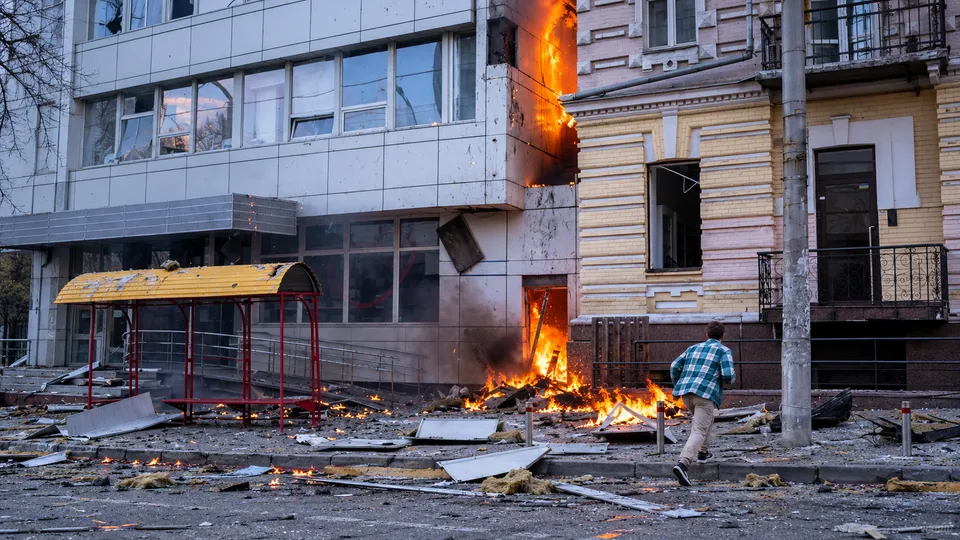
Russia, meanwhile, spent the week hitting Ukraine’s cities, striking power plants along with homes, kindergartens, schools and office buildings. On Sept. 28, a drone destroyed part of the National Academy of Sciences in Kyiv, killing several people. On Sept. 30, Russian drones hit a thermal power plant in the Kyiv region and knocked out power in the capital; at least five people were killed across the country that day.
“Since the summer, there has not been a single day when the enemy has not attacked energy infrastructure,” Prime Minister Sergii Koretskyi wrote on social media. “However, such a massive and combined attack has not occurred since the end of the last heating season.”
Mr. Zelenskyy has warned for weeks that Moscow intends to hit the energy sector hard enough to cause suffering in the cold. On Sept. 30, Russia also tested a drone carrying a cumulative cutting warhead “specifically designed to destroy high-voltage pylons,” said Serhii Beskrestnov, an electronics adviser to the Ukrainian defense ministry. “I believe the enemy’s plan is to attack important high-voltage power lines,” he said. Russia struck data centers throughout September as well, apparently to try to disrupt connectivity and commerce.
Ukraine is short of interceptors for ballistic missiles, and several got through on Sept. 30, the president said. At the NATO summit in July he persuaded President Trump to let Ukraine build Patriot interceptors under license, arguing it could make them faster and more cheaply than its allies if the technology were shared. Mr. Trump later retracted the offer.
The larger shift is speed. Ukraine once destroyed well over 90 percent of Russia’s propeller-driven drones, but in the week ending Wednesday it stopped only 81 percent of the 1,933 long-range drones Moscow launched, because many were jet-powered. Interceptors have been racing to catch up; for now, “Ukraine’s interception rate for jet-powered ‘shaheds’ is now 55 percent,” Mr. Zelenskyy wrote. He said Russia planned to spend $12 billion on jet drones and loitering munitions next year.
Mr. Beskrestnov said Russia was also building a radio-beacon system to guide drones more accurately. “This system will allow them to navigate deep within our territory, at a distance of up to 100 km. This essentially means the ability to accurately attack a vast portion of Ukraine,” he wrote.
Ukraine answered with deep strikes of its own, against the fuel and factories that feed the Russian war effort. Its drones hit the Perm and Novoshakhtinsk refineries on Sept. 25, the Ilsky refinery the next day and four oil deposits in Krasnodar Krai two days later. The same week they struck NPP Zavod Iskra, which makes electronic components for Kh-59 cruise missiles and the Pantsir-S air defense system; the Efremovsky Synthetic Rubber Plant, which makes solid rocket fuel for Iskander-M ballistic missiles; and the foundry and five buildings of the Azov Optical-Mechanical Plant, which makes optics for artillery, missile and antitank weapons.
Both governments have overrun their defense budgets for the year. Ukraine is looking for another $27 billion in talks with the European Commission and the International Monetary Fund. “Part of these resources is needed immediately for advance payments for supplies that are expected to arrive in the first quarter of 2027,” Mr. Koretskyi said. Some would come from reallocating funds, he said, but “we are also counting on support from the EU.”
Russia spent 30 percent more on the war in the first half of this year than in the same period last year, according to Ukraine’s Foreign Intelligence Service. Reuters, citing leaked government documents, reported that Moscow plans to raise defense spending another 27 percent in 2027, to an estimated $204 billion, and to pay for it with extra borrowing and cuts to nonmilitary spending.