
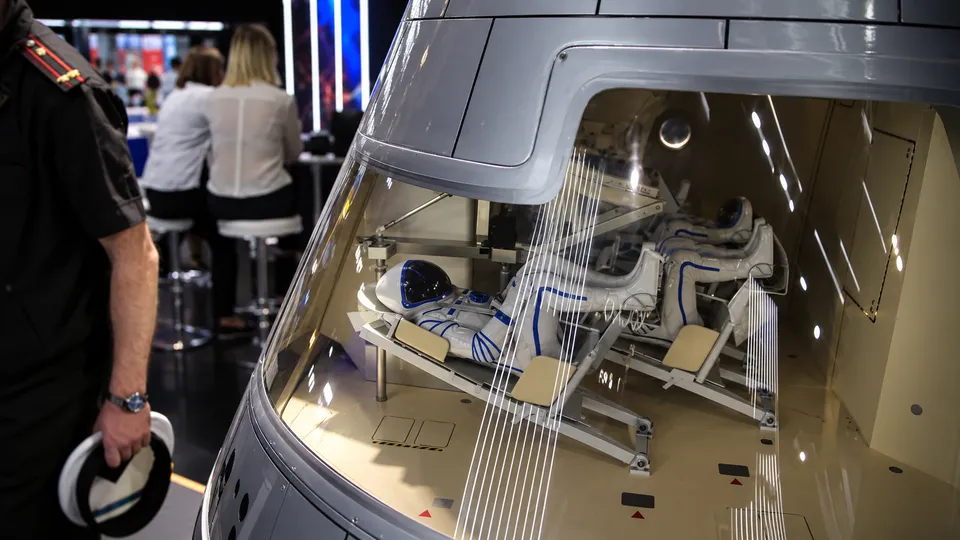
Russia will begin parachute drop tests of its next-generation crewed spacecraft this fall, the head of the country’s space agency said, with a first crewed flight still planned for 2028 or 2029 after years of delays.
Dmitry Bakanov, the director general of Roscosmos, said the craft would be dropped and its parachutes tested in Russia’s Far East, in comments to a Russian publication translated for Ars Technica by Rob Mitchell.
“The first step is the launch and testing of a new, promising, reusable manned transport spacecraft,” Mr. Bakanov said. “And in the fall, there will be a parachute drop and testing in the Far East.”
Later this year, the spacecraft is to undergo tests of emergency rescue systems for an accident on the launch pad, according to the publication. In 2027, tests would take place “in the zone of maximum dynamic pressures” — a reference that suggests a launch abort test, a step toward an actual spaceflight, Ars Technica reported. It was not clear from the report whether any of the tests will use real flight hardware, boilerplate vehicles or mockups.
Russian space officials are holding to a debut crewed launch in 2028 or 2029, most likely on the Angara A5M rocket. That date comes with a caveat. Four years ago, President Vladimir V. Putin spoke confidently about the spacecraft, often called Orel, or “Eagle,” and about restarting Russia’s lunar program. Neither has happened.
Whenever it flies, the new vehicle is meant to replace the Soyuz, which has carried cosmonauts to low-Earth orbit for decades, and to be capable of flying humans to the Moon.