
Five European governments, the European Commission, the European Council and a NATO representative sat in on a video call with Ukrainian President Volodymyr Zelenskyy and the two senior US envoys, Steve Witkoff and Jared Kushner, on Monday. The Kremlin says none of that composition has been agreed. That gap between who showed up to one call and who Moscow will admit to the next is the whole state of play in the Ukraine talks this week, as Al Jazeera reported.
Zelenskyy called Monday’s session “not easy.” The outcome he announced was a date and a venue, not a deal: negotiators will meet in Berlin on Thursday as part of the Coalition of the Willing, the ad hoc grouping of Ukraine’s backers assembled outside NATO’s own structures. France, Germany, Britain, Italy and Poland sent national security advisers; the European Commission and the European Council joined, alongside a NATO liaison, Alex Grynkewich, and Witkoff and Kushner for the US side, Zelenskyy’s office said.
The discussion was difficult, but there is a result: we will meet in Berlin as part of the Coalition of the Willing and work out concrete joint steps in the negotiation process.
Three tracks, one disputed seat
The call sits on top of two earlier tracks. Nine days ago, US, Russian and Ukrainian officials held the first trilateral talks in nine months, in Abu Dhabi, where Washington pressed Kyiv on territory in the Donbas in exchange for security guarantees short of NATO membership. Witkoff and Kushner then flew to Moscow and met Vladimir Putin, the encounter Kushner later described as having produced progress, writing that “a final agreement will require difficult decisions.” Coming out of Moscow, the US envoys said Europeans would join the next round of negotiations.
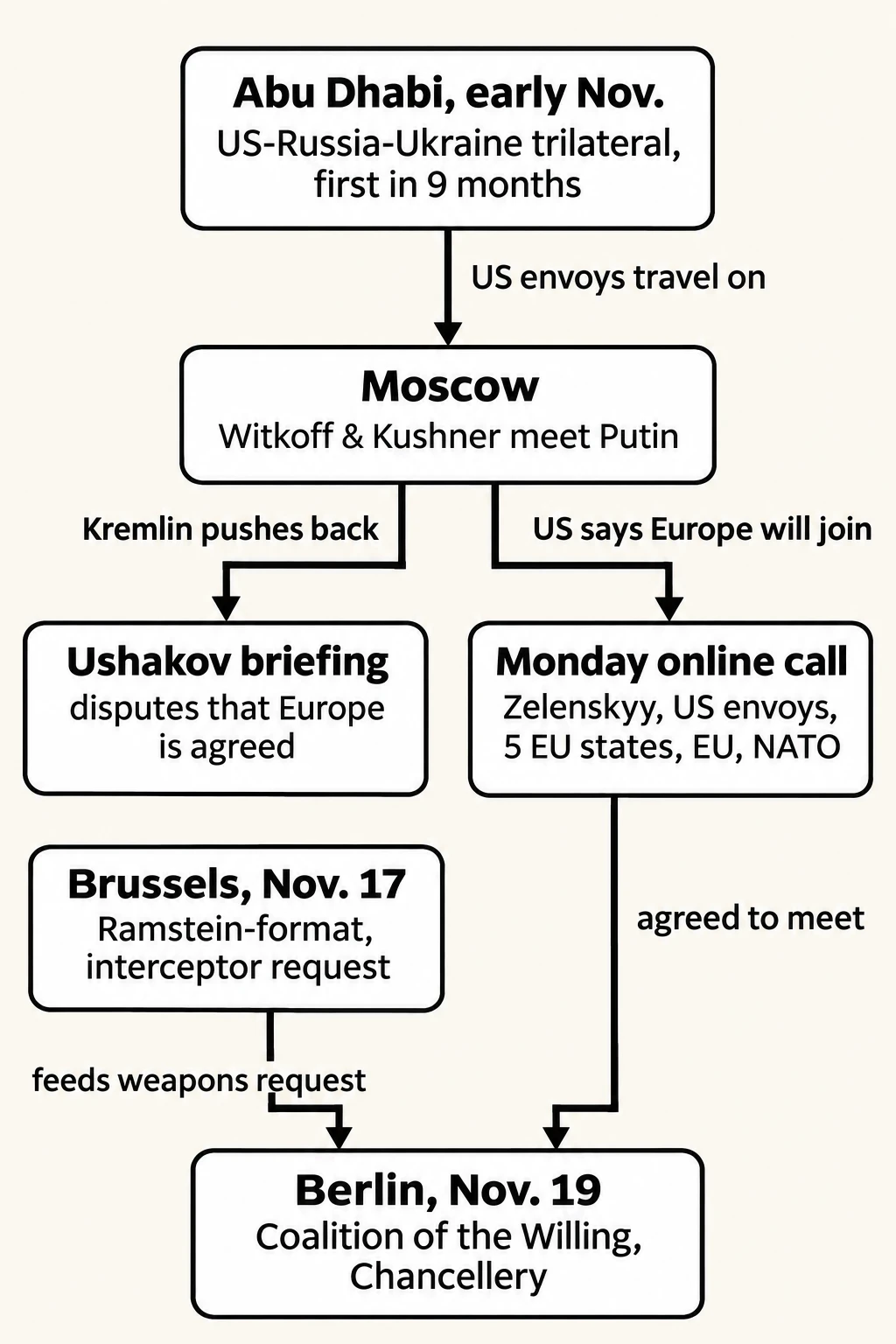
| From | To | How |
|---|---|---|
| Abu Dhabi, early Nov. (US-Russia-Ukraine trilateral, first in 9 months) | Moscow (Witkoff & Kushner meet Putin) | US envoys travel on |
| Moscow (Witkoff & Kushner meet Putin) | Ushakov briefing (disputes that Europe is agreed) | Kremlin pushes back |
| Moscow (Witkoff & Kushner meet Putin) | Monday online call (Zelenskyy, US envoys, 5 EU states, EU, NATO) | US says Europe will join |
| Monday online call (Zelenskyy, US envoys, 5 EU states, EU, NATO) | Berlin, Nov. 19 (Coalition of the Willing, Chancellery) | agreed to meet |
| Brussels, Nov. 17 (Ramstein-format, interceptor request) | Berlin, Nov. 19 (Coalition of the Willing, Chancellery) | feeds weapons request |
The Kremlin aide Yuri Ushakov corrected the record on Monday without naming the US envoys he was correcting. “What is currently being discussed is holding the next round in a trilateral format,” he told reporters. “The date has not yet been agreed and the expansion of the format — some people are talking about it — but it has not been agreed with us.” Asked what Russia would need to admit Europeans, Ushakov set two conditions: another full round, possibly more, of trilateral talks first, and “a clear signal from the Europeans about what they want and what constructive, substantive contribution they can make.” Kremlin spokesman Dmitry Peskov gave a softer version the same week, saying Moscow did not oppose European participation in principle but would decide once it understood Europe’s “real intention.” Russia’s foreign ministry went further, claiming the question of European participation never came up in the Putin meeting at all — three Russian officials, three slightly different positions, in the space of one week.
The war did not pause for the calls
Hours before the Monday call ended, Russia fired seven ballistic missiles at Kyiv’s two main bridges over the Dnipro — four at the Southern Bridge, three at the Northern — according to Zelenskyy’s account cited by the Kyiv Independent. Both bridges were closed to traffic afterward; by mid-afternoon the city had reopened one carriageway of the Southern Bridge to vehicles under an unspecified weight limit while engineers still ran structural calculations on the rest. Ukraine’s State Emergency Service reported two deaths in Kyiv’s Obolonskyi district. Elsewhere that night: two dead and 31 injured from six strikes in Zaporizhzhia region, three injured in Smila, a hit on Kharkiv’s Kholodnohirskyi district, and roughly 700,000 households without power in Dnipropetrovsk region after strikes on energy infrastructure, according to the grid operator DTEK.
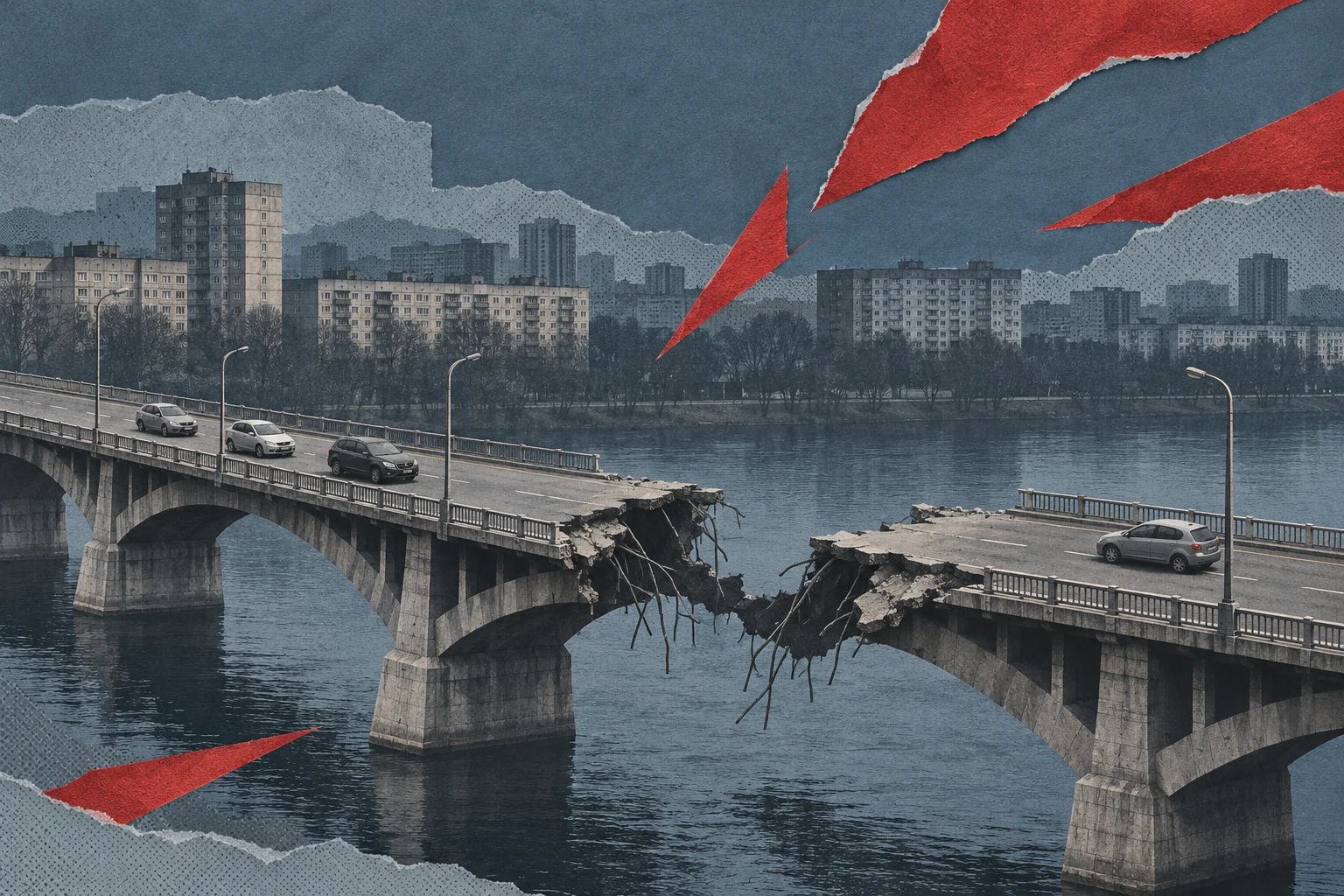
Ukraine’s reply came the same night. A Flamingo cruise missile strike collapsed a section of the 227-metre road arch of the Crimean Bridge, the 19-kilometre crossing Putin opened four years after annexing Crimea in 2014 — the bridge’s second hit in two days, and the final stage of what Zelenskyy called a seven-phase operation carried out over several weeks, the Moscow Times reported. Ukraine’s defence minister, Yevhen Khmara, called it retaliation for Russia’s pattern of hitting bridges in Zaporizhzhia, Dnipro, Kyiv and Odesa region: Russia hits bridges, Ukraine now hits the one bridge Russia cannot do without.
Russia’s defence ministry said it shot down 1,441 drones over 22 regions overnight into Tuesday, a new one-day figure topping the 1,336 it claimed the previous night — an 8 percent rise, by the ministry’s own count, which is a claim about Russian air defence performance, not an independently verified tally of Ukrainian sorties flown. Around Moscow specifically, the ministry said about 800 drones approached and 321 were intercepted en route to the capital.
| Drones intercepted (Russian MoD claim) (drones) | |
|---|---|
| Night of Nov. 16 | 1,336 |
| Night of Nov. 17 | 1,441 |
Source: Russian Ministry of Defence, via The Moscow Times. Figures are the Russian defence ministry's own claims, not independently verified
The diplomatic track and the sanctions track moved in parallel rather than in sequence. On November 16 the EU Council adopted asset freezes on 113 more Russian individuals and entities — 12 people and 101 companies, including roughly 50 banks, 15 shadow-fleet tanker operators registered in the UAE, Oman, Seychelles and Hong Kong, and the controlling shareholders behind the online retailers Wildberries and Ozon, according to the EU’s own listing. Irish Foreign Minister Helen McEntee summed up the European reading of the week’s two parallel facts — talks advancing, strikes intensifying — bluntly: “Russia has clearly not changed its position.”
US President Donald Trump offered a different read, saying he would raise the war with Xi Jinping and with Putin on an upcoming trip to China and that he detected movement: “I think he’s backing down a little bit.” Trump did not say what evidence supports that, and the week’s record runs the other way: Ushakov has not set a date for even the trilateral round, let alone the expanded one, and Russia launched its two largest claimed drone-interception nights of the year on the same two nights its negotiators were on the Monday call. The Berlin meeting on Thursday is billed as covering security guarantees and a postwar recovery plan for Ukraine. Whether Russia sends anyone to the next trilateral session, and whether that session ever grows a European seat, is still an open question Ushakov has deliberately left unanswered.