
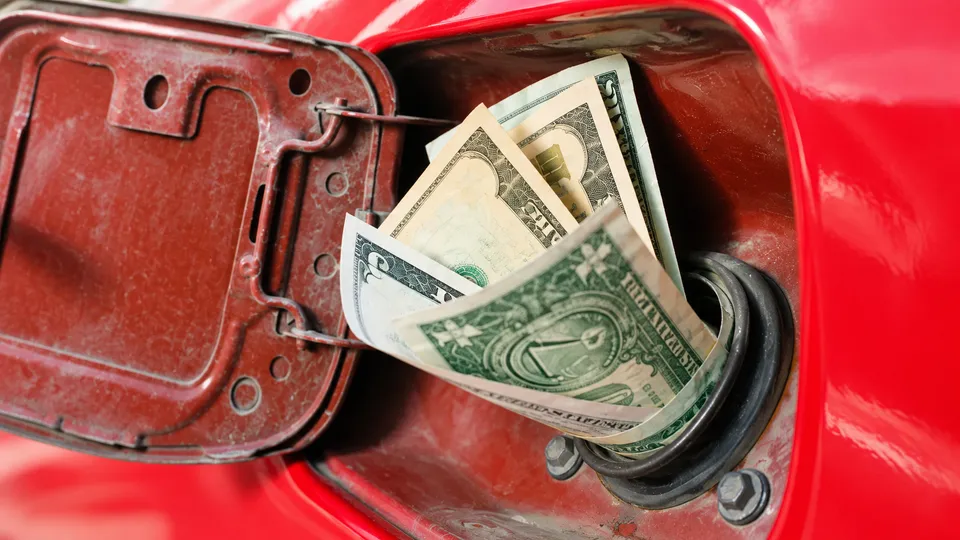
America invented fuel-economy rules in the 1970s because petrol was painfully expensive. Petrol in America is now more expensive than ever, so naturally the government has decided its cars need not be thriftier. On September 28th the Department of Transportation finalised a rule gutting Corporate Average Fuel Economy (CAFE) standards, rolling them back to levels last seen in 2014.
The new rule requires carmakers to make their passenger-car and light-truck fleets up to 1% more fuel-efficient each year, aiming for an industry-wide average of 34.9 miles per gallon in model year 2031, according to NPR. That replaces a target of 50.4 mpg—a standard roughly [31% less stringent](https://carbuzz.com/fuel-economy-regs-rollback-september-2026/ than the one it supersedes, by CarBuzz’s arithmetic.
The timing is exquisite. Fuel prices are climbing higher than Americans have seen before, as Ars Technica notes; diesel is at record highs, with a gallon hitting $6.50 last week according to Al Jazeera. Rules designed to shield drivers from shocks at the pump are being weakened at precisely the moment the shock arrives.
There is one genuinely defensible change buried in the rule. Cars and light trucks have long faced separate standards, with weaker ones for trucks—a loophole that encouraged carmakers to design crossovers to qualify as trucks, leaving the roads full of sport-utility vehicles bigger and thirstier than they need be. From model year 2030 the government will “change classification criteria starting in model year 2030 to reflect each vehicle’s intended use accurately,” flipping today’s fleet mix of roughly 70% light trucks and 30% passenger cars to about 70% cars and 30% trucks. That assumes, of course, that the regulations are still in effect by 2030—a caveat the department itself felt obliged to attach.
The meagreness of the 34.9 mpg target is best measured against history. In 2012 the Obama administration set a path to 54 mpg by 2025. The first Trump administration assailed those standards, eventually cutting them in 2020 from 46.7 mpg in model year 2026 to 40.4 mpg. The Biden administration slowly undid the damage and altered the rules to encourage smaller, lighter vehicles. Now the wheel turns backwards again.
Critics connect the dots. “The CAFE program was created in the 1970s in response to price shocks at the pump that raised costs for every American,” said Albert Gore, executive director of the Zero Emissions Transportation Association. “Lowering these standards now, when so many families are already struggling with rising transportation costs, will only make things harder for them. At the same time, lowering the bar for innovation risks a future where the global auto market leaves American industry behind.” Environmental groups are blunter: the Center for Biological Diversity calls the rule a gutting of standards that save consumers billions at the pump.
The carmakers’ counter-argument is familiar: strict standards raise sticker prices, and rules fixated on efficiency push firms towards electric vehicles their customers have not embraced. There is something in the first point, less in the second. Fixing the light-truck loophole while slashing the target suggests the industry’s real objection was never classification but obligation. Carmakers gain certainty and cheap compliance; drivers gain the privilege of buying more petrol at record prices.
Shielding Detroit from efficiency rules has a poor record of shielding it from competition. The last great wave of American gas-guzzling ended with Japanese imports eating the industry’s lunch and two of Detroit’s three in bankruptcy court. Fuel-economy standards, whatever their flaws, were a hedge against both. Their dismantling is a bet that this time thirst will be a strategy.