
Obbe Vermeij, Rockstar North’s technical director from 1998 to 2009, thinks an AI agent could strip a PlayStation 5 build of Grand Theft Auto VI down to source code and rebuild it for Windows for “tens of thousands of dollars in tokens.” He told Rock Paper Shotgun, as Ars Technica reported, that the threat is real enough to change Rockstar’s release calculus. The claim is bigger than it sounds: it says the thing that used to protect a staggered console-then-PC schedule - the sheer cost of building a game this complex - no longer protects anything once an AI agent can rebuild the binary.
The loop that makes this possible
The mechanism is a verification loop, not a translator. A toolkit called Reverse Engineer Anything, built by a developer using the handle Morluto, doesn’t decompile code itself; it wires an AI coding agent (Claude Code, Codex, Cursor, Gemini CLI) to existing reverse-engineering programs - Ghidra, IDA, Hopper - and lets the agent drive them. The agent pulls a candidate function out of the binary, recompiles it, and diffs the result against the original executable byte for byte. A mismatch sends it back to try again; a match, or a stall after repeated failures, is the only point a human needs to look at the output, as Tom’s Hardware described the tool. The GitHub repository for the tool picked up more than 25,000 stars in a single day, and a public tracker lists byte-matching decompilation projects - GoldenEye 007, Super Smash Bros. Melee, Super Mario 64 DS, Super Mario Galaxy - now moving at a pace that took human-only teams years, according to one such list.
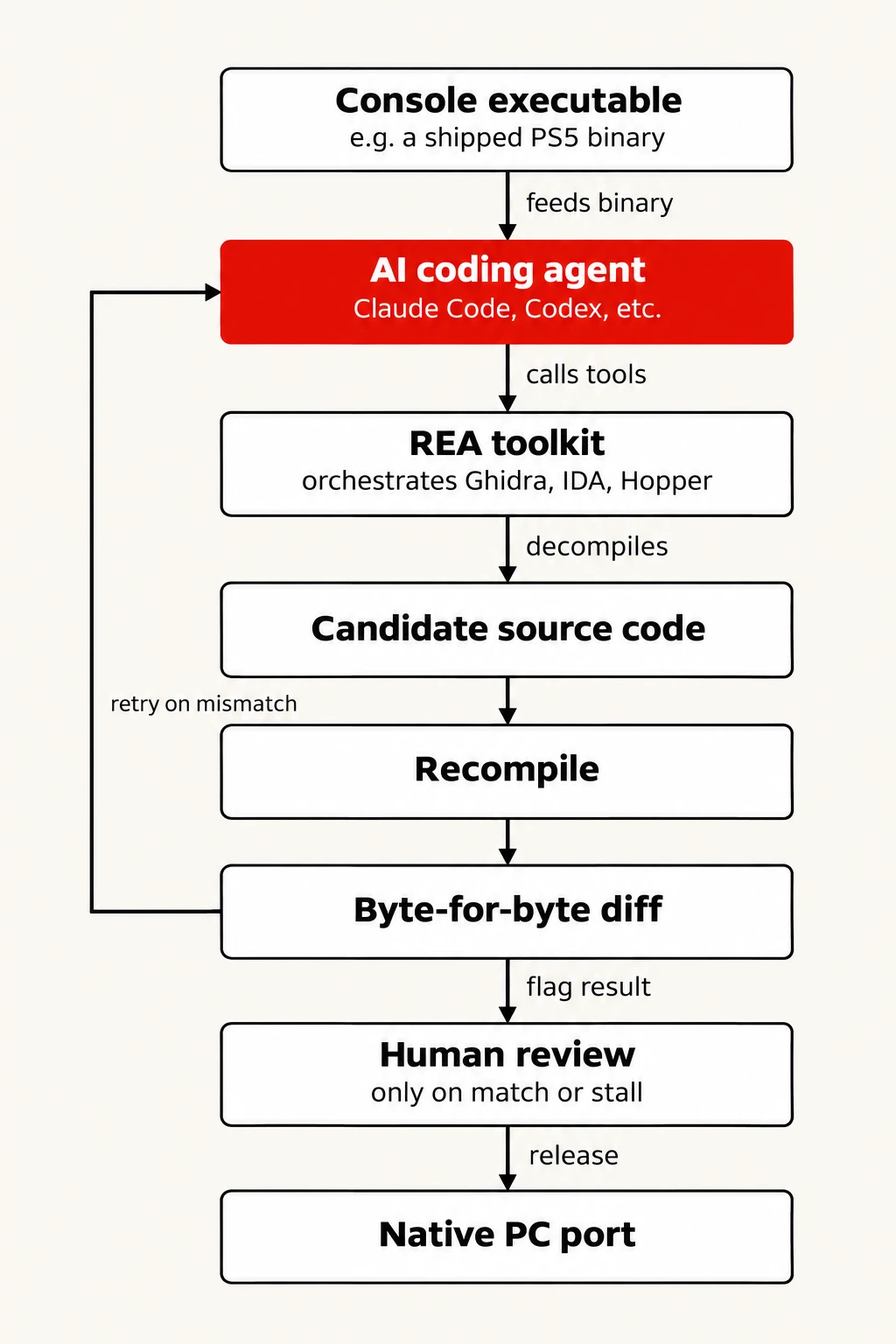
| From | To | How |
|---|---|---|
| Console executable (e.g. a shipped PS5 binary) | AI coding agent (Claude Code, Codex, etc.) | feeds binary |
| AI coding agent (Claude Code, Codex, etc.) | REA toolkit (orchestrates Ghidra, IDA, Hopper) | calls tools |
| REA toolkit (orchestrates Ghidra, IDA, Hopper) | Candidate source code | decompiles |
| Candidate source code | Recompile | |
| Recompile | Byte-for-byte diff | |
| Byte-for-byte diff | AI coding agent (Claude Code, Codex, etc.) | retry on mismatch |
| Byte-for-byte diff | Human review (only on match or stall) | flag result |
| Human review (only on match or stall) | Native PC port | release |
The only project of this kind with public numbers is a decompilation of Call of Duty: Modern Warfare 2, a 2009 game, undertaken by the developer Maurice Heumann. Over three months, a fleet that grew to 17 AI agents running Claude Code and Codex CLI against the game’s binary through IDA’s decompiler burned through more than 500 billion tokens - Heumann’s own estimate runs to 600-700 billion - to reconstruct 99% of the game’s functions, 83% of them matching the original byte for byte, Tom’s Hardware reported. At standard API pricing, that token count works out to somewhere between $80,000 and $250,000. Heumann is keeping the code private.
Measured against that, Vermeij’s “tens of thousands of dollars” for Grand Theft Auto VI looks low by at least an order of magnitude, not because his logic is wrong but because his comparison case is wrong-sized. Modern Warfare 2 is a 17-year-old linear shooter with no open world, no dynamic weather, and none of what Ars Technica’s report called GTA VI’s “scripted sweat simulations.” A 2026 open-world game ships a vastly larger codebase and asset library to reverse-engineer. Vermeij’s own hedge, that a brute-forced port “won’t be as good as Rockstar’s effort,” is the tell: cheaper and worse is still the trade an AI port makes, and nobody has yet put a real token bill on a game of GTA VI’s scale.

Rockstar doesn’t have to wait for that bill to arrive to see the risk. In October, an unofficial WebAssembly port of the 2013 Grand Theft Auto V ran in a browser at playgta5.com, built, according to its creator, with AI help. A technical teardown found a 63MB WebAssembly module with roughly 91,000 functions, translating the game’s Direct3D 11 calls to WebGPU and streaming about 20.9GB of game assets in pieces as a player moved through the map, Tom’s Hardware reported. It went up on October 6 and was gone within hours; neither Rockstar nor Take-Two has confirmed sending a takedown notice, and nobody has established how the site actually went offline. It is the same pattern already playing out around smaller creative work, where AI tools clone indie game demos faster than their own developers can build an audience for the originals - except here the target is a franchise that has sold more than 200 million copies across its catalog.
The gap Rockstar has to close
Grand Theft Auto V shipped on PlayStation 3 and Xbox 360 in September 2013 and reached Windows in April 2015 - a 19-month gap, after the PC version itself slipped twice. Grand Theft Auto VI launches on PS5 and Xbox Series X|S on November 19, 2026, and four anonymous industry sources told GamesBeat that Rockstar is now targeting the first quarter of 2027 for PC, which would put the console-to-PC gap at somewhere between six weeks and four months, according to GamesBeat’s report. The two figures are not measured the same way: the GTA V gap is a fact drawn from Rockstar’s own confirmed release dates, while the GTA VI window is an unconfirmed target attributed to sources speaking anonymously, with neither Rockstar nor Take-Two commenting on it.
GamesBeat’s sourcing ties the faster timeline partly to Rockstar’s purchase of Cfx.re, the company behind the FiveM modding platform, since a PC release is a prerequisite for the roleplay and user-generated-content servers that platform depends on. Vermeij’s framing adds a second motive that has nothing to do with modding: an unofficial PC build, even a rough one built by an AI agent working from the PS5 disc, would compete directly with Rockstar’s own eventual PC sales before Rockstar has shipped anything.
What was the case before is that there’s so much effort in developing the game, that it is not possible to rip it off, and that’s completely changed now.
That line is Vermeij’s, and it is the only part of his comments that isn’t speculation about Rockstar’s plans. He has no inside knowledge of what Rockstar intends to do; he left the studio in 2009 and says so. What he is describing, correctly, is a cost curve that has moved: reverse-engineering effort that scaled with human engineering hours for decades now scales with a cloud compute bill, and that bill is falling as token prices and model efficiency improve, even as the games being targeted get larger. Which number moves faster between now and GTA VI’s November 19 launch - the falling price of an unofficial AI port, or Rockstar’s willingness to ship an official one inside a few months instead of nineteen - is the thing to watch, not whether either is possible.