
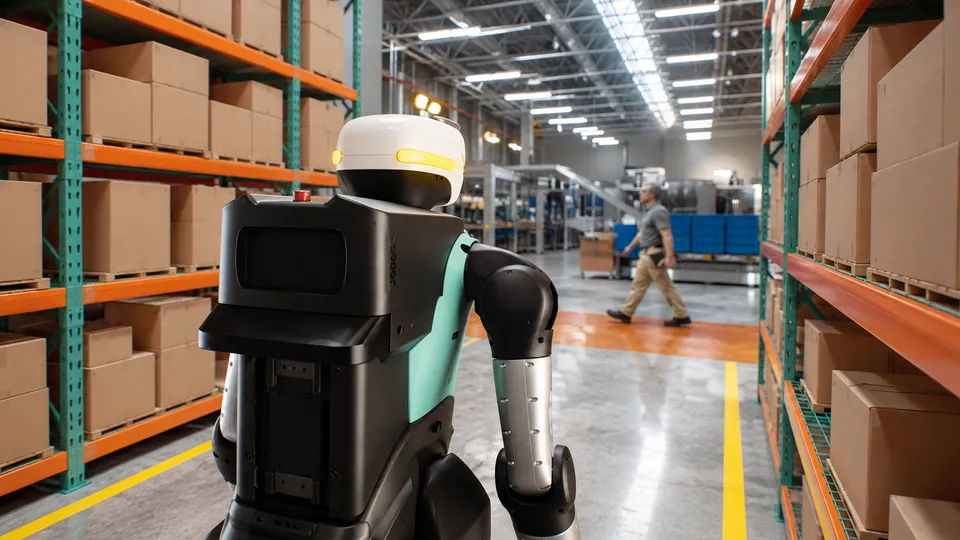
Robotics companies are building Nvidia’s Halos safety platform into their machines, and the company had to rework the system, first designed for self-driving cars, to fit robots that do anything from vacuuming hallways to hauling pallets, Ars Technica reported on Thursday.
Nvidia introduced Halos for Robotics on June 22 at the Automate trade show in Chicago and billed it in its announcement as the industry’s first full-stack safety system for physical AI. Agility Robotics signed on first. It is putting Nvidia’s IGX Thor computer and its Halos Core software into the system its Digit humanoid uses to detect people nearby, and its customers include Amazon, GXO, Schaeffler and Toyota Motor Manufacturing Canada, according to Nvidia.
The software is built to watch everything. The Halos operating system tracks “every hardware block” and “every software library” so that failures turn up quickly, Goel, who described the platform’s design to Ars, said. It also keeps safety-critical computing apart from other workloads so they can’t interfere with it.
A piece called the Holoscan Sensor Bridge links sensor data to the safety processing in a way meant to make corrupted data easy to spot. It can be built into parts as small as a microcontroller or a field programmable gate array, and Nvidia says the bridge carries SIL 2 safety certification, Robotics 24/7 reported from the Chicago show.
The package also comes with Nvidia’s simulation tools for testing robots in virtual settings and an inspection lab where partners get fast feedback on safety “artifacts” that turn up during development. Nvidia says the lab is the first program of its kind accredited by the ANSI National Accreditation Board, and that it prepares companies for outside certifiers such as TÜV Rheinland, UL Solutions and TÜV SÜD.
The hard part was deciding what safety means. In driving, functional safety means about the same thing from one automaker or country to the next, Goel said. A robot vacuum cleaning a hallway and a robotic forklift moving heavy loads on a warehouse loading dock face different risks.
“We had to reimagine and do a lot of foundational work to build a platform that is programmable, that gives all the hooks to the developers to actually define custom safety functions, but at the same time not break the underlying infrastructure that we built,” Goel told Ars. “Because giving flexibility can come at the cost of losing some control over the stack.”
Robots also work in messier places than highways. Gold, another person Ars interviewed, described a machine moving through a building it can’t fully see.
“If you are a robot coming down an aisle at six miles per hour, your senses do not see what are the blind spots and what is coming around the corner,” Gold said. “What the robots do is almost come to a halt before the turn, because they really don’t know what’s happening in all these factories, warehouses and hospitals - they’re unstructured environments and things can come from anywhere.”
Nvidia’s answer to that problem includes an open-source tool it calls the Outside-In Safety Blueprint, which uses cameras mounted around a site and AI agents to give robots a wider view. The company says Halos draws on more than 18,600 engineering years of safety work from its autonomous-vehicle business, and Halos Core is the next version of DriveOS, its car operating system, which has met the ISO 26262 vehicle safety standard, AIwire reported.
Other partners Nvidia named include FORT Robotics, KION Group, Advantech, NXP and Texas Instruments. In a July 7 analysis, Olivier Blanchard, a research director at Futurum Group, asked whether one shared safety architecture could become a baseline requirement for using robots at scale in factories and warehouses.
Peggy Johnson, Agility’s chief executive, said in Nvidia’s announcement: “For humanoids to deliver value at scale, safety has to be built into the robot and validated across the entire system.”