
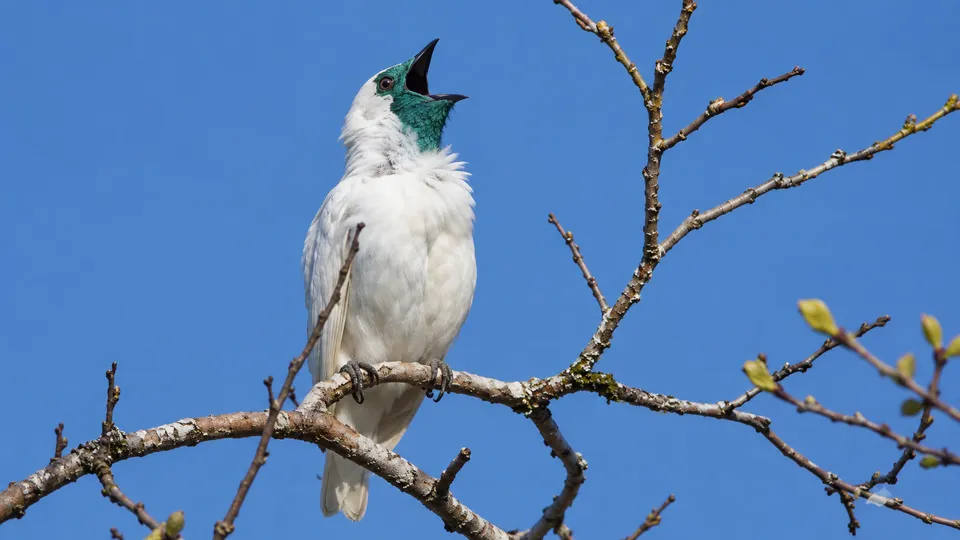
Researchers at the University of Massachusetts Amherst have identified two bird species whose calls exceed 120 decibels, louder than a jackhammer, in a study published Tuesday in the journal Evolution.
The bare-throated bellbird and the red-legged seriema now occupy the same decibel range as the white bellbird, which was crowned by Guinness World Records as holder of the loudest bird call after recordings of up to 125 decibels in 2019.
“The nearest comparison in everyday sounds would be a jackhammer,” study co-author João C.T. Menezes, an evolutionary biologist, told CNN. Menezes conducted the research as part of his PhD with his former teacher, UMass Amherst biology professor Jeff Podos.
The bare-throated bellbird’s shout was recorded at 122.4 decibels, measured from a standardized distance of 1 meter and averaged over a 20-millisecond time block, according to the study. That is a sound pressure 800 times that of the quietest species recorded, the dusky-throated hermit, a hummingbird with a call of 64.1 decibels.
Which bird holds the record depends on the criterion. The loudest single call, a peak of almost 131 decibels across 1 meter, belonged to one bare-throated bellbird. Averaging the noisiest calls over 20-millisecond blocks puts the red-legged seriema first, at almost 121 decibels across two birds. Averaging each bird’s peak volume favors the white bellbird, at 127 decibels across six birds.
The world’s loudest bird “depends on how one defines ‘loud,’” Catherine Sheard, an evolutionary biologist at the University of Aberdeen who was not involved in the study, told CNN, adding that the result showed the difficulties of measuring loudness.
The researchers measured the vocalizations of 123 bird species in Massachusetts and Brazil between December 2018 and January 2025. The calls of 113 of those species had never been recorded before, the university said in a statement.
Loudness has been hard to measure in the wild because it depends on the distance to the animal. A researcher might hear a bird without seeing it, and then the bird flies away or “stops singing altogether out of shyness,” Menezes said.
The team solved the problem with the laser rangefinders golfers use to judge distance to holes. “The laser rangefinders help us determine the distance between the recorder and the bird,” Podos told 404 Media in an email. The volume readings themselves, he said, come from “a Sound Level Meter (normally used in industrial acoustics, but that can also serve in working with animals!).”
“We were interested in a pretty basic question that’s still out there because we know so little about amplitude,” Menezes told 404 Media. “We were basically interested in finding out why some species sing louder than others. For that, the more diverse the sample, the better.”
After correcting for background noise and distance, the researchers found that larger species and species with broader beak openings tended to sing louder, because “bigger birds have bulkier muscles, which are capable of creating greater internal pressures, which ultimately generate louder sounds,” Menezes said, with broader mouths radiating more energy. Yet some birds outcall elephants, lions and bison, indicating a mechanism the researchers have not yet explained.
The team also found no clear link between loudness and habitat or mating behavior. Bellbirds live in dense forest and are highly polygamous, with only males calling, while the red-legged seriema lives in open habitat including pastures and forms long-term monogamous pairs. “If you look at the top three birds, we can see perfect counterexamples for each of those factors,” Menezes said, calling them “parallel routes to extreme loudness.”
Menezes said 120 to 125 decibels appears to be a ceiling for terrestrial animals, including elephants and loud echolocating bats. “Based on that, my hunch is that we’re not going to find a much louder bird, but I do think we’ll find others that fall in that same category,” he said.
Sheard predicted further records. “It doesn’t surprise me that even a relatively modest survey of volume has newly identified some very loud birds,” she said. “As fieldworkers continue to collect more data on avian sound, I would predict that even more ‘loudest’ birds will be identified in the future.”