
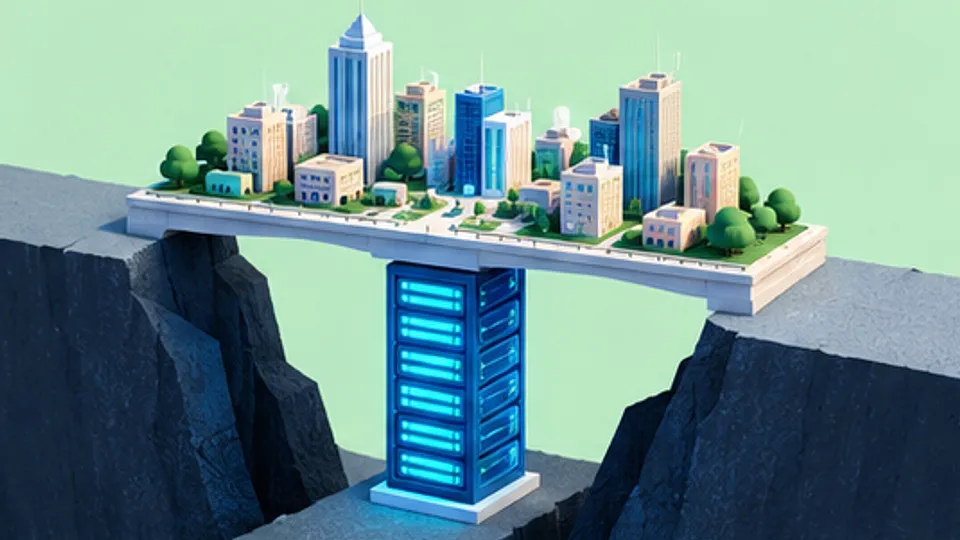
Reid Hoffman has a thank-you note for the least popular buildings in America. The LinkedIn cofounder, appearing on the “Newcomer” podcast released Friday, credited the torrent of capital pouring into AI data centers with being “the only reason we’re not in a recession.” This is a striking claim to make at the precise moment when data centers have become something close to a bipartisan enemy. We’ll get to that. First, the argument.
Hoffman’s point is about where the money actually lands. A tech company announces a data center and people picture the money vanishing into a server hall somewhere. But buildings are obstinately physical things. “Most of that capital” doesn’t stay where the data centers are, Hoffman said: “Most of that’s more distributed across the country. That’s great.” Someone has to pour the concrete, pull the wire, frame the walls, draft the contracts and sell the land. His list: construction workers, electricians, carpenters, real estate agents, lawyers. “All of this capital infusion, people think, ‘Oh, that’s just going to the tech companies,’” he said, when a “massive percentage of it is going towards data center construction.”
Which is to say, the AI boom is at least partly a construction boom, and construction booms are the traditional way an economy keeps a lot of people employed at once. You can be skeptical of chatbots and still cash a paycheck from the building that houses them.
The awkward part is that the neighbors hate the buildings. Data centers have become a source of genuine bipartisan fury ahead of the midterm elections, with both Republican and Democratic governors recently moving to curtail or restrict construction. A Pew Research Center poll released last week, which surveyed people in August, found that half of rural Americans say data centers “are mostly bad for the environment” — up sharply from 32% in January. Hoffman’s response to all this is not that communities are wrong, exactly; it’s that data center builders need to work fairly with local communities so that both sides get a good deal. Which is the sort of thing everyone says and no one prices.
It is also worth noticing the incentives humming underneath the debate. US investors have enormous sums riding on the hope that AI becomes profitable soon, and data centers are where that hope gets poured into the ground. For OpenAI, Anthropic, Meta and Google the issue is existential: without data centers there is nothing to sell. OpenAI’s Sam Altman has floated building new facilities far from where people live — in the desert, say — which would solve the neighbor problem by redefining who counts as one.
Is he right?
The claims “we are not in a recession” and “AI spending is the reason” are separable, and the first is on much firmer ground than the second. Yes, September’s jobs report disappointed, but unemployment remained low — a middling labor market, not a collapsing one. Real gross domestic product grew at a 2.2% annual rate in the second quarter, and GDP is a measure that typically declines during recessions. Real personal income minus transfers, another classic recession indicator, is up from a year ago, and consumer spending is still growing. An economy can be propped up by AI capital expenditure and also by people simply buying things, and at the moment both are happening.
None of that makes Hoffman wrong about the construction money, which is real and geographically broad and employs exactly the sort of people politicians claim to care about. It just makes the word “only” do a suspicious amount of lifting. And there is a flip side hiding inside his own framing: if one industry’s building spree is the thing holding the economy up, then the day the spree ends you don’t just get smaller tech companies. You get the recession too, plus a lot of very large, very quiet buildings in the desert.