
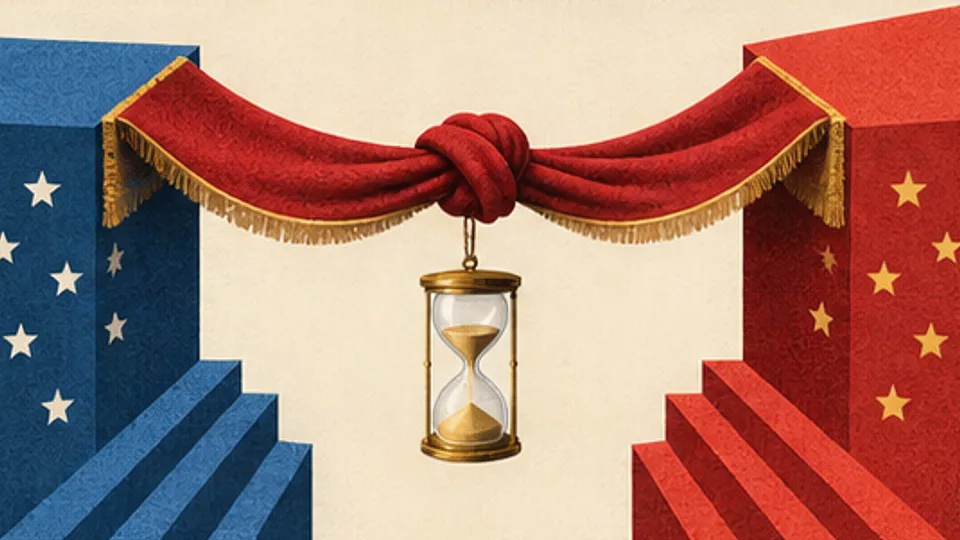
The red carpet was literal. The cannons were literal. The fighter jets, the two military bands, the flyover, the tarmac greeting, the gleaming new helipad on the South Lawn with the President of the United States personally walking the President of China up the steps of the new Marine One to let him poke around inside — all of it literal, all of it staged, all of it, per CNN’s reporting, plotted for months by Donald Trump to impress one man: Xi Jinping, in Washington for three days this week on the first state visit by a Chinese leader in 11 years. And when it was over, when Xi had sipped his tea at the White House and gazed upon the Declaration of Independence at the National Archives and flown home, what did the world’s two largest economies have to show for it? A two-month extension of a trade truce. An agreement to open a phone line about artificial intelligence. Two pandas. No joint statement, no press conference, not even — as South Korea’s Chosun Ilbo pointed out — a fact sheet. Welcome to what we might call the Pageant Doctrine: diplomacy in which the reception is the deliverable.
“The deliverable was a good time had by all, or something,” one former Trump State Department official told CNN, summing up the summit.
Start with the substance, since it’s the shortest chapter. Treasury Secretary Scott Bessent told reporters he had agreed with the Chinese side, the day before the summit, to push the trade truce born last year in Busan out from November 10 to January 10 — “more time to see what we can do” economically, as he put it. The truce keeps American access to Chinese rare earths flowing and lets China buy some advanced American semiconductor chips, according to NPR. But the two unformed boards of trade and investment? No details. Boeing purchases? No details. Chinese farm-good purchases? No details — and much of what was announced after Trump’s May visit to Beijing, Chosun noted, remains unimplemented. Danny Russel, an Obama-era assistant secretary of state for East Asia, put it to the Guardian this way.
Pandas are cute, but what the United States needs is rare earths.
Russel dubbed the whole affair less diplomacy than “diplotainment,” and the man has a point: China controls roughly 70 percent of the world’s rare earth mining and more than 85 percent of its refining, and has wielded that chokehold in the trade war — yet the minerals stayed right where they were on the negotiating table. Xi did promise Atlanta’s zoo two giant pandas, Pingping and Fushuang. The state dinner of about 145 guests — Jeff Bezos, Elon Musk at the main table, Sam Altman, Jensen Huang, Michael Dell, Sundar Pichai, LVMH’s Bernard Arnault — dined on sesame-crusted sea bass with braised baby bok choy, a menu the First Lady helped craft, and raised a “toast to peace” with the same Schramsberg wine poured for Nixon in 1972. Trump presented Xi an eagle statue designed “in personal collaboration with Melania and myself.”
On artificial intelligence, the White House said the two countries agreed to establish a “bilateral communication channel” for AI incidents, with another meeting planned within a month. “When I think about it, I think about the red zone between the Kremlin and the White House during the Cold War,” U.S. Trade Representative Jamieson Greer told Al Jazeera — while insisting the sale of America’s top-end chips never came up: “These are the crown jewels of American technology… those conversations… [are] not really happening in these negotiations.” Trump, who told the UN General Assembly this week that the U.S. government would rename artificial intelligence “super intelligence” in all its documents, posted that Xi “seemed to like calling the poorly and inaccurately named Artificial Intelligence to a far more accurate and important name, SUPER INTELLIGENCE. That would be ‘SUPER!’” Xi, for his part, pressed the opposite instinct — AI must always remain under human control — and invoked the “Thucydides trap” in his opening remarks. Trump countered with the shared history of U.S. Marines and Chinese Communist fighters: “Look at the greatness that we had together fighting in World War II.”
And here the show eats itself, because the one thing Xi craved most from the visit, CNN reported, was the television — and Trump had banned it. Days before the summit, the president barred CNN, MS NOW and Politico from the White House; the networks jointly suspended pooled TV coverage for all of Xi’s first day, and some print outlets held back pool photos in solidarity. The Chinese embassy phoned American networks to ask what it meant for coverage; Beijing’s more than 100 dispatched state-media staffers could film all they liked, but as foreign ministry adviser Wu Xinbo told CNN, it was “regrettable” so little footage reached the American public — “It could have helped improve the atmosphere in US-China relations.” Trump, months of plotting undone by his own feud with the press, privately fumed that he wanted the pool back while publicly raging: “The event was magnificent — Actually made for Television but, because they’re Fake News… they refused to be there.” White House communications director Steven Cheung blamed a “juvenile boycott.” The pool returned Friday once CNN’s access was restored — whereupon the White House barred CNN from Air Force One pool duty on Saturday.
Meanwhile the harder questions sat untouched at the door. Before Thursday’s meeting had even concluded, China’s state news agency demanded the U.S. oppose Taiwan’s formal independence. “Neither side is really in a position from a domestic standpoint to work out the really complicated issues,” said New America’s Samm Sacks, who told NPR that Beijing sees in Trump a rare window — “they know there are China hardliners who want decoupling waiting in the wings.” Lucy Hornby, author of the upcoming Xi biography The Last Man, noted the familiar choreography: with American presidents Xi plays coequal problem-solver, and with everyone else he talks solidarity against the “hegemonic” United States. The Chinese readout said the leaders spent 90 minutes behind closed doors on the Middle East, Ukraine and the Korean Peninsula; the White House said nothing at all. Trump did announce the road show continues — he’ll attend APEC in southern China in November, and Xi will come to Miami for the G20 in December.
Watching it all from Ottawa, with a very personal scorecard, is Michael Kovrig — the former Canadian diplomat seized in China alongside Michael Spavor in what was widely seen as retaliation for the 2018 arrest of Huawei executive Meng Wanzhou in Vancouver on a U.S. warrant; this very week marks five years since his release. Now the International Crisis Group’s senior Asia adviser, Kovrig told CBC the pageantry left the two powers in “a kind of strategic stalemate,” and warned that Canada’s hawkish-on-China allies in Washington have a president who “has undercut much of that policy” in his eagerness to impress an autocrat. Prime Minister Mark Carney, he said, will be scanning for any U.S.-China deal that could “leave Canada out on a limb” — exposed to Chinese trade or diplomatic penalties, or disadvantaged economically. His sharpest exhibit: Trump has held back a $14-billion U.S. arms package for Taiwan since May and has called it, out loud, a negotiating chip — in an Indo-Pacific on whose stability Canada’s prosperity depends.
So: harmony declared, confrontation deferred, tea sipped, pandas promised, hotline pending, cameras banished and grudgingly readmitted. The truce holds for another sixty days. Come January 10, the Pageant Doctrine meets its deadline.