
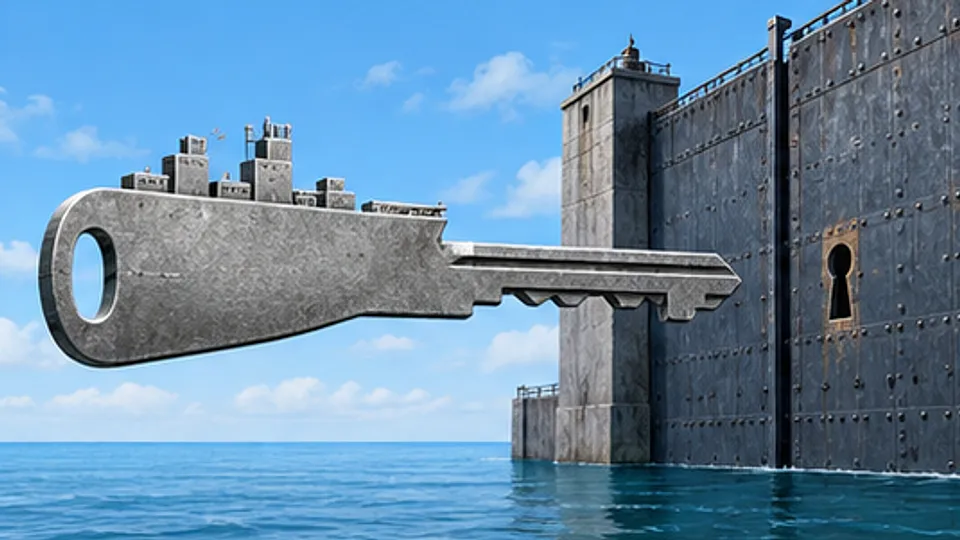
Here is a deal that makes obvious sense. The United States Navy needs more ships than American shipyards can currently build, and South Korea has some of the best shipyards on the planet, with spare capacity and fast delivery times. Korea builds the ships, the Navy gets the hulls, everybody waves at China across the Pacific. The RAND Corporation looked at this arrangement and, in a commentary published Thursday titled “A Phased Agenda for Korea-US Shipbuilding Cooperation,” delivered the findings of its research, which can be roughly summarized as: yes, but have you met Congress?
The headline conclusion, reported by the Chosun Ilbo, is that “large-scale overseas construction of combatant fleet vessels remains politically difficult and, in many cases, operationally sensitive.” RAND acknowledged the counterargument – that if the goal is getting additional ships into the fleet quickly, allied or foreign yards may be the only realistic option – but noted the rejoinder: even if a Korean yard could pull delivery dates forward, Congress is unlikely to sign off on building combat-related vessels abroad at scale.
The specific wall here has a name: the so-called “Golden Amendment” in the fiscal 2027 National Defense Authorization Act, which restricts the overseas construction of US military vessels plus their major hull sections and superstructures. According to RAND, the amendment came up repeatedly at a conference it hosted in July on Korea-US shipbuilding and maritime innovation. When the same law keeps getting mentioned at your industry conference, that is the industry’s way of telling you where the fence is.
RAND’s read of the politics is worth quoting because it explains everything else. Congress, the think tank said, doesn’t see shipbuilding as an ordinary industrial-policy question – who can build the cheapest frigate fastest – but as a matter of “sovereign capability.” And that concern is sharpest precisely where the ships touch combat power and strategic deterrence. Any cooperation that is perceived to bypass American workers or hollow out American yards, RAND warned, will struggle to survive. Now, you could argue this is protectionism in a flag, and certainly the mechanism is that ships built in Korea are ships not built in somebody’s congressional district, with jobs not held by somebody’s voters. But you don’t have to find that sympathetic to find it binding. The constraint exists whether or not it’s wise.
So RAND’s advice to Seoul is to start where the politics are boring. Its list: auxiliary ships, strategic sealift vessels, maintenance, repair and overhaul (MRO), supply-chain cooperation, workforce development, and the production of components and blocks. Auxiliaries and sealift ships are less politically sensitive than frontline combatants, RAND said, so they could serve as pilot projects – a way for the two countries to test a cooperation model on vessels that carry fuel and supplies rather than missiles. MRO is a similar story: the legal restrictions on servicing ships overseas are comparatively looser for auxiliaries than for combatants, and the US has a real maintenance backlog for Korea’s yards to help clear.
I think the interesting question is whether the boring stuff is actually the point. Nobody holds a ribbon-cutting for a replenishment oiler, and “joint component production” does not make anyone’s highlight reel. But the backlogged, unglamorous work – parts, blocks, overhauls, training – is also where cooperation can run for years without needing a vote of Congress to bless each step. The combat ships are the prize everyone talks about. They’re also the prize locked in the case labeled “sovereign capability,” with the Golden Amendment as the lock. RAND’s message to Korean shipbuilders, translated from think-tank, is: the case is not opening soon. Take the keys they’re actually offering.