
On election night the victor stood in the Greek Theatre in Griffith Park, in the hills above the city she had just been chosen to govern, and named the thing she had beaten before she beat her opponent. It was cynicism, Nithya Raman said, the cynicism that “started to make us believe that L.A.’s problems weren’t just bad, but they were permanent.” Then she promised that Los Angeles “is worth fighting for every single day of our lives.”
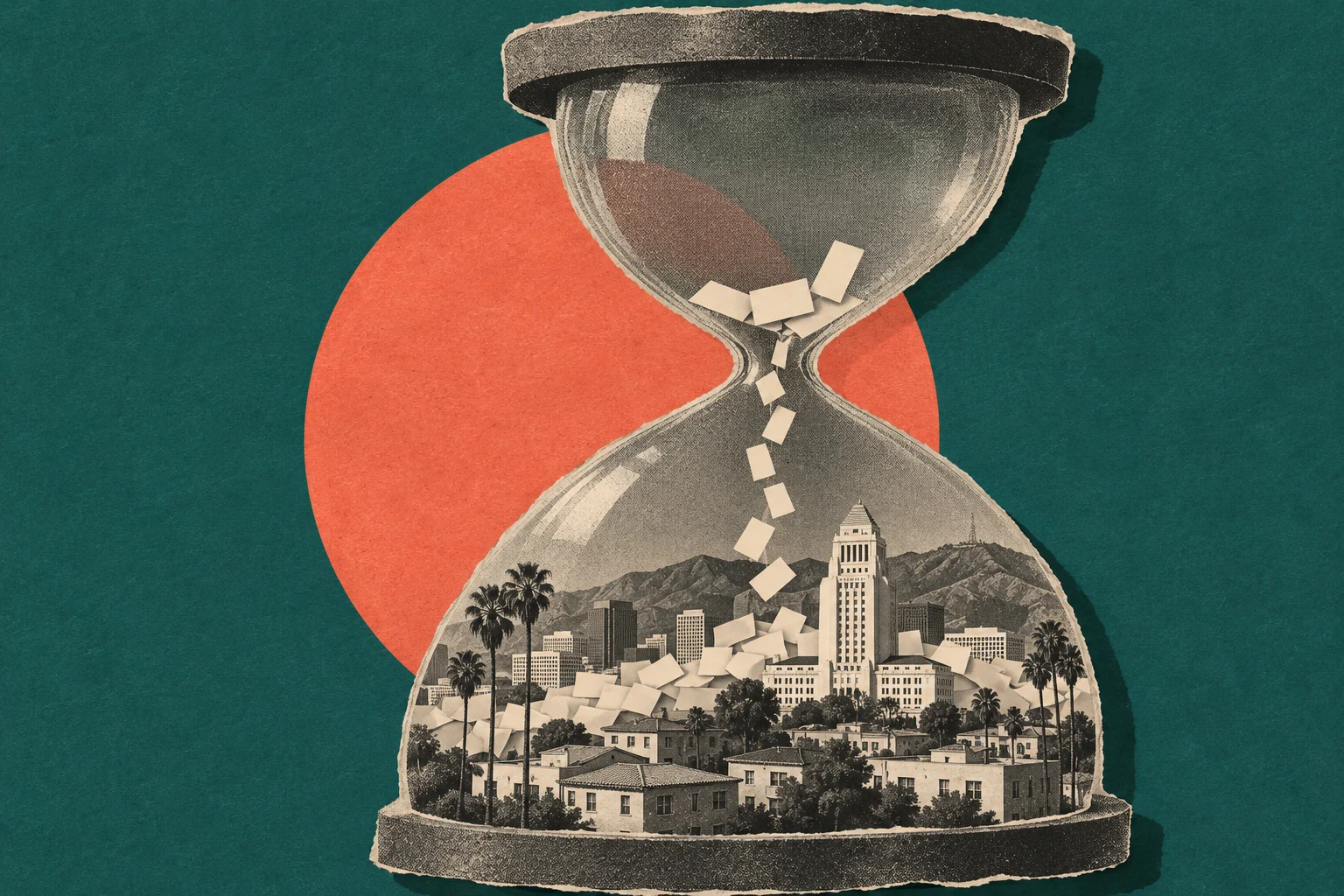
A few hours later, Decision Desk HQ, the independent election site that partners with Ballotpedia, projected that Raman would be the 44th mayor of Los Angeles, ending Karen Bass’s tenure after a single term and, as the Hollywood Reporter first reported, making her the first Asian American to hold the office. Other major outlets, NBC News among them, had yet to call the race. Raman led by more than three percent with nearly three-quarters of expected votes counted; mail ballots postmarked by Election Day remain valid for days to come, and the full count may take a week or longer. Los Angeles, which has always measured time on its own terms, will be told who governs it the same way.
A city drawn in two colors
The map of this runoff is a portrait of a city divided by roof and by rent. According to the precinct-level results published by the L.A. County Registrar-Recorder and mapped by basin.la, Bass led in Bel Air and Baldwin Hills; Raman led in Echo Park, East Hollywood and Boyle Heights. The incumbent kept the homeowners’ hillsides; the insurgent took the flatlands of renters. It was an election about housing decided by those who have no certainty of it. The money told its own parallel story in the weeks before the vote, when outside groups poured $24.5 million into runoff advertising whose two vocabularies, “homelessness” on one side, “safer” on the other, never met.
Bass, 73, was the city’s first female mayor and its second Black one: a former community organizer who rose through the California Assembly, spent more than a decade in Congress representing a largely African American and Hispanic stretch of South L.A., and was reportedly weighed seriously by Joe Biden as a running mate in 2020. She was defeated not by the right but from the left, by a fellow Democrat who ran openly against the local party machine, and against those of her own progressive colleagues on the City Council who had already endorsed the incumbent. In the end the dethroning of an incumbent mayor requires no revolution party, only a long enough list of grievances: housing, affordability, the flight of film and television production, and above all the response to the Palisades wildfire, whose smoke hung over this entire campaign.

The planner from the City Council
Raman, 45, was born in India, trained as an urban planner at Harvard and MIT, founded a homelessness nonprofit and served as executive director of Time’s Up, the workplace-harassment advocacy group, before winning her council seat in 2020. Her district runs from Sherman Oaks to Studio City, over the Hollywood Hills to Los Feliz and Silver Lake, a corridor containing the Hollywood Bowl, the Hollywood Sign and NBCUniversal. The industry adopted her campaigns: donors to her mayoral run included Tina Fey, Mike Schur, Mindy Kaling and Cord Jefferson, and her husband, Vali Chandrasekaran, is a writer-producer with credits from 30 Rock and Modern Family to The Four Seasons. Yet Bass had Hollywood allies of her own: Jane Fonda, J.J. Abrams, Samuel L. Jackson and Anthony Anderson. Los Angeles elections are often fought between two wings of the academy.
Both candidates promised to back unlimited state film and TV credits and to champion a federal incentive against runaway production; Raman attacked Bass for, among other things, her tardiness in appointing a film liaison, though the Reporter notes Raman’s own record of advocating for Hollywood’s needs has been questioned as production kept leaving. On housing, her signature issue, Raman first championed Measure ULA, the so-called Mansion Tax, then criticized its unintended consequences when its damaging effect on apartment construction became clear, and has since pushed for reform. An ideology that meets a building crane, like an army that meets a river, must either cross or learn to.

The court, the censure, the fire
Her relationship with the Democratic Socialists of America captured the paradox of her candidacy. Once a dues-paying member of the local chapter, she was censured by DSA L.A. in 2024 for not fully adopting its positions against Israel; in the mayoral race the local chapter backed her anyway, over the objections of the national leadership. Her campaign included an interview with the leftist streamer Hasan Piker. The primary that preceded the runoff was defined by the grievance candidacy of Spencer Pratt, the former reality-TV star who lost his house in the Palisades fire and blamed government negligence. And there in the wings stood Rick Caruso, the billionaire developer Bass beat in 2022, who declined to run again, criticized her fiercely all term, and in October announced he would vote for her. He lost; so did she.
Raman will govern with allies in high places: City Controller Kenneth Mejia and the newly elected City Attorney Marissa Roy, a DSA member, form with her, in the Reporter’s phrase, a triumvirate of progressivism at the summit of City Hall. And her term will run into 2028, when the Summer Olympics come to Los Angeles, that festival at which cities present the world with a retouched photograph of themselves, with the ceremonies now overseen by former Lucasfilm chief Kathleen Kennedy after Peter Rice left to become Netflix’s chief content officer. The photo will be taken. Whether the city beneath it has changed is the question her voters asked of the last mayor, and will ask of her.