
Every autumn in the occupied West Bank the olives have to come down from the trees. Every autumn, too, the question of who may pick them turns into a question of who owns the hills on which they grow. This year a rabbi has given his answer.
On Friday, October 16, Rabbi Dov Lior issued a religious ruling permitting Jewish settlers to take olives from Palestinian orchards, as Al Jazeera’s Mohammad Mansour reported. The ruling is meant for the trees that Palestinian owners cannot reach this season because of Israeli restrictions. Those owners, Lior reasons, have been compensated enough already, in the earlier years when they could still get to the fruit. Jews may therefore pick it, and by picking it they lay claim to the land.
Accounting by scripture
Read one way, the ruling is a piece of bookkeeping. The Israeli state keeps a farmer away from his grove. That absence then becomes the reason a stranger may harvest the grove, and the harvests the farmer brought in before the gate closed are entered in the ledger as payment received. The restriction produces the loss, and the loss is then used to justify the taking.
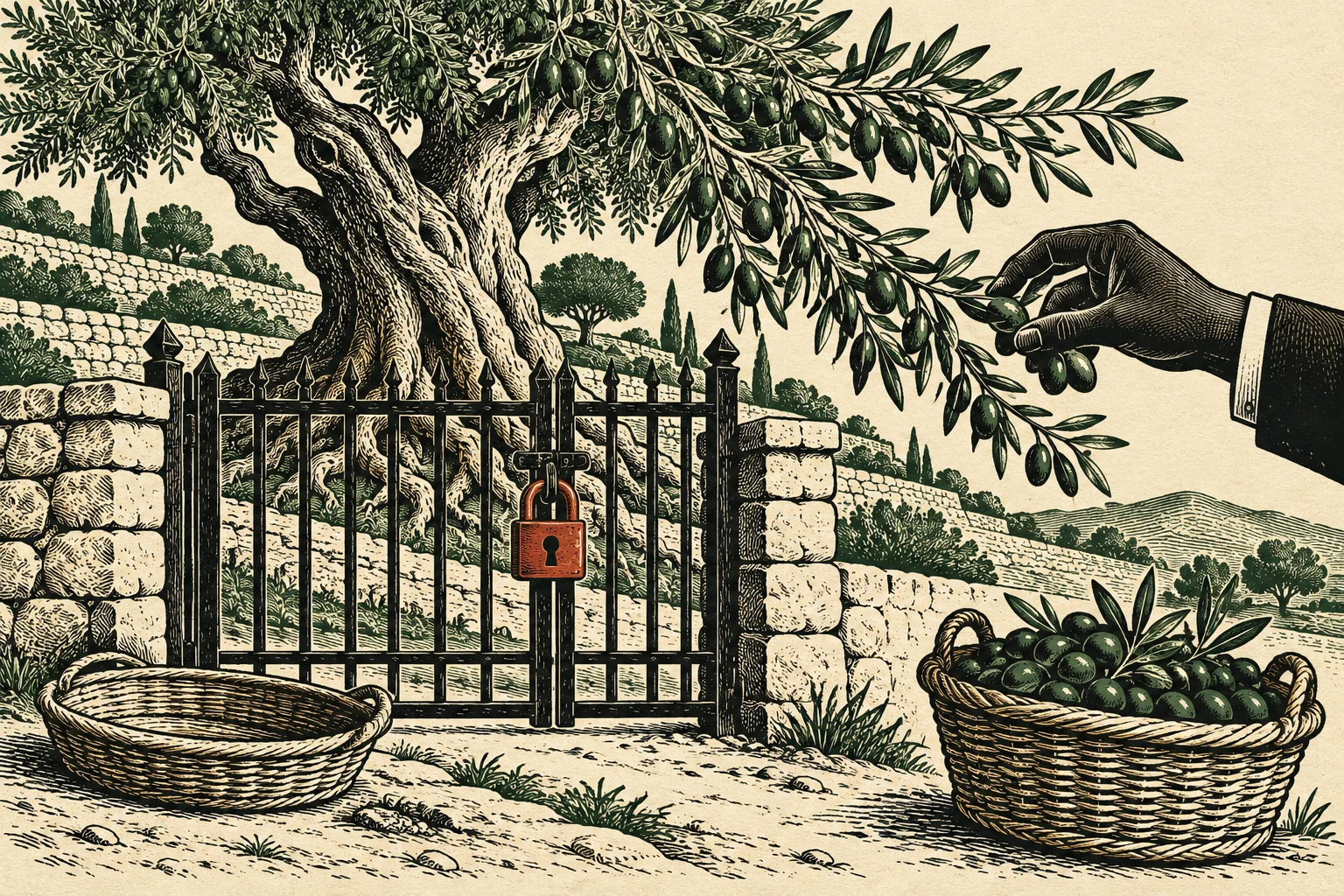
Lior did not present it as bookkeeping. He called taking the olives an “additional virtue” and told settlers to “conquer the land” far from Jewish communities in order to “demonstrate our ownership,” pointing to biblical commandment. Arabs never bought the land from Jews, he argued, which makes it “stolen land in their hands.” And: “The Jewish people have never given up on the Land of Israel, as we express in our prayers every single day.”
Friday in the groves
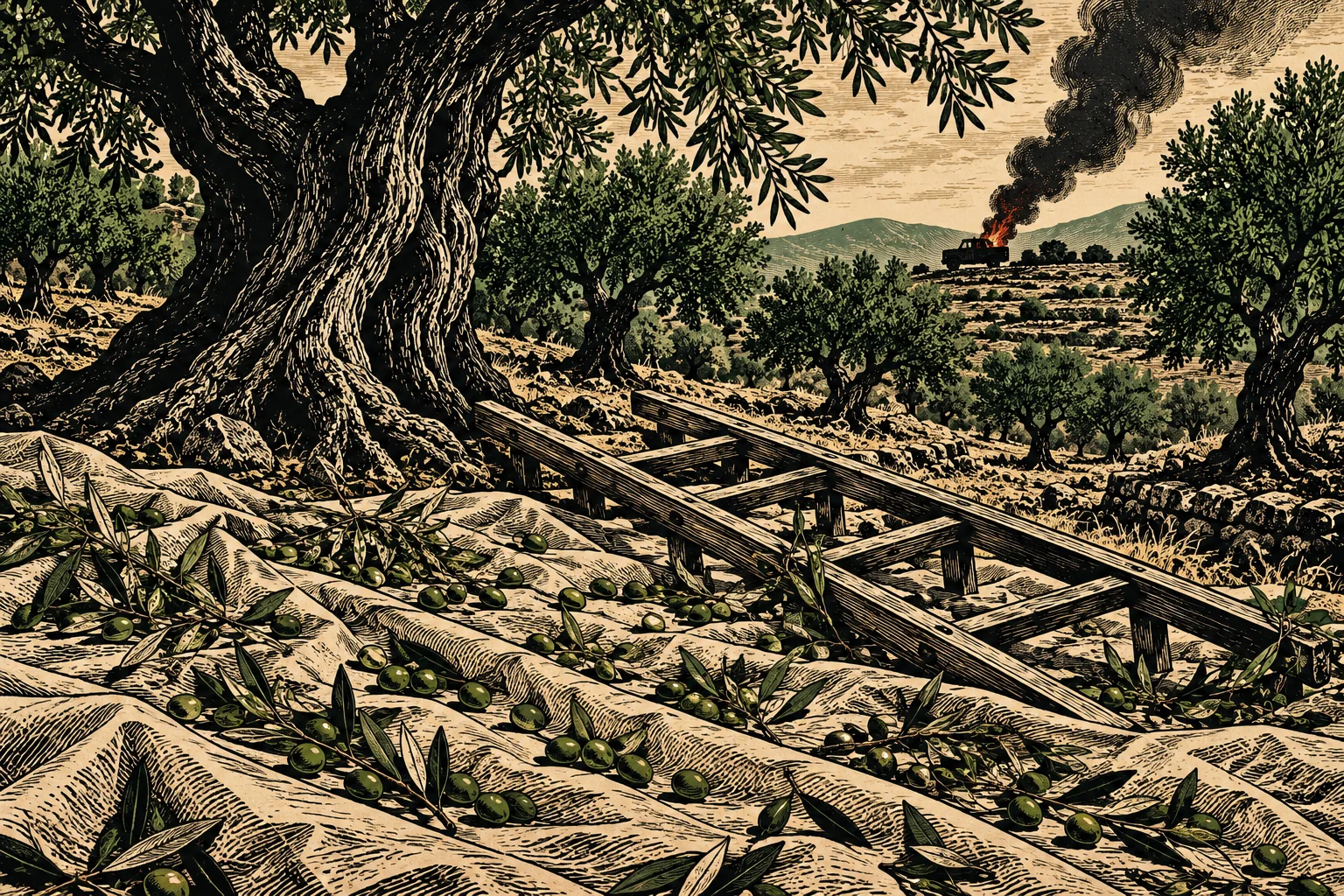
The ruling came out in the middle of what Al Jazeera called a new wave of settler pogroms against the harvest. On that same Friday, Israeli forces and settlers carried out 34 attacks on Palestinians picking olives, and at least 19 people were injured. Five vehicles were set on fire. Settlers also attacked an American photojournalist working for The Washington Post, an assault that had already made the beating at Abu Falah a story in its own right. Many farmers cannot get to their trees at all, kept away by Israeli restrictions and by threats from settlers.
The man who ruled
Lior was born in Poland in 1933. He is a leading figure in Religious Zionism and has great influence among hardline settler groups such as the Hilltop Youth, who support his opposition to any territorial compromise. He is also the spiritual guide of Otzma Yehudit, Jewish Power, the party led by National Security Minister Itamar Ben-Gvir, who only weeks ago led hundreds into the Al-Aqsa compound. In 2011 he was briefly arrested over his endorsement of The King’s Doctrine, a book that offers scriptural justification for killing gentiles in a religious war.
Rabbis against the rabbi
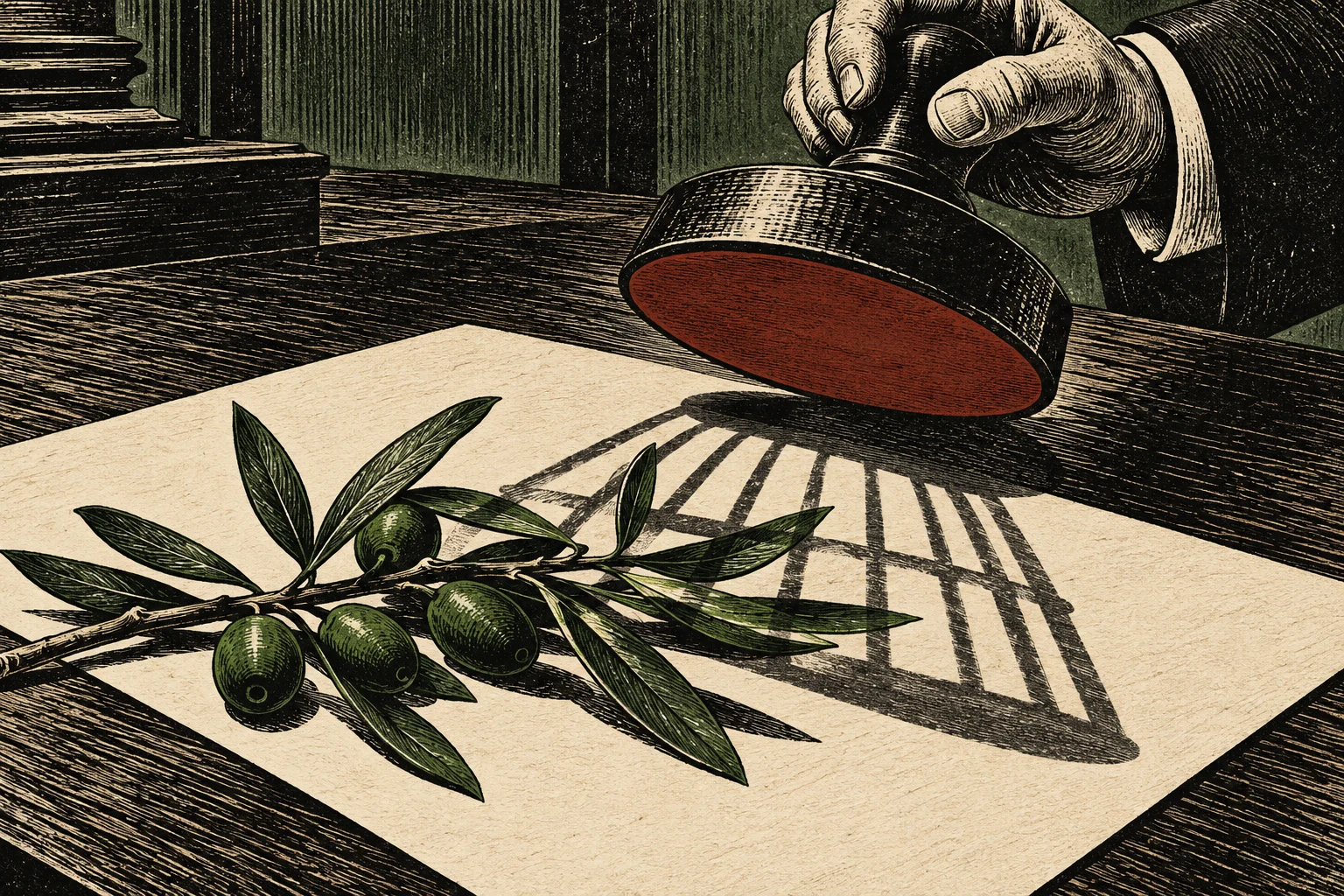
Other rabbis rejected the ruling, and they did so in strong terms. The rabbinical council of the Gush Etzion settlements wrote a letter calling such harvesting theft, blasphemy and a moral defect. Tzohar, an organisation of 800 Orthodox rabbis, said that only the state has the power to confiscate property, and that since the state recognises Arab ownership, the olives belong to the Arabs.
The objection is narrower than it first appears. It rests on the authority of the state, which is the same state whose restrictions keep the owners away from their trees. Under that argument the olive is protected until a government decides otherwise.
In the Knesset, Gilad Kariv of the Democrats said Lior and his followers were dragging Israel into moral vice. “Whoever stands on the sidelines in this issue joins the camp of Rabbi Dov Lior and his criminals,” he said.
The Palestinian analyst Mamoun Abu Amer doubts the rabbis’ motives. He suggested their rejection may be political, intended to make Lior’s supporters look like “anomalous voices.” In his view, the government wants the blame to fall on a small group, the Hilltop Youth, so that settlers as a whole can be presented as law-abiding. “Ben-Gvir relies on the religious rulings of Rabbi Dov Lior, which rely on biblical texts and the Book of Deuteronomy,” he said. He described Lior’s interpretations as the most extreme available.
Before the vote
Israel goes to the polls in a few weeks, and far-right parties are courting settlers and the people who back them. Abu Amer says Ben-Gvir uses TikTok and populist language to win votes in a climate, after October 7, where there is a “market for extremism.” A ruling about olives can also work as a campaign message.
The harvest has its own figures. On October 9, the olive press at Qusra, near Nablus, saw little demand, because closures had cut farmers off from their land. Oil prices may rise as a result.