
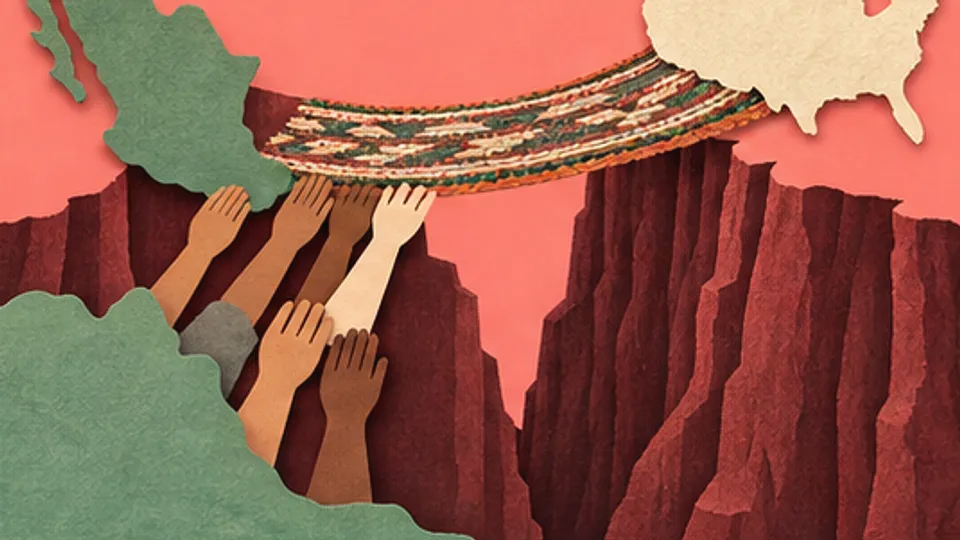
In June 2022, the U.S. Supreme Court’s decision in Dobbs v. Jackson Women’s Health Organization ended the federal abortion protection that Roe v. Wade had established in 1973. Four years on, the consequences are unusually well documented, for a particular reason: the people filling the gap keep careful records. According to reporting by Roberto González in El País, Mexican feminist collectives have helped thousands of American women end pregnancies since the bans began, and a series of recent studies now describes who those women are — and confirms what the collectives had already learned one phone call at a time.
The largest of the studies began with a collision of expertise. Alexandra Wollum, a public health researcher at the Ibis Reproductive Health institute, turned to Verónica Cruz Castro, director of the Guanajuato-based organization Centro Las Libres, and Sandra Cardona Alanís, founder of the Red Necesito Abortar MX network. Wollum had collaborated with both for years on sexual and reproductive health research. Together they set out to answer a simple question: who is it that turns to Mexican feminist collectives for abortion help?
The collectives were hardly new to the work. Las Libres had spent more than two decades helping women end pregnancies in Mexico, with or without government approval. Their attention turned north in September 2021, when Texas enacted a law banning abortion once a physician could detect fetal cardiac activity — a milestone its backers presented as proof a pregnancy was viable. That claim has been dismantled twice over in the medical literature: studies have documented cardiac activity in fetuses with anencephaly, in which the brain or skull fails to develop and survival is impossible, and separate research notes that the human heart is not fully formed until around the twentieth week of pregnancy, meaning the flicker detectable from week six is not comparable to the beat of a finished heart.
The law’s effect was immediate: women in Texas lost access essentially overnight, including some whose medical conditions made carrying a pregnancy to term dangerous. Las Libres and Necesito Abortar MX began providing information and accompaniment for self-managed abortions at home, sending misoprostol and mifepristone free of charge. After Dobbs fell, Castro and Alanís recall, requests surged and started arriving from every state that rushed restrictions onto the books. In 2023 alone the collectives logged at least 2,850 requests — the sample that Wollum’s study analyzes, using a questionnaire designed, from long experience, around what frightened people would actually answer, delivered through secure communication channels.
The findings land where the warnings said they would. Eighty-two percent of requests came from states with complete abortion bans, Texas foremost among them. Using ZIP code information, the researchers could show that request rates climbed in areas with more poverty, lower insurance coverage and larger Spanish-speaking populations — though, to the organizers’ surprise, most of the people who got in touch were English speakers. In areas where only about 5% of residents live below the poverty line, the request rate was 0.35 per 100,000 women; in areas where poverty reaches 17%, the rate rose to 1.63. The study’s overall average was 2.44 per 100,000. Many women, González reports, have also simply crossed the border; some were received by Alanís herself at her abortion clinic in Monterrey, Nuevo León.
Support groups are truly helping to bridge a gap in access to abortion for people in the U.S. who, at this time, face the greatest obstacles to receiving care, including cost, distance, and language barriers.
Wollum, quoted in El País, is one of a growing roster of researchers documenting what restriction looks like from the patient side. The journal Obstetrics and Gynecology alone has published at least three such studies in the past four months. One of them came from Tuyet Mai Hoang, a social work specialist who interviewed people who traveled from restrictive states to legal ones like Illinois, where she works. Her central conclusion is that the trip is as much about trust as geography. “They don’t travel only to receive abortion care. And not only because abortion is unavailable or banned in their state, but because they sought medical care that, for them, felt safe, reliable, respectful, and nonjudgmental,” she explains. On Wollum’s study, which she did not take part in, Hoang singles out the collaboration itself: “It’s important that activists, researchers, patients, and other stakeholders take part in the research process and the generation of scientific evidence to inform laws.”
Anna Fiastro, a public health expert whose research reached similar conclusions, adds a wrinkle about the women who travel specifically to obtain misoprostol and mifepristone: many do so because they distrust remote options like telemedicine. That distrust, she found, is fed by poor information and by fear of legal consequences — a rational calculation in states that have made helping someone end a pregnancy a potential crime. Where the system punishes proximity, people seek distance, and when the distance is too far or too expensive, a stranger in Guanajuato or Monterrey becomes the nearest provider willing to answer.
For Alanís, the lesson of the past five years is that collective action can fill the gaps governments leave — or, in this case, governments on two sides of a border, one restricting and the other imperfectly permitting. Castro adds that the joint research with Ibis has shown her how far the model has traveled: the Americans who received accompaniment have begun forming their own community networks, extending the practice across the border on their own. Studying that spread is her next project. But the work runs on criminalized labor, and Castro is blunt about the constraint: given the daily criminalization feminists face, she does not think now is the time to document it. The corridor stays half-lit on purpose; the women using it can find it in the dark, and the people who built it would prefer it stay that way for a while longer.