
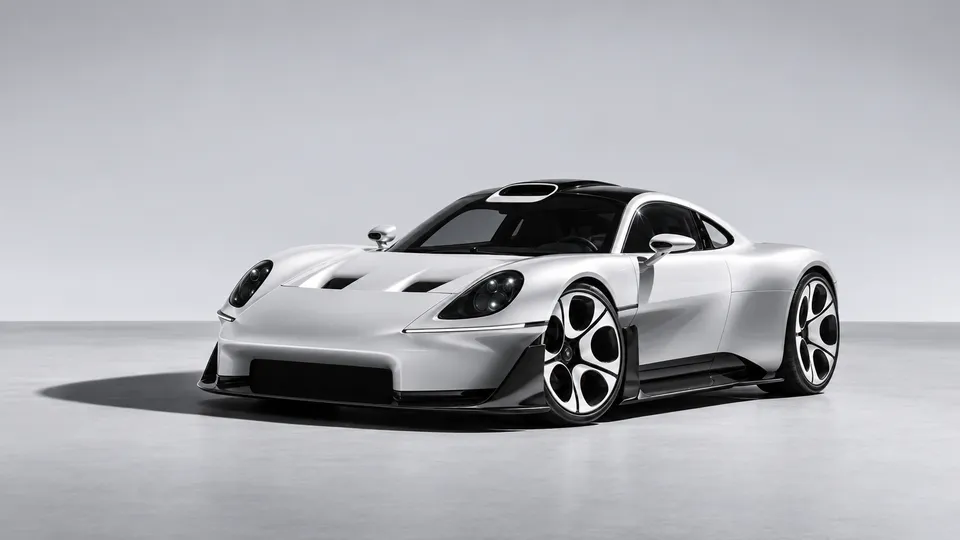
On 7 October, in Weissach, the town where Porsche designs its cars, the company told investors how it means to get through the next nine years. The plan has a German name, Sportwagenschmiede ’35, the sports car forge, and a simple sum at its centre: build fewer cars and charge more for each one. Eight days later Porsche showed what the forge is supposed to produce.
The object is the Mission S, a mid-engined supercar concept, and as Jonathan M. Gitlin reported for Ars Technica, the company’s chief executive, Michael Leiters, took care to say it is no trinket for a few hundred collectors:
“The Mission S provides a glimpse of the ideas and design features that will shape Porsche in the coming years. At the same time, the Mission S represents a mid-engined supersports car platform positioned above the 911—not as a one-off hypercar, but as a permanent and versatile addition to our customer offering.”
For decades the 911 has been the ceiling of the house. Now Porsche is building another floor on top of it.
The arithmetic of less
The numbers behind the concept are less romantic. According to accounts of the Capital Markets Day, Porsche wants to break even at fewer than 200,000 cars a year. In 2025 it delivered 279,449. It will cut its model variants by about 20 percent. It wants its Sonderwunsch personalisation department, which builds cars to a customer’s individual specification, to grow its sales sixfold. Over the medium term it aims to lift the average selling price of its top models by 20 percent, and it targets a net cash flow margin of 9 to 12 percent.
Read the figures together and the logic is plain. A company that can live on 200,000 cars has a cushion of nearly 80,000 below last year’s deliveries. That is a company preparing to be smaller and asking its richest customers to make up the difference.
The plan also takes back some of what the electric decade promised. It rules out a fully electric 911. It revives a combustion-engined SUV the size of the Macan. A third SUV, a seven-seater above the Cayenne, is under consideration. The workforce got a negotiated settlement, the “Future Package,” which guarantees no compulsory redundancies until the end of 2035; jobs will go instead through voluntary severance, early retirement and attrition.
Here is a pattern familiar from boardrooms everywhere: when volume fails, the answer is usually exclusivity, a higher price presented as a gift to the buyer. Jaguar has made a similar wager, staking its name on a £130,000 car. The difference is that Porsche still has a past to sell.
Looking back in order to look forward
The Mission S quotes that past freely. Its exterior styling nods to the 917, the 928, the 959 and the GT1; Gitlin admits that from some angles he also sees the Aston Martin One-77 and the BMW i8. It is the first car from Tobias Sühlmann, Porsche’s new head of style, Motor1 reported. The cabin borrows from the company’s earliest years, from the 356 and the 550 Spyder.
Porsche says the interior is built around the driver, mixing haptic and digital feedback. Screens have been banished. There is no display for the passenger and no central infotainment screen; the driver’s smartphone docks onto a MagSafe connector and works as the navigation or information screen only when wanted. A red button carries the words “on your own.” Gitlin bets that it switches off a range of driver assists. Porsche has not said.
For years the industry measured progress in square inches of glass across the dashboard. A maker of expensive cars now advertises their absence. Removing a screen, it seems, can be sold as a luxury too.
The silence about the engine
On the heart of the matter Porsche says nothing. It has published no powertrain details, no performance figures, no price and no production timeline. The exhaust pipes at the rear suggest an internal combustion engine. For a week before the reveal, rumours had circulated that Porsche would build a flat-eight; Gitlin thinks one behind the cockpit is a good bet, along the lines of the 908 race car or the engine Ruf recently showed. Forced induction and hybrid assistance are both open questions, though Porsche’s recently developed electric T-Hybrid system makes both plausible.

Others have read the signs the same way. Motor1 reports that these cars will not be electric. Hagerty considers hybrid power the likelier choice for a model meant to stay in production, since emissions rules are tightening, especially in Europe. Hagerty also reports that the platform is understood to borrow heavily from the 911 and to combine steel, aluminium and carbon fibre instead of using a bespoke carbon tub. Zero2Turbo notes that the doubts about electric supercars Leiters voiced while running McLaren point the same direction.
The target is no secret. The car is meant to take on the core models of Ferrari and Lamborghini on both design and price, Elite Traveler reports, adding that executives want it called a “super-sports” car, not a hypercar, a choice of words that may leave room for a pricier, limited-run successor to the 918 above it. Leiters was once Ferrari’s technical chief. He knows what his new rival charges, and he put the plan in one sentence: “We are developing a super sports car platform, and we intend to use it as the basis for a new mid-engined car.”