
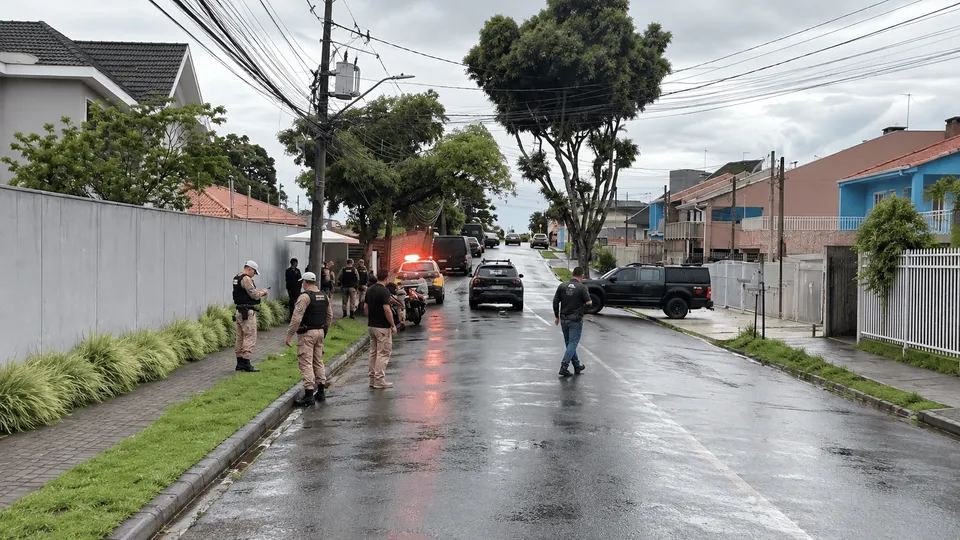
On Friday afternoon a man climbed over the gate of a municipal early-childhood centre in São Braz, a neighbourhood of Curitiba in southern Brazil. He forced his way into a classroom and held 13 small children there for up to three hours. He had a knife, a lighter and what looked like a gun. He spread a flammable liquid around the room. Then the police killed him, and all 13 children came out alive.
That is the outline Al Jazeera reported from statements by police in Paraná state. Leticia Martins, a state police spokesperson, told journalists outside the school that the man jumped the gate, broke into the classroom and took the children hostage. He then covered the room in a flammable substance and stood holding a lighter. Officers initially thought he also had a firearm, but it turned out to be fake. The Associated Press, in a report carried by ABC News, said he threatened to pour gasoline onto himself and others, and that some staff members were held along with the children. The school is CMEI São Braz, and Paraná’s public security secretariat put the number of children held at 13, according to the Brazilian outlet ND Mais.
Alexandre Lopes Dias commands the military police special forces unit in Paraná. He described the scene inside:
“During the entire negotiation, he stayed with all the children around him and one on his lap.”
Why police went in when they did
A hostage negotiation usually runs on the idea that time works for the police. Each hour of talking is an hour in which nobody gets hurt, the person inside gets tired, and the people outside learn more. Going in is the expensive option, because it trades a slow and uncertain situation for a fast one in which a lot can go wrong. So the question negotiators keep asking is whether waiting is still costing them nothing.
In Curitiba it stopped costing nothing. Lopes Dias said the children grew agitated and the man began hitting them. “Once we realised that the kids were becoming increasingly upset and that the attacker started assaulting them physically, we opted for a tactical intervention to avoid a greater problem,” he told reporters. Martins put it more bluntly: “Our negotiating teams were in place but saw no alternative but to neutralise him.”
It helps to picture the conditions for that intervention: a room soaked in something flammable, a man holding a lighter, a child on his lap and a dozen more around him. It would be hard to design a worse room to storm. Police went in anyway, which tells you how they had come to weigh the risk of waiting. Lopes Dias said officers “entered the classroom using a very tactical approach with little risk for the children.” Local television had been showing parents in tears outside the school during the talks. It then broadcast what local media described as flash bangs, and minutes later officers came out carrying some of the children.
What isn’t settled
The accounts differ on a few things. The AP said no children were injured. Al Jazeera’s later report quoted Lopes Dias as saying at least one child was wounded, although he did not say who or what hurt the child. The AP also put the standoff at about two hours, while Al Jazeera said the talks lasted up to three. The Washington Post’s account of the police killing the suspect after he held the children at knifepoint runs along the same lines. Brazilian coverage describes it as a military police operation that killed the intruder and rescued the 13 children.
Officials have said very little about the man. Lopes Dias said he had schizophrenia. He did not name him or say how he was killed. Martins did not say whether the man had given any reason for what he did.
The relief was immediate and public. “The 13 children are alive and safe! After anguishing and tense moments, this is the news we were all waiting for,” Curitiba’s mayor, Eduardo Pimentel, wrote on Instagram. City Hall said the children and school staff would receive psychological support.
Curitiba is a city of 1.8 million people about 400km (250 miles) south of São Paulo, and Brazil has had several attacks on schools in recent years. The one most people there will remember is from April 2023, when a man with an axe killed four children at a day care in Blumenau, also in the south of the country. This attack ended differently, and the difference came down to a decision made inside a room where any decision was dangerous.
The authorities have not yet explained how a man got over a nursery gate with a knife and a container of something flammable. Of all the open questions, that is probably the one a city can most directly fix.