
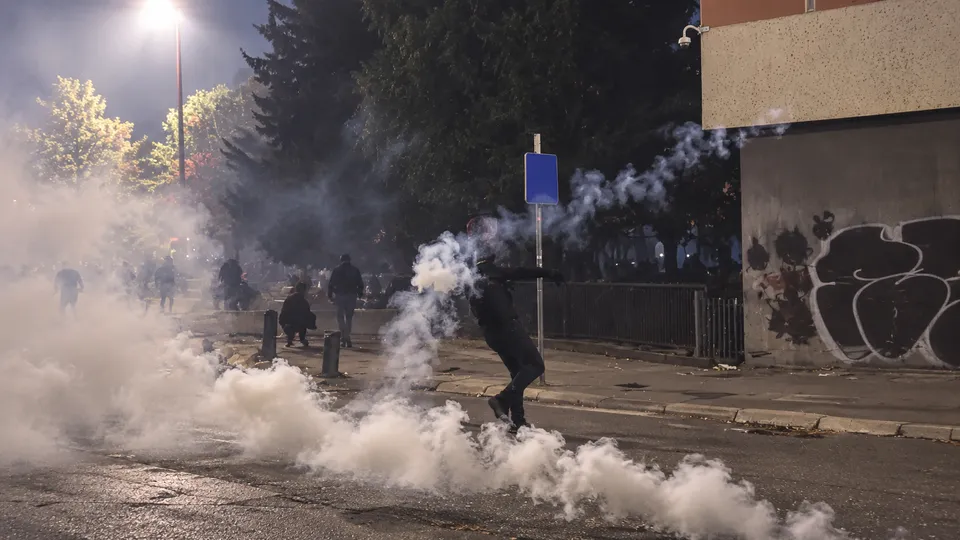
On Monday evening in Pristina, the street gave its verdict before the chamber gave its own. Police clashed with protesters outside Kosovo’s Parliament, Al Jazeera reports, over plans to limit the powers of the Hague-based war crimes court; footage distributed by APT showed tear gas fired as demonstrators threw rocks and firecrackers and blocked the way. The violence broke out after Parliament ended its session.
The object of the quarrel is the Kosovo Specialist Chambers, a court dedicated to crimes committed during the Kosovo War of 1998 to 2000 — a tribunal that sits in The Hague and judges the men of Kosovo’s own liberation war. Every young state carries such a shadow behind it; Kosovo’s happens to have an address in the Netherlands.
What exactly happened inside the chamber depends on who tells it. Al Jazeera reports that the Assembly ended its session on Monday without passing the proposed changes. RFE/RL and European Western Balkans report that deputies did approve the amendments — at first reading, with every participating lawmaker in favour, 91 by RFE/RL’s count and 90 by EWB’s — while noting the bill requires a second reading and final approval before it takes effect. Prishtina Insight likewise describes a first-reading adoption whose enforcement awaits a second vote.
What the deputies set in motion, according to Reuters, is a deliberate shrinking of The Hague’s reach: prison sentences capped at 15 years, appeals opened to Kosovo’s own Supreme Court, sentences permitted to be served in Kosovo, and a power for the country’s president to grant amnesty to the convicted. Prishtina Insight places the move in its immediate context — it follows the conviction of former Kosovo Liberation Army leaders.
Prime Minister Albin Kurti has kept a sceptical distance from the enterprise. We consider these moves to amend the law on the Specialist Chambers rushed and insufficiently analysed and thought through, he told parliament, according to Reuters.
The dispute over the court has become tangled in a second clock now ticking in Pristina: Al Jazeera notes it has become a factor in negotiations over holding a new presidential election. Kosovo’s Constitutional Court has ordered MPs to elect a president by October 6; fail, and the country goes to fresh parliamentary elections within 45 days. In late August, Kurti’s Vetevendosje and the Democratic League of Kosovo under Lumir Abdixhiku had agreed on Bekim Sejdiu, a former Constitutional Court judge and diplomat, for the post — but Sejdiu withdrew on September 14 amid disagreements within the LDK parliamentary group. On Tuesday the Assembly faced two unfinished tasks at once: a president to elect by the deadline, and a law to carry through a second reading.