
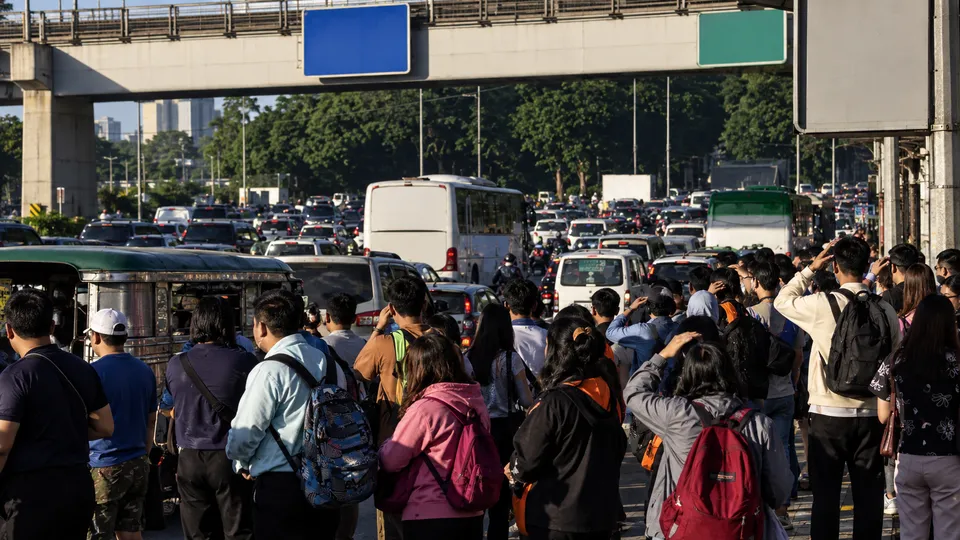
The logic of a transport strike is simple enough. Drivers stop driving, commuters can’t get to work, the city seizes up, and the government — which can feel the anger but not the fuel costs — is supposed to fold. Thousands of drivers of informal public transport vehicles in the Philippines began that experiment on Tuesday, walking off the job for two days in a strike organised by Piston, a transport workers’ union, over rising fuel prices that they blame on the US-Israel war on Iran.
The government, rather than negotiating, reached for the countermove: it deployed police officers and buses to help stranded commuters and offered free rides. This is worth pausing on, because it is the actual mechanism of the fight. A transport strike has no direct effect on fuel prices. Its entire leverage is commuter misery. If the state can absorb that misery with its own buses and free tickets, the strike stops being a threat and becomes a demonstration. The drivers are, in effect, competing with the government to be the ones who look after the public — except the drivers’ version involves not working, and the government’s costs it money it was going to spend anyway.
The strike was telegraphed well in advance. Philstar reported on September 22 that a major transport group had set a nationwide two-day strike for September 29 and 30 as fuel prices squeezed drivers’ earnings, and Inquirer.net confirmed the dates through Piston’s national president. The demands, per Balitang Marino’s report from the picket at Aurora Boulevard in Cubao, Quezon City, were lower fuel prices and — this is the slightly unavoidable part — a higher fare increase. Drivers who cannot control the price of diesel can at least ask to charge more for the ride. That is a coherent position, though it does mean the commuter pays either way: either in taxes for the free government buses, or in fares if the drivers win.
The causation here is also worth a sentence. The drivers blame a war thousands of kilometres away for their costs, and they are probably directionally right: informal transport workers buy fuel at world prices while charging fares set in pesos by local politics. Any supply shock lands on them first and hardest, because they have no contract that passes costs through automatically. The strike is, in that sense, a manual pass-through mechanism — an attempt to renegotiate the fare by withholding the service. It runs through Wednesday.