
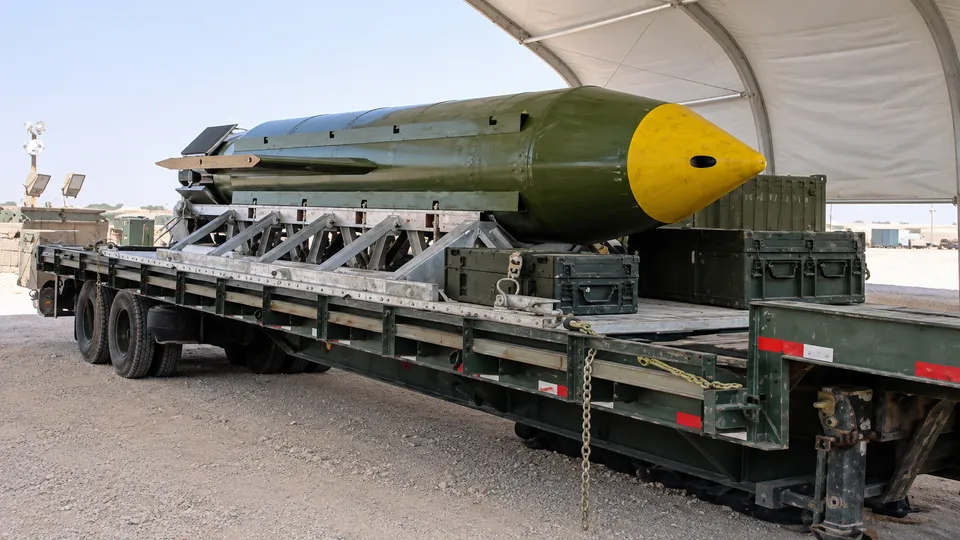
The GBU-43/B Massive Ordnance Air Blast bomb has been dropped in combat exactly once, on 13 April 2017, against an ISIS tunnel complex in Afghanistan. It killed 36 fighters, destroyed three tunnels, and caused no reported civilian casualties, according to Afghan officials cited at the time. Now, according to multiple US officials cited by CNN, the Pentagon has built the same weapon into strike plans for Iran, to be used against energy infrastructure and nuclear sites if President Donald Trump orders combat operations to resume.
The bomb weighs 21,600 pounds (9,798 kg), according to the Air Force Armament Museum, which holds a training unit. It carries 18,700 pounds of H6 explosive, a compound roughly 1.35 times more powerful than TNT by weight, and is steered by a GPS/INS guidance kit accurate to within a few meters. It has no penetrator casing. It is built to detonate a few feet above the ground, spreading blast overpressure across a wide radius rather than punching through anything. One of the five sources CNN quoted put it plainly: the MOAB is “a massive information operation type weapon,” good for “huge area clearance but not much else.” CNN reported the blast radius covers an area equivalent to roughly nine city blocks.
That distinction matters because of what the Pentagon’s plans reportedly target first: Pickaxe Mountain, a site Iran calls Kuh-e Kolang Gaz La, about 1.6 km south of the Natanz enrichment complex in Isfahan province. Satellite analysis cited by Al Jazeera puts the facility under at least 100 meters of granite, with two tunnel entrances reached by paved roads inside a security perimeter tied into the Natanz fence line. No IAEA inspector has been allowed inside. A second CNN source said strike plans for Iran’s nuclear sites, Pickaxe Mountain included, explicitly call for the MOAB. A third source called the weapon “definitely not designed as a deep penetration warhead,” and said Trump is “almost compelled to do something” given the lack of a munition that can reliably get through that much rock.
The weapon built for that job is the GBU-57A/B Massive Ordnance Penetrator, a 30,000-pound bunker-buster carried only by the B-2 Spirit, which punches into the ground before its warhead detonates. The US Air Force used it in the February 2026 strikes on Fordow and Natanz that opened the current war, and in late February awarded Boeing a $61.55 million contract, according to Army Recognition, to rebuild the stock the strikes used up; the contract covers tailkits, fuze hardware and shipping containers, with delivery running from September 2028 to May 2030. If 30,000 pounds of penetrator could not finish the job at Fordow and Natanz, the case for a 21,600-pound air-blast weapon succeeding against a target reportedly built to be harder than both is not obvious, and CNN’s sources did not make it; they raised doubts instead.
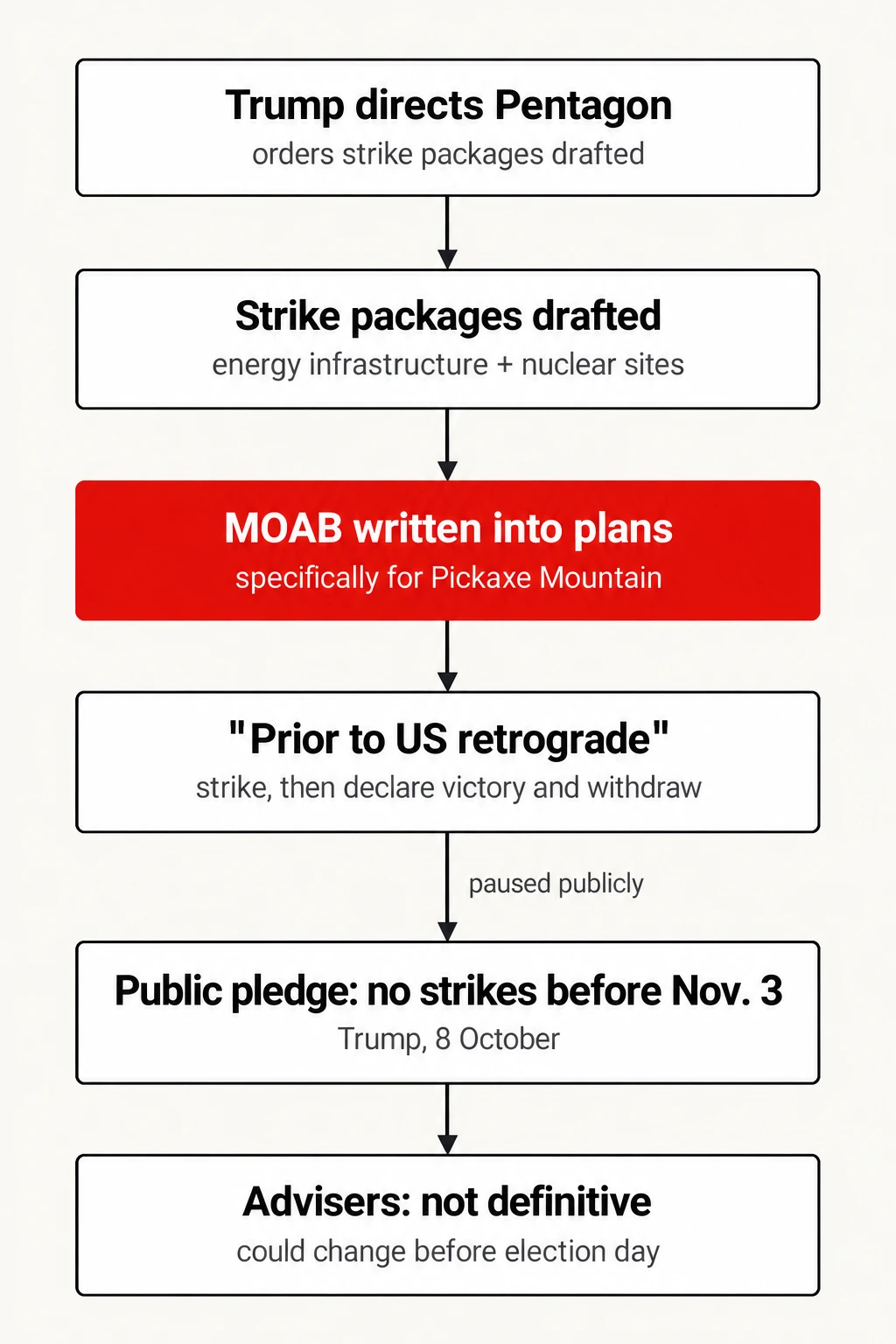
| From | To | How |
|---|---|---|
| Trump directs Pentagon (orders strike packages drafted) | Strike packages drafted (energy infrastructure + nuclear sites) | |
| Strike packages drafted (energy infrastructure + nuclear sites) | MOAB written into plans (specifically for Pickaxe Mountain) | |
| MOAB written into plans (specifically for Pickaxe Mountain) | "Prior to US retrograde" (strike, then declare victory and withdraw) | |
| "Prior to US retrograde" (strike, then declare victory and withdraw) | Public pledge: no strikes before Nov. 3 (Trump, 8 October) | paused publicly |
| Public pledge: no strikes before Nov. 3 (Trump, 8 October) | Advisers: not definitive (could change before election day) |
Based on CNN, citing US officials
CNN’s sources described the planning language for any renewed strike as calling for action “prior to US retrograde in CENTCOM AOR” — military shorthand for withdrawing forces from the US Central Command area of responsibility covering the Middle East. Read plainly, that means hit Iran once more, then pull troops out and let the administration call it a win. That timeline runs straight into Trump’s own public position. On 8 October he posted that the US “will not be attacking Iran at any time prior to the Midterm Elections” on 3 November, after Al Jazeera and others reported the Pentagon had been told to develop pre-election strike options. Several advisers told CNN privately they did not know whether that pledge was final or would hold past election day. A White House official, asked about the MOAB specifically, said only that Trump “keeps all options on the table to ensure that Iran can never have a nuclear weapon,” and that the administration does not comment on “sensitive military plans that may or may not exist.” A Pentagon official gave a similarly generic statement about planning for “a wide range of operational scenarios.”
Trump himself addressed the weapon on Newsmax, according to CNN, calling it “not nuclear at all” while also describing it as “like a tiny nuclear bomb,” and said the US has not had to use actual nuclear weapons because it has the MOAB instead. Both descriptions can’t be doing real work at once: the MOAB’s explosive yield, at roughly 11 tons of TNT equivalent from 18,700 pounds of H6, is a small fraction of even the smallest fielded US nuclear warhead, whose yields start in the hundreds of tons and run into kilotons. The comparison is the kind of psychological framing the weapon has always traded in — the Air Force’s own 2003 test assessment, per CNN’s sourcing, concluded the MOAB was conceived more as a psychological-operations weapon than a purely destructive one.

The war the MOAB would reenter has run for eight months with no settlement. It began in February 2026 with US and Israeli strikes on Iran’s nuclear program, has included a US naval blockade on Iranian oil exports through the Strait of Hormuz, and has drawn in a third US aircraft carrier, as reported this month. Diplomacy has gone nowhere: Washington’s own offer to sell Iran enriched uranium rather than let it enrich domestically was rejected by Tehran. A White House official told CNBC the administration considers Iran’s economy “collapsing” under the blockade, a characterization Iran disputes; CNN’s sources described an administration looking for an “off-ramp,” including a possible deal to reopen the strait, while simultaneously drafting the plans for a harder hit if that off-ramp doesn’t materialize.
What CNN’s reporting does not resolve is whether the MOAB option is a real military plan or a card being kept visible in case Tehran needs reminding what else is on the table. The Pentagon drafts a “menu” of options from low-end to high-end for every contingency, one official told CNN, and the MOAB sits at the high end by default because it is the biggest thing in the inventory, not because the people planning the strike think it can crack Pickaxe Mountain’s granite. Whether Trump orders any of it hangs on a pledge he has already shown he can revise, and on what happens to that pledge once 3 November has passed.