
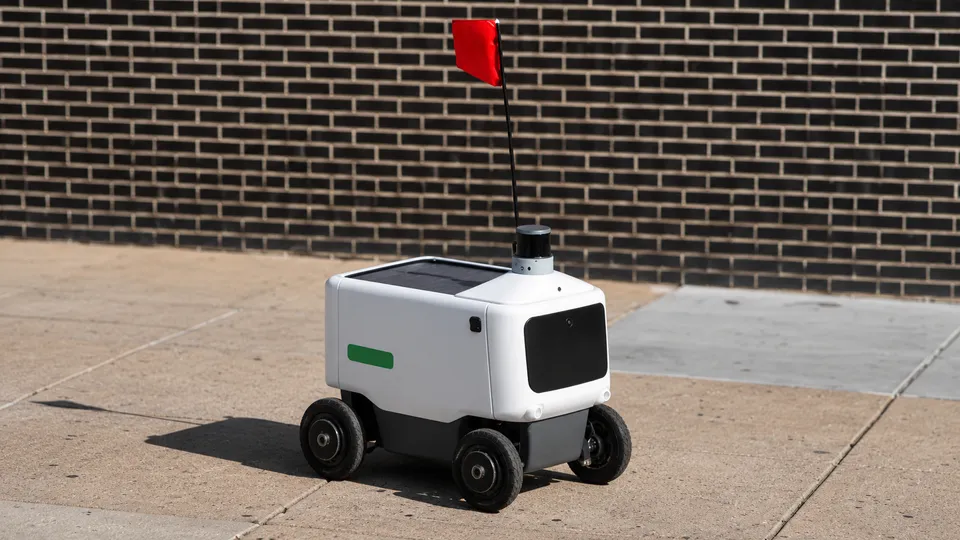
Under a law Pennsylvania passed in 2020, an autonomous delivery robot — what Act 106 of 2020 calls a “personal delivery device,” a class of machine that can weigh up to 550 pounds before cargo — is legally a pedestrian, not a vehicle. Cars must yield to it in a crosswalk as they would to a person. On October 14, a 78-year-old retired University of Pennsylvania communications professor named Carolyn Marvin stood in front of one on a Philadelphia sidewalk, as she had done many times before, and this time she left in handcuffs with a citation for disorderly conduct, as CNN reported.
Marvin’s protest is low-cost by design. When she crosses paths with one of the wheeled food-delivery robots Uber Eats launched in Philadelphia in March — the fourth city to get the fleet — she stands in front of it and moves when it moves, delaying it for 10 or 15 minutes when it is, in her words, “convenient and possible.” “I have a life, so I don’t have tons of time to stand in front of robots,” she said. The total damage she assigns to her own campaign: an office worker’s lunch bowl “might be delayed for about 15 minutes at the most.”
The arrest
On the 14th, walking home from a flu shot with a jar of enchilada sauce in one hand and chicken biryani takeout in the other, Marvin stopped in front of a robot in a busy part of the city. A larger-than-normal crowd gathered, some supportive, some critical. She suspects someone in it called the police. Officers handcuffed her, put her in a squad car and cited her for disorderly conduct.
The Philadelphia police account differs on one number that matters: how many chances she got. The department said officers responded to a report of “criminal mischief involving a delivery robot” and “encountered a female who was refusing to allow a delivery robot to pass.” “Police issued multiple commands directing the female to move; however, she refused to comply.” Marvin had assumed arrest was off the table because, as she put it, “I wasn’t impeding any persons. I was impeding a machine.” The 2020 statute is roughly the reason that assumption is now wrong. A friend of hers summarized the result: “Well, you got a disorderly conduct charge for impeding capitalism.”
What the law actually does
The pedestrian classification cuts both ways, and Marvin’s case sits on the cut. Vehicles must yield to a personal delivery device in a crosswalk, said John Mattiacci, a Philadelphia personal injury attorney. But humans still sit at the top of the hierarchy in theory: “Personal delivery devices must yield to other pedestrians and pedalcyclists in a pedestrian area,” Mattiacci said. So the statute officially ranks a 550-pound robot below a walking person, while in practice the walking person blocking one gets cited for disorderly conduct. The police did not charge her under the delivery-device statute; they did not need to.
The bill’s path through Harrisburg tracked a familiar split. Democrats, labor unions and accessibility advocates largely opposed it, arguing that legalizing sidewalk robots could kill delivery jobs and endanger children and pedestrians. Republicans backed it as a technological step forward. The machines that arrived in Philadelphia five-plus years later have not been universally welcomed: videos from Philadelphia and elsewhere show people sitting on them, kicking them and vandalizing them. Uber Eats did not respond to CNN’s request for comment.
The argument she’s making
Marvin lists three concrete objections to the robots: they displace low-income delivery workers, they are a physical hazard on the sidewalk, and their embedded cameras raise privacy concerns. On top of those sits a constitutional claim she is explicit about: “I also think that I have a First Amendment right to protest the abuses of corporations in public space, in the same public space that the robots are occupying.”
Her protest history runs through civil rights, abortion rights, Black Lives Matter, and the Gulf and Vietnam wars, and she frames the robot blocking as the same practice in a new venue: “It’s what we need to do to make sure the government hears the will of the people.” She says standing in front of the robots reliably produces conversations with passersby, most supportive or curious — the robots, unlike social-media algorithms or AI adoption, are a visible, physical instance of the machinery she objects to. Her protest “makes it visible to people and presents the issue in a way that it might not otherwise be presented.”
“There’s a way in which we’ve surrendered the streets to cars long ago, and I don’t think we should surrender the sidewalks to machines,” she said. “Machines in general encroach on our lives. Public space is the most visible place where they’re encroaching on our lives, but they’re going right up the ladder, and lots of people are interested in making that happen.” Asked whether she will resume blocking robots after the arrest, her answer was “Oh yeah.” The one operational change: she’ll watch for the police.
The next number to watch is the citation itself — what a Philadelphia court does with a disorderly conduct charge whose underlying act was delaying a delivery by, at most, 15 minutes.