
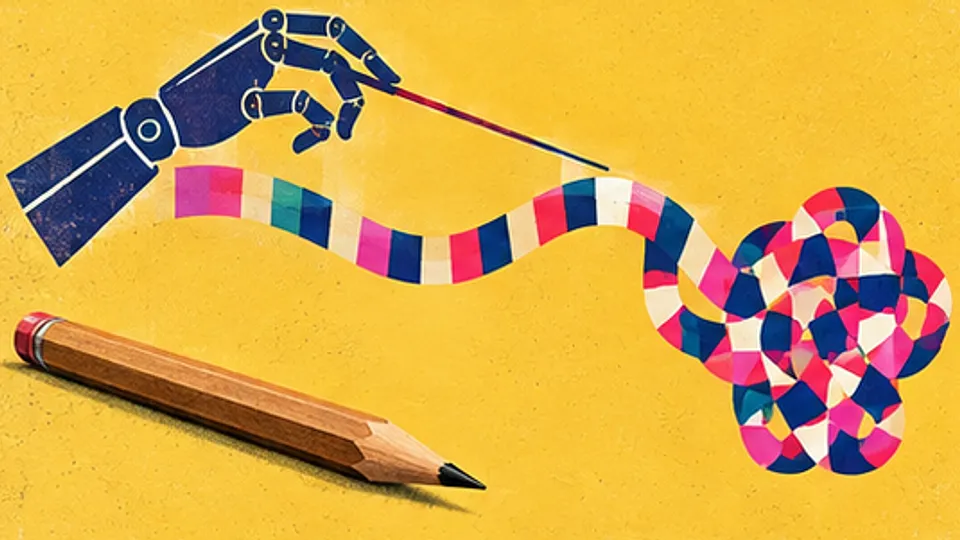
It is a little like Stradivari declaring that, from now on, the robots will carve the violins. David Heinemeier Hansson—DHH to the software world, and the creator of Ruby on Rails, the framework beneath countless web applications—has decreed that his software company will no longer write code by hand. “We are going, and have gone, pencils down,” he told the audience during his keynote at Rails World, the framework’s own conference, Business Insider reports.
The rule at 37signals, the firm he runs, is that writing code by hand is now an “exceptional state”, reserved for when the artificial-intelligence agents fall short. If a machine cannot produce what an engineer wants, a human may “get the old pencil out and dot it down for them”, as Mr Hansson put it—but after that, they “fix the machine”. The policy, he said, is a recognition of what is already happening.
He has a point about the speed of it. Coding has been upended in the past year by AI tools such as OpenAI’s Codex, Anthropic’s Claude Code and Cursor, which generate working software from plain-language prompts. Among developers the response is split: some find the agents exhilarating and stay up into the night building with them; others describe AI coding as lonely or tiresome.
A poll of more than 150 software engineers by Business Insider in January captures the ambivalence. Over 45% of respondents felt they were “keeping up” with AI tools; 17.5% were opting out of AI code-editing tools entirely. The rest, presumably, were muddling through with the machines somewhere between partner and nuisance.
Mr Hansson, never one to downplay a conviction, insists there is only one “serious question” in this moment for the craft: how best to reap the rewards of AI. “Every other question is below that in the stack of values,” he said. Asking the Rails World crowd how many still wrote material amounts of code by hand each week, he surveyed the raised hands, let out an expletive, and counted: “That’s about five.”
Whether the rest of the industry follows as gleefully is another matter. Programmers tend to listen to the man who built their tools; but many of them like the pencil, and some of them are better with it than the machine will ever be. The coming years will show who was making a virtue of inevitability, and who was simply keeping their edge.