
The sale takes place in a crowded hall in the offices of the Panjshir provincial government, and the bidding moves fast. Before it starts, the buyers bend over small heaps of roughly cut green stone and shine their phone flashlights through each piece to judge its quality. Most of them have come up from Kabul. A few have come from abroad.
This was the 23rd auction of its kind in Panjshir this year, as Rob McBride reported for Al Jazeera. Close to 3,000 carats were sold. Officials value the emerald sales so far at nearly 400m afghanis, about $6.12m, which is well above last year’s figure.
So the product leaves the valley in carats and afghanis, counted, taxed and announced. It comes out of the rock by other means.
The hall
The merchants have no doubts about what they are buying. Ghulam Mustafa Habibi, a gem trader, said Panjshir emeralds “have many buyers around the world because of their very high quality”, and that this makes them dearer than emeralds from other places.
The auctions are frequent and closely tracked. In January, according to Hasht-e Subh, Taliban officials in the province said 4,177 carats had been sold for more than $47,000. In June the same outlet reported the authorities’ claim that 19,846 carats had been extracted and sold since the start of the year, for a total of $424,220. Local officials said then that the province had 600 mining sites and that 10 percent of the sales revenue went to the Taliban treasury. In late August, the governor’s spokesman Saifuddin Laton announced that 3,842 carats in 22 lots had been sold to Afghan traders for nearly 33m afghanis. The news agency Pajhwok reported that more than 100 young people from Panjshir took part in that auction, some of them new to the trade.
These figures come in dollars at one moment and in afghanis at the next. They cover different periods and they are hard to add up. The one constant is who does the announcing.
The treasury
Since taking power in 2021, the Taliban say they have signed agreements with dozens of investors to mine gemstones and other minerals, most of them Chinese, Russian and Iranian. The World Bank found that state revenues rose 22 percent year on year in April and May, and it counted auctions of mines and resources among the reasons.
Here is a reflection, not a finding: a government shut out of much of the world’s banking soon learns that the ground is a creditor that does not ask questions. The stones need no recognition. They only need a buyer with a flashlight.
Not everyone is satisfied with the arrangement. Critics quoted by Hasht-e Subh say mining since the Taliban’s return has had no independent oversight, no financial transparency and no environmental safeguards. The outlet also reports repeated clashes over mining sites, some among Taliban fighters and some between the Taliban and local residents. Dealers who win at auction, it says, get their stones only after they pay the 10 percent levy.
Underground
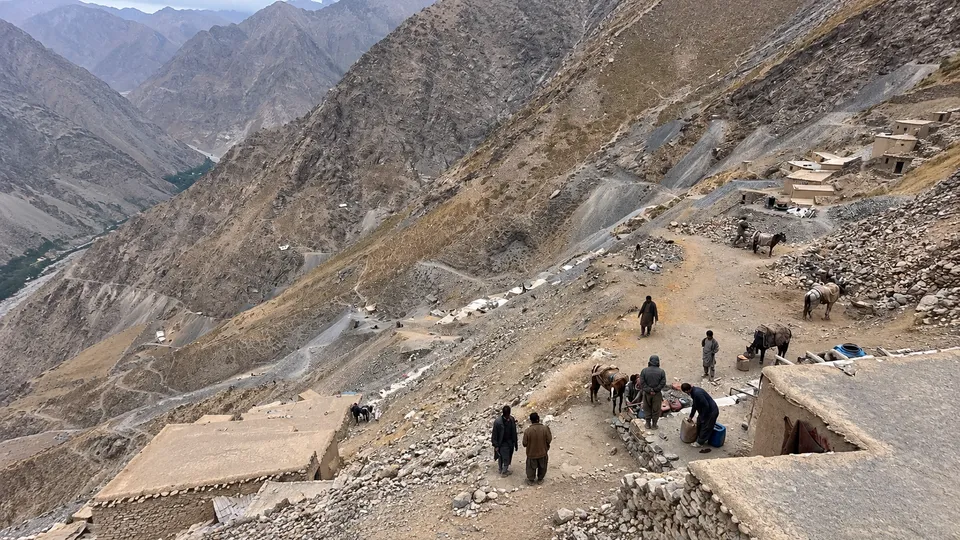
The hall has electric light. The mine where a miner named Mahdi works is almost dark, and his tools are a crowbar and a hammer.
We work only with basic tools such as shovels, pickaxes, drills and similar equipment.
Muhammad Aman Rezaii, a mining official, said that “more than 15,000 people are currently employed in Panjshir’s mining sector”. He has asked for better equipment so the work can be safer and more efficient. He also listed the risks the miners already face in the steep valleys: landslides, avalanches, floods and falling rock. According to officials, more than 2,000 further potential mining sites have been identified.
That means two thousand more seams to be worked, by the reported count, with the same shovels.
No cutting room
Between the dark of the mine and the bright hall, there is nothing else. The sector still lacks international investment and expertise. Panjshir’s governor, Hafiz Muhammad Agha Hakim, mentioned proposals for an international gem market in Kabul. Then he described how things stand now: “At the moment, there is no standardised centre or proper processing facility.”
So the emeralds leave Panjshir as they came out of the rock, roughly cut and checked by phone light. In the valley, the value of a stone is measured once, at the moment of sale, in a government office. The men who cut it out of the mountain are not part of that count.