
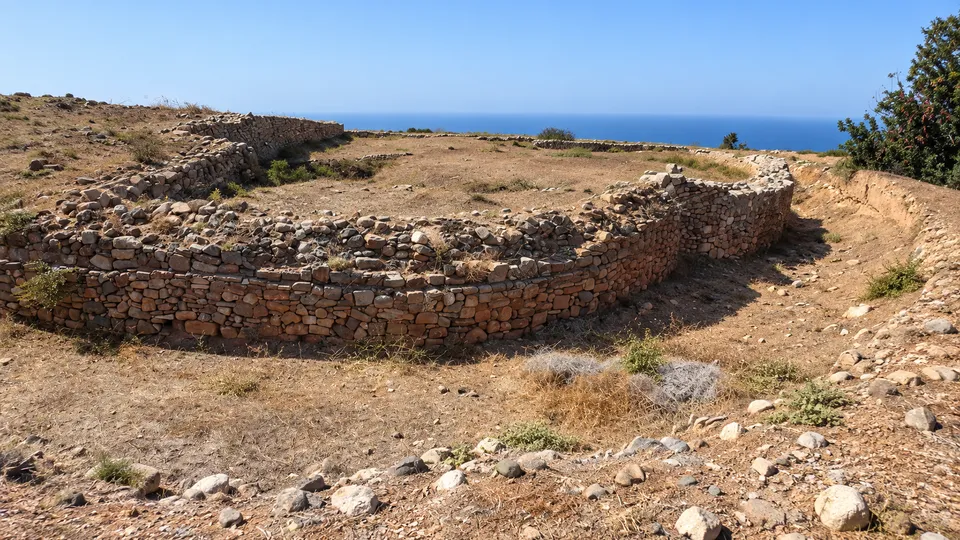
The ancient city of Palaepaphos in Cyprus now has its first confirmed Late Bronze Age fortification system, more than 3,000 years old. The date comes not from a dramatic find but from a layer of pottery in an undisturbed deposit and a smear of marl, the construction material that tied the ceramic chronology to a defensive wall’s stone foundations. As Arkeonews reported, the discovery was made at Marchello, near the modern village of Kouklia, during the 2026 excavation season — August and September — run by the National and Kapodistrian University of Athens under Professor Konstantinos Kopanias.
The dating problem
Marchello lies less than one kilometre northeast of the Sanctuary of Aphrodite at Palaepaphos, one of the most important religious centres of ancient Cyprus. British, German-Swiss and University of Cyprus teams had excavated there before, and had turned up an extensive rampart, a monumental gateway and other substantial remains. What nobody had established was when the earliest defences were built, or how the structures related to each other in time. Decades of digging, no firm start date.
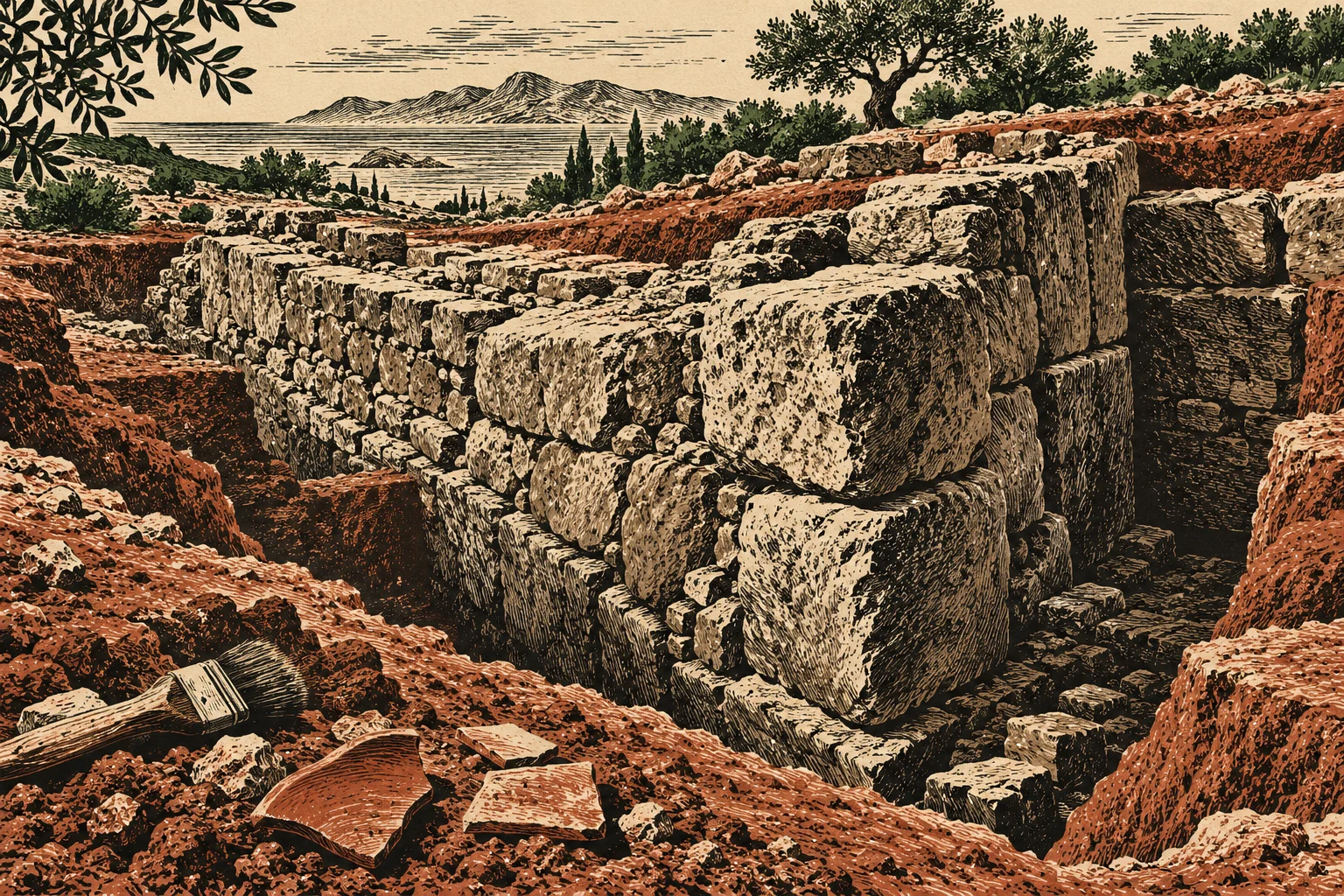
The 2026 season provided one. The evidence points to the original rampart belonging to the Late Cypriot IIC–IIIA period, toward the end of the Late Bronze Age. Beside a newly exposed section of the defensive wall, the team found an undisturbed deposit containing pottery from that period, with a concentration of marl on its surface. Marl, in this context, is a prepared building material: it had been spread over the stone foundations to create a level bed for the mudbrick superstructure above. Because the marl sits with the period pottery and directly on the wall’s foundations, it anchors the earliest construction phase of the wall to the same horizon as the ceramics. This is the standard stratigraphic logic of tells and ramparts — date the sealed layer, and you date what the layer touches — but it only works if the deposit is undisturbed, which this one was.
How a bastion became a tower
The season’s main architectural result is a reconstruction of how the defences grew. In Late Cypriot IIIA, builders added a rectangular bastion projecting out from the defensive wall. A bastion, in fortification terms, is a projection that lets defenders fire along the face of the wall rather than only outward. That bastion was then enlarged with a three-sided extension, and the two elements together formed an almost square tower of about 7.4 by 7.3 metres, with thick walls around an internal chamber of roughly nine square metres.
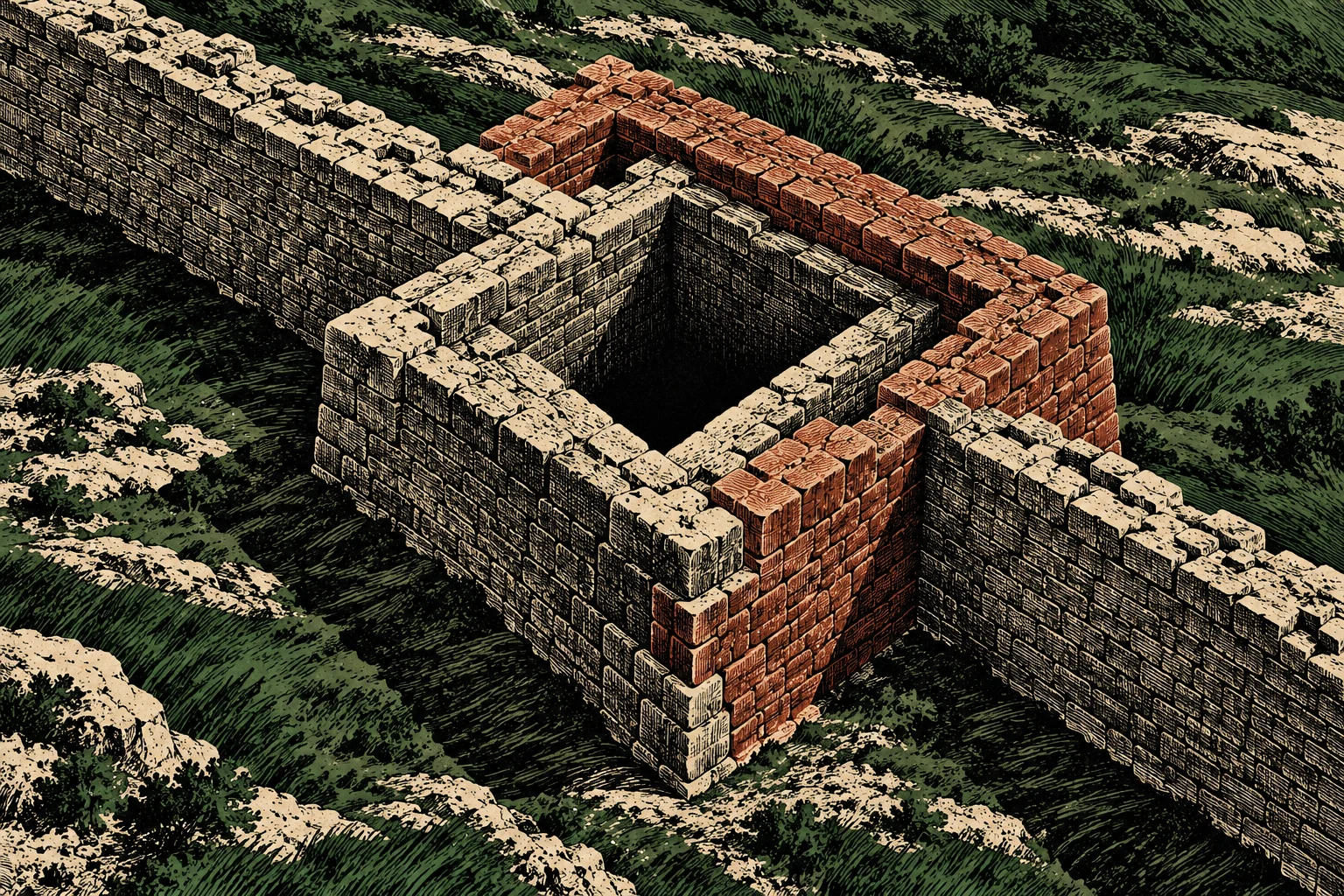
The dimensions, wall thickness and enclosed chamber are the basis for reading it as a defensive tower, possibly one that carried upper levels. Only the foundations survive, so the original height is unknown and probably unknowable from this evidence. A further reinforcement — a wall about 2.7 metres thick added along the tower’s northwestern side — followed, probably still within the same Late Bronze Age phase. The sequence matters more than any single wall: Palaepaphos’s defences were not one construction project but a series of campaigns, each responding to the last.
Eight centuries later, more walls
The complex kept changing long after the Bronze Age ended. In the fourth century BC, the Late Cypro-Classical period, another reinforcing wall was added along the tower’s northeastern and southeastern sides; pottery from the foundation trench dates that intervention. The main rampart was also widened in a later phase, possibly within the same Cypro-Classical period.
Between those two ends lies a gap the excavation could not close. The Athens University team found no securely dated Cypro-Geometric or Cypro-Archaic construction phases in the excavated area. That is the span from roughly the eleventh century BC to the sixth, the centuries between the Bronze Age rampart and the fourth-century reinforcements. Two readings are possible: the fortifications stayed in continuous use and simply saw no new building in that window, or they fell out of use and were revived centuries later. Absence of construction is not absence of use — a wall that still works needs no rebuilding — but the record as it stands cannot distinguish the two.
What the season does establish is the baseline fact: monumental defensive architecture existed at Palaepaphos by the end of the Late Bronze Age, at one of the major settlements of ancient Cyprus. Further study of the excavated material is expected to refine the sequence of construction phases. After digging ended, the exposed remains were covered with protective ground-cover fabric to limit deterioration until work resumes — the standard measure, since exposed mudbrick and marl survive millennia underground better than they survive a single wet season in the open.
The next number to watch is whether the gaps fill in. If Geometric or Archaic material turns up in adjacent sections of the rampart, the fortification line becomes one of the longest continuously maintained defensive systems known on the island; if it does not, Palaepaphos abandoned and re-walled its defences at least once, and the question becomes what, in the fourth century BC, made the city worth fortifying again.