
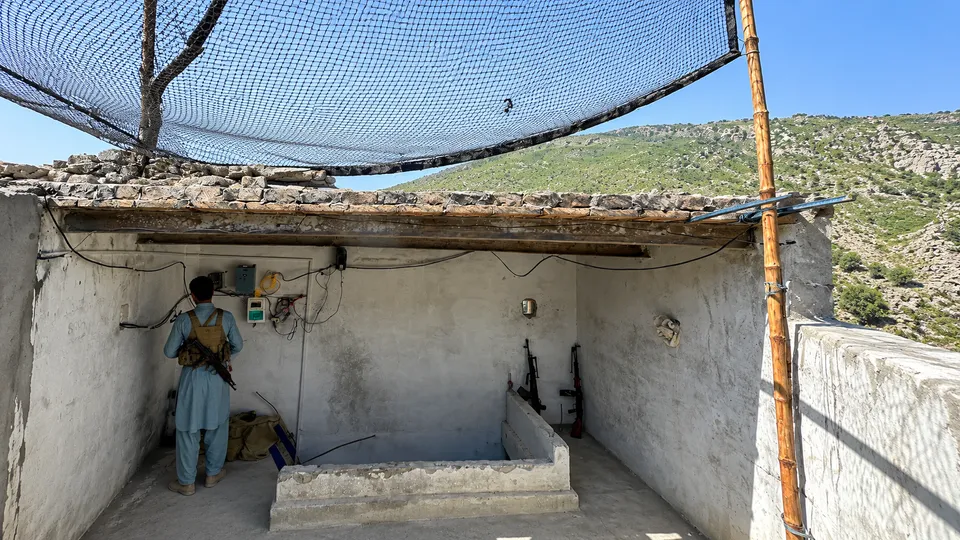
There is a well-known dynamic in military technology where a cheap weapon forces an expensive countermeasure, and the side using the cheap weapon wins on economics even when it loses on the day. The classic modern example is a $500 drone destroying a multimillion-dollar tank, or a million-dollar interceptor missile being fired at a $20,000 drone. Northwest Pakistan has come up with a version of this that runs in the other direction: the weapon is a drone dropping explosives on a police checkpost, and the countermeasure is fishing nets strung several metres overhead. The countermeasure appears to be cheaper than the weapon, which almost never happens, and is in its way a small masterpiece of fiscal realism.
Al Jazeera reports that police in Khyber Pakhtunkhwa province have begun installing the netting over security outposts in areas prone to attacks by armed groups, chief among them Tehreek-e-Taliban Pakistan, the TTP — the Pakistan Taliban. The idea is simple enough to describe in one sentence, because it is one sentence of technology: a drone carrying explosives arrives above the checkpost, and instead of the payload landing on the roof, it snags in a net. No radar, no jammer, no interceptor. Just mesh.
The reason police are bothering is that drones have moved from novelty to routine hazard. Officer Fayyaz Khan and his colleagues ducked for cover as explosive-carrying drones attacked their post earlier this year, Al Jazeera reports. The April 16 attack on the Sarki Piyala police checkpost in Hangu district was claimed by the TTP, whose fighters then opened fire from all sides — the drone strike acting, in effect, as the opening barrage for a conventional assault. Sarki Piyala sits about 30km (18 miles) from the Afghan border, in what Al Jazeera describes as a hotbed of deadly attacks by armed groups, mainly the TTP. If that is what the drones are for — softening up a position before the men with rifles arrive — then keeping them from landing their payloads cleanly is not a marginal gain.
The scale of the problem is bigger than one checkpost. Militants have carried out at least 182 drone attacks against Pakistani security forces in Khyber Pakhtunkhwa over the past 18 months, according to provincial authorities cited by Khaama Press — a pace of roughly ten a month, and a sign of how thoroughly commercially available drone technology has filtered down to an insurgency. The TTP has also grown more ambitious overall: in March it claimed 31 attacks across the province in a single 24-hour period under a campaign it called “Operation Khyber”, Republic World reported.
What is striking about the nets is what they say about procurement. The wealthy-country answer to small drones is a layered air-defence architecture: detection, electronic warfare, kinetic interceptors, integration, contractors. The answer available to a district police force in Hangu is whatever the hardware shop sells. And so the state’s forward line against an increasingly air-capable insurgency is, in places, literally the same product used to catch tilapia. Both approaches can be rational given the budgets involved, but only one of them tells you exactly how thin the budget is.
Nets will not stop a determined, well-aimed attack, and they do nothing about the rifles. But they are cheap, quick to hang, and aimed squarely at the most likely threat, which is a drone hovering overhead trying to drop something. Insurgents adapt, countermeasures iterate, and somewhere an engineer is presumably working on a better drone. Until then: netting.