
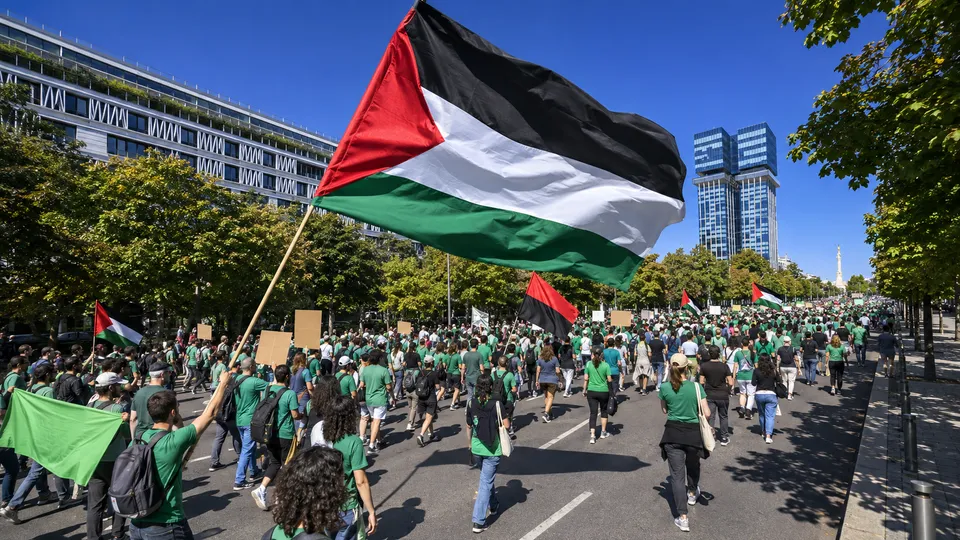
This autumn Europeans have gone into the streets over things close to home: rent, schools, the cost of living. Over these local grievances, as Peyman Pejman reported for Al Jazeera, the same flag keeps appearing. It belongs to a country that is not theirs. Next to it is the keffiyeh, the chequered Palestinian scarf. The flag has turned up even in Northern Ireland, where a standoff decades old threatened to revive historic grievances.
A flag is cheap to carry. What it means depends on who holds it, and this autumn the people holding it disagree about that.
Puerta del Sol
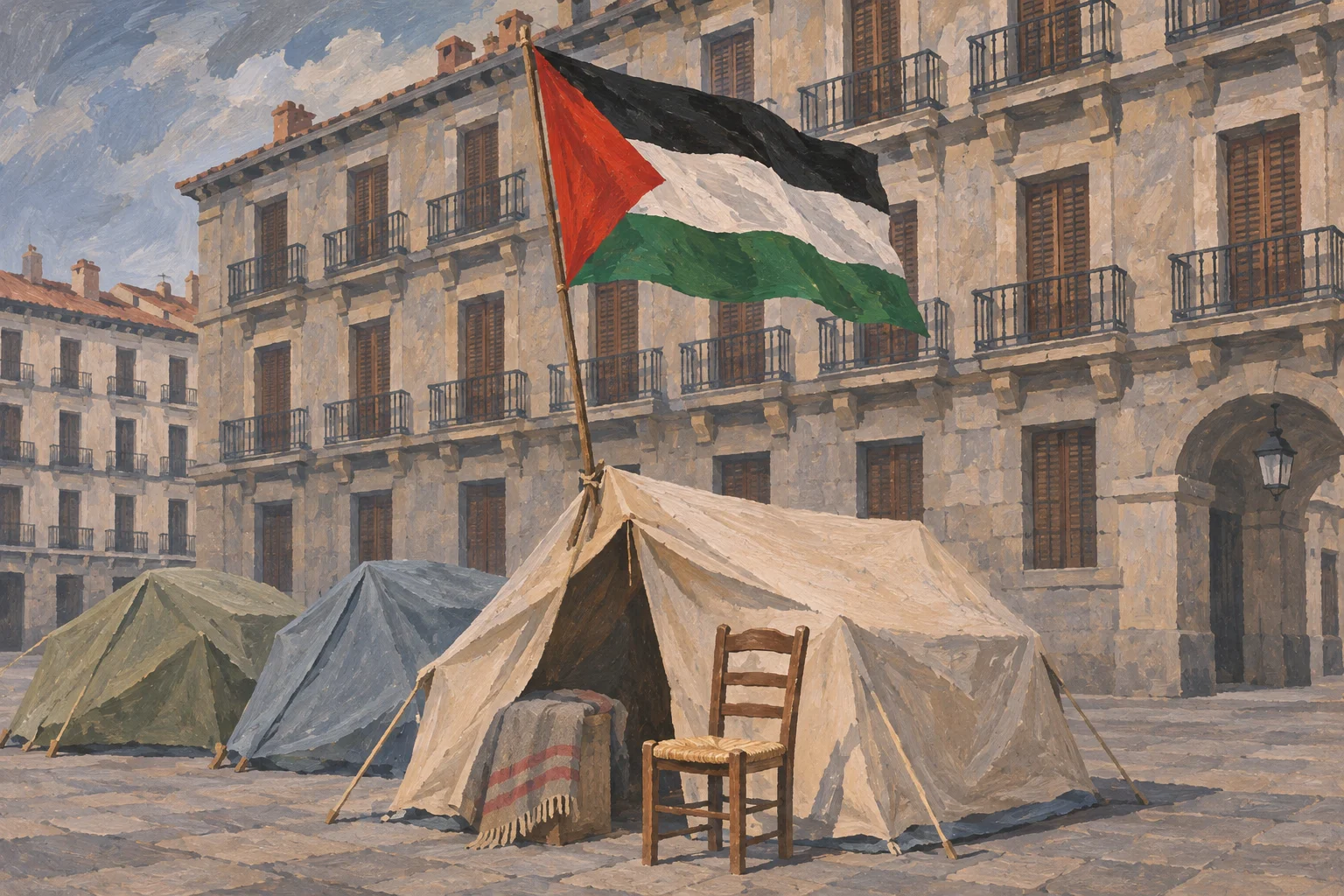
On 28 September a Palestinian flag flew over the protest camp in Puerta del Sol, the square at the heart of Madrid. The camp was about housing, and in particular about one woman. Maricarmen Abascal was 87 and disabled, and she had lived in her flat for more than 70 years. An investment fund bought the building and raised her rent by more than 300 percent. Three earlier attempts to evict her had been stopped and the United Nations had intervened, but the courts let the eviction go ahead anyway. When it came, eldiario.es reported, it took a huge police operation and went ahead despite pressure from her neighbours. About two weeks later, in early October, she died. By then she had become a symbol of the fight against evictions.
So the camp had an old woman, an investment fund and a court order. Above the tents flew the flag of Gaza.
On 15 October students and education workers marched through Madrid on the second day of an indefinite education strike called by the sector’s unions. Spain has seen this symbol on its own leaders before. In 2006 the Socialist prime minister, José Luis Rodríguez Zapatero, briefly wore a keffiyeh after a young Palestinian reportedly put it on him.
The crossroad
In Brussels, Kenny Pierre Agboton of the Free University of Brussels for Palestine platform sees the flag as a reference to struggles against colonialism and repression. His group coordinates with other Belgian university associations, and at national demonstrations it usually gives out “one flag to each association”. To him the political choice is simple: education rather than “giving arms to the military”. The Palestinian question, he said, “becomes the crossroad for every fight we have, at least in Western Europe.”
In France the protests began in the schools. High school students, supported by university and teachers’ groups, unions and some politicians, want cheaper and better education, renovated buildings, smaller classes and more teachers. On 3 November in Paris, students faced police at a demonstration the authorities had banned. These are the same weeks of French anger that had already brought violence.
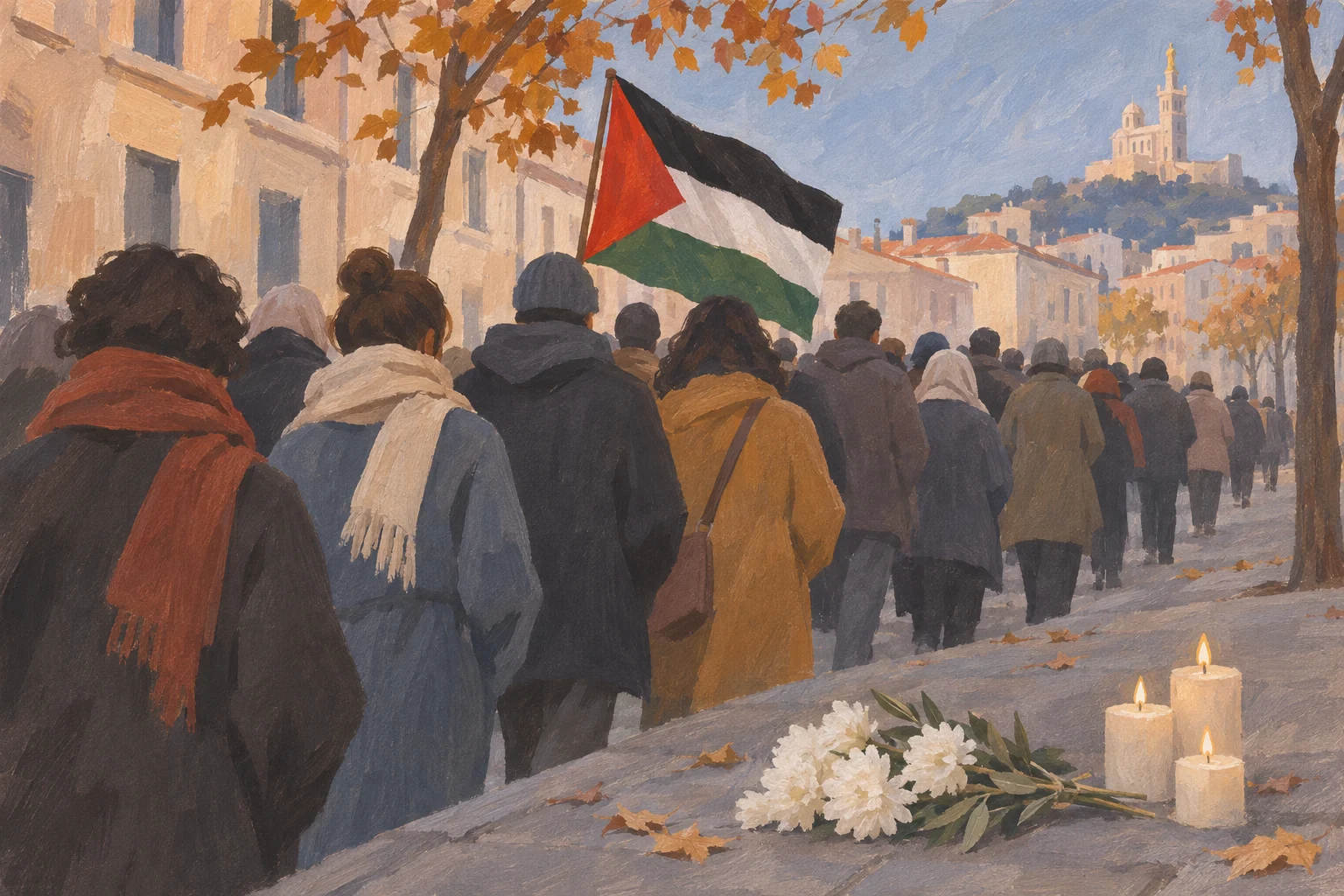
On 26 October the flag was raised in Marseille at a silent march for the victims of a racist attack. Three days earlier, on 23 October, a gunman had fired from a car in Trappes and La Verrière, in the Yvelines. One person was killed and several were wounded, among them a 12-year-old girl. The count compiled from French reporting gives one dead and seven injured. The suspect, Kévin T., 39, has been charged in a terrorism investigation. He has told investigators that he chose his victims, and of Trappes he said it was, in his own words, “a den of Islamists”. He remains presumed innocent.
Alice Cohen-Morzadec, spokesperson for the French Student Union, says the flag stands for daily hardship in the West Bank and Gaza and for inequality across the world. She said the students are confronting “a global system that is organising attacks on our rights”, part of “a broader movement against world capitalism and colonialism system.”
The symbol has done this sort of work before. In Algiers on 18 May 1990, at a meeting held in his honour by the National Union of Algerian Youths, Nelson Mandela wore a keffiyeh.
Mario Furore, an Italian MEP from the Five Star Movement who sits with The Left group in the European Parliament, doesn’t see why anyone should object. “What’s wrong with a citizen taking to the streets with a Palestinian flag?” he asked. He pointed to the genocide accusations against Israel over Gaza and to the continuing killings in the West Bank, and he warned against “relativising everything”. Since 7 October 2023, he said, Israeli operations have killed tens of thousands of Palestinians, “nearly 80,000 according to some estimates.”
Tirana
In Albania the flag has struggled to catch on. Fatos Lubonja is a writer who spent 17 years in prison under communism. He says he is one of the few people who have carried the flag or worn the keffiyeh at the anti-corruption protests of the past four months, the same protests that have turned violent. He explains why it doesn’t catch on. Some Albanians link the Palestinian cause with Muslims, and Muslims with the Ottomans who once occupied the country. The national story is one of returning to Europe, of turning West and wanting NATO. That history makes Albanians strongly pro-American, and in his view being pro-American implies being pro-Israel.
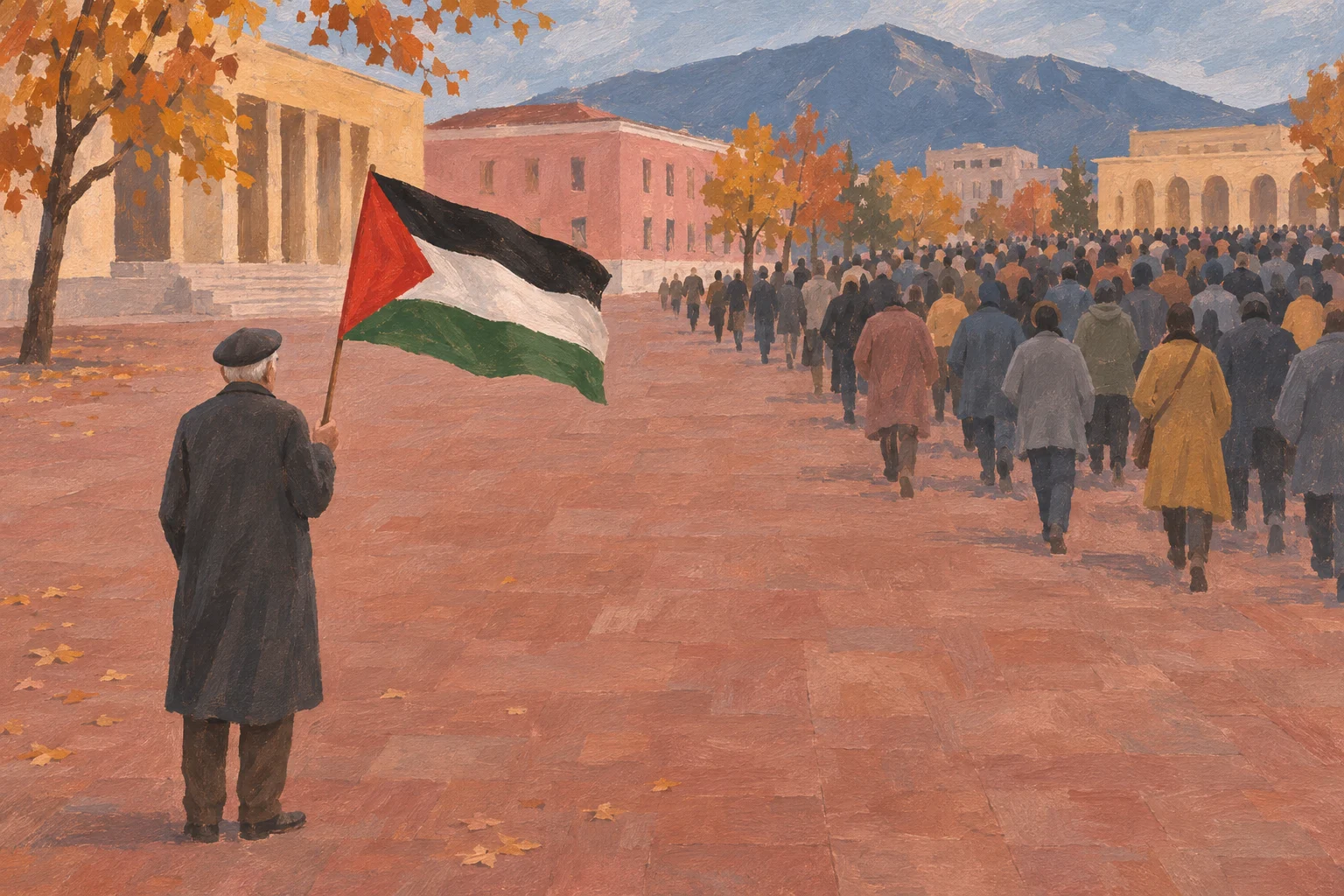
Here is a paradox, offered as reflection: a man jailed for 17 years by a regime that claimed to speak for the oppressed now finds himself almost alone in carrying the flag of a people the world calls oppressed.
On its own terms
Some of the strongest objections come from people who know Palestine best. In October the Palestinian writer and researcher Waddah Abu Jamea wrote in Al Majalla that he felt uneasy watching the flag’s meaning get lost among other agendas: identity, immigration, religion, security. Palestinians, he wrote, are expected “to condemn the thief while thanking the student or academic who raises their flag.” The flag reaches European universities while Gaza’s schools lie destroyed. It flies in Paris while Palestinians in the West Bank cannot carry it freely.
On 18 October, during the olive harvest, the journalist Janine di Giovanni wrote on Facebook from the West Bank. She lives in Paris, has worked in Palestine for more than 30 years and heads The Reckoning Project, which documents war crimes. The violence there, she wrote, is daily. Her message to French protesters was direct: “please don’t link your struggle to Palestine.”
Her reasoning was that the two causes are different. Palestinians are asking for the most basic right, to live safely on their own land. Merging that with French school reform blurs it, she argued, and gives critics an excuse to dismiss both. She told the protesters to fight for their future and to let Palestine’s story be told on its own terms.