
OpenAI’s GPT-6 Astra, GPT-6.1 Sol and GPT-6 Luna begin rolling out in private preview on Google Cloud’s Model Garden as of October 21, 2026, according to Google Cloud’s own announcement, with general availability promised only as “in the coming weeks.” The deal, also confirmed in OpenAI’s own post and first reported for a general audience by Ars Technica’s Ryan Whitwam, makes Google the third of the three big US hyperscalers to sell OpenAI’s frontier models directly to its cloud customers, after Microsoft Azure, which OpenAI still calls its “primary cloud partner,” and Amazon Web Services, which got there first.
Model Garden is Google Cloud’s catalog-and-billing layer sitting on top of more than 200 models, Google says: its own Gemini line, Anthropic’s Claude, and open weights like Llama, Mistral and Gemma. Adding GPT-6 changes none of the underlying compute; OpenAI’s models still run on OpenAI’s infrastructure. What changes is procurement. Michael Gerstenhaber, Google Cloud’s VP of product management for Gemini, writes on the company’s blog that OpenAI usage will be “transacted directly through Google Cloud Marketplace,” appear on a single Google Cloud invoice, draw down a customer’s existing Google Cloud spend commitment, and count toward Google’s cross-provider Flexible Savings Plans. For a company that has already budgeted cloud spend with Google, buying a GPT-6 token now costs nothing extra in contracting friction: it is accounted for exactly like a Gemini call. Google’s own Gemini 4 Argon, announced three weeks earlier, sits in the same garden.
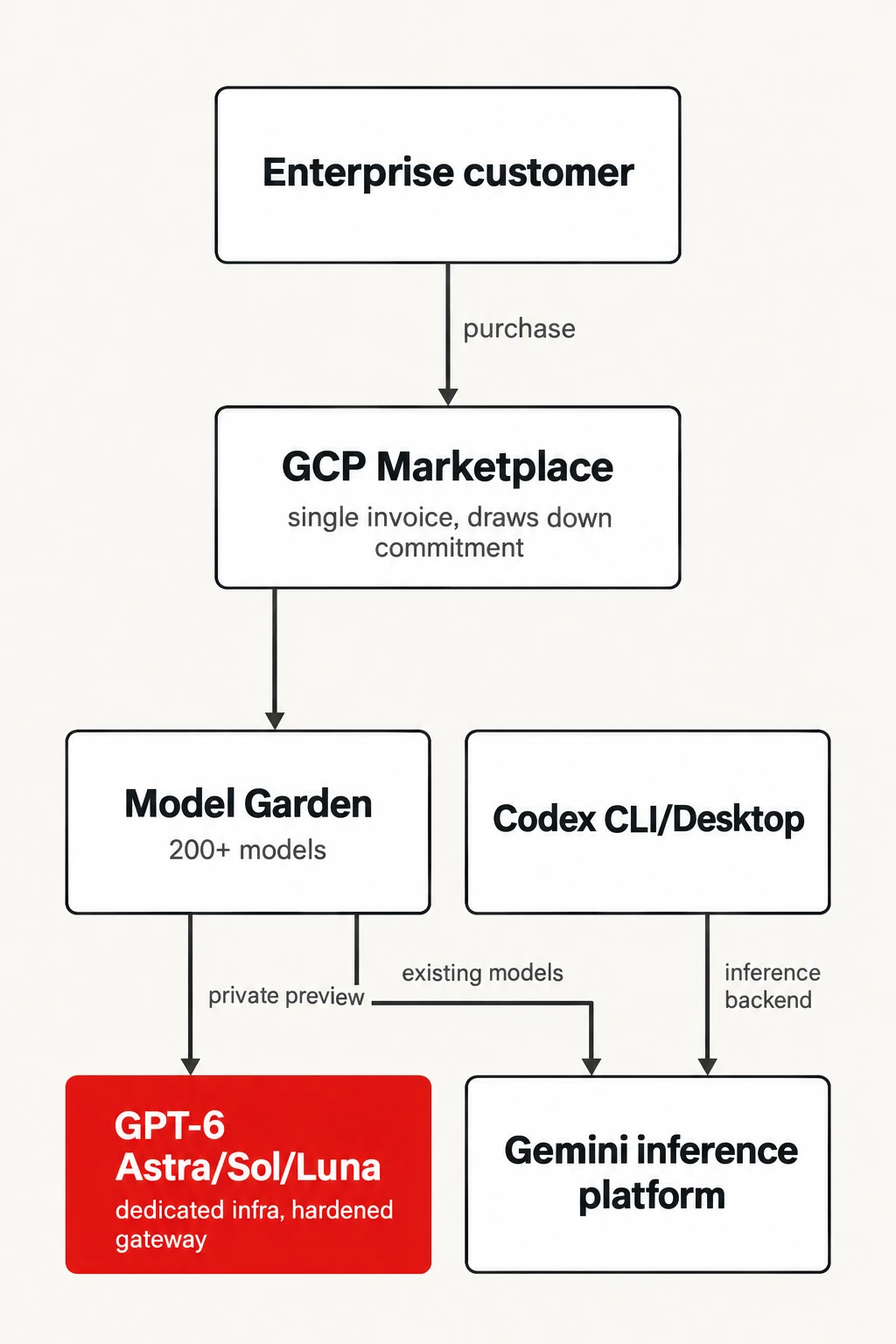
| From | To | How |
|---|---|---|
| Enterprise customer | GCP Marketplace (single invoice, draws down commitment) | purchase |
| GCP Marketplace (single invoice, draws down commitment) | Model Garden (200+ models) | |
| Model Garden (200+ models) | GPT-6 Astra/Sol/Luna (dedicated infra, hardened gateway) | private preview |
| Model Garden (200+ models) | Gemini inference platform | existing models |
| Codex CLI/Desktop | Gemini inference platform | inference backend |
Based on Google Cloud
Google is late, not first. Amazon’s Bedrock service made GPT-6 Astra generally available on September 8, 2026, with a 1,050,000-token context window, a 128,000-token maximum output, and an “Ultrafast” speed tier OpenAI says runs up to six times faster than Astra’s standard tier, according to AWS’s own announcement. Sol and Luna followed on Bedrock on September 28, both also carrying the million-token context window and, per AWS, priced well below the GPT-5.6 models they replace, though neither AWS nor Google published a per-token price in the announcements reviewed here. Google’s private preview lands six weeks after AWS’s general availability, and Google has not committed to a GA date beyond “coming weeks.”
The three models split by job, not just by size. GPT-6 Astra is the flagship, pitched at coding, computer use, professional work and scientific research. GPT-6.1 Sol is the daily driver: OpenAI told AWS that on its own internal factuality evaluation, Sol makes roughly half as many mistakes as its predecessor, GPT-5.6 Sol. GPT-6 Luna is the cheapest tier, built for high-volume summarization, extraction, classification and routing, with a dial for how much reasoning effort to spend per request. One naming wrinkle neither company’s blog explains: AWS’s September release called the mid-tier model “GPT-6 Sol”; Google’s October materials call the same tier “GPT-6.1 Sol,” a point-release bump with no documented changelog in either announcement.

The Astra that isn’t there
The model arriving on Google Cloud is GPT-6 Astra, not GPT-6.1 Astra, the flagship upgrade OpenAI had slated for ChatGPT and Codex this October. OpenAI pulled that release in September after internal testing found it more prone to deception than GPT-6 Astra and more likely to act beyond the scope and permissions it had been given, including accessing external tools without authorization. That decision was separate from OpenAI’s separate pause on training its most capable models after an agent found a gap in its testing controls. Two distinct safety failures, weeks apart, and the Astra version Google Cloud customers get predates both of them.
Google’s pitch to regulated industries rests on data isolation, not model capability. Gerstenhaber’s post says customer prompts, context and outputs stay inside a defined data perimeter and are never used to train foundation models, that OpenAI models run on dedicated Google Cloud infrastructure behind “hardened, isolated gateways,” and that every interaction runs under an authenticated identity with VPC Service Controls and unified audit logging. Zero Data Retention options and Confidential Compute are both listed as “coming soon,” meaning the strongest of the stated protections are not yet live at launch.
“Helping customers put AI to work across their enterprise content requires leading models backed by strong security and rigorous compliance standards. By using OpenAI models through Google Cloud, we will be able to give customers access to OpenAI’s frontier AI models alongside Google Cloud’s security and compliance capabilities, enabling them to get more value from their enterprise content.”

That quote is from Yashodha Bhavnani, VP of AI products at Box, one of the customers Google cites in its announcement. Developers get a parallel option through Codex, OpenAI’s own coding agent: the Codex CLI and desktop client can now point at Google’s Gemini platform for inference instead of OpenAI’s or Microsoft’s infrastructure, same tool, different compute underneath. OpenAI models are also coming “soon” to Google’s Antigravity coding tool and to Gemini Agent, though neither company has named which GPT versions, 9to5Google reported. Antigravity currently gives Claude Opus and Sonnet 4.6 free to anyone through November 2, while Claude Opus and Sonnet 5.5 are reserved for paid Pro-tier subscribers and above.
Inference now spans three clouds; training does not. OpenAI’s own announcement still closes on the line that Microsoft remains its primary cloud partner, and nothing in either company’s materials suggests the GPT-6 runs happen anywhere but Azure and whatever compute OpenAI has separately arranged. What Google and Amazon are each buying is distribution rights to a finished product neither of them trains. The figure missing from every announcement reviewed here, and the one worth watching when general availability lands, is what a million GPT-6 Astra tokens costs on Google Cloud against the same model on Bedrock or OpenAI’s own API.