
The posters on Louisa Nordstrom’s childhood bedroom wall were not of pop stars or film actors but of Sir Ben Ainslie, Britain’s most celebrated skipper, personally autographed. Twenty years on, it is Ms Nordstrom who hands out autographs to young girls — and next July she will race in the 38th America’s Cup, the world’s oldest still-running sports competition, off Italy. For the first time, the rules guarantee her company: every crew must field at least one woman.
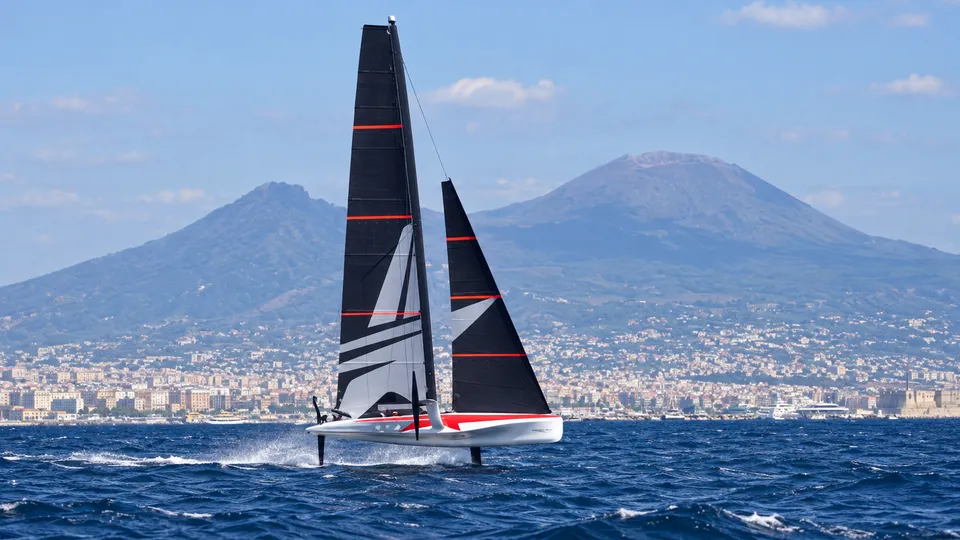
Ms Nordstrom and her ARC Team USA crew-mates spent this month training in the Gulf of Naples, ahead of a regatta that makes Italy only the second European host, after Spain. The mandatory inclusion of women is no small matter in a sport long accused of being a masculine environment, if not outright sexist. “I hope that young girls now are able to see more and more women at the highest level of sport,” she told CNN, “and have something to aspire to and see that there is a path forward.”
They have had reason to want one. A survey published this year by The Magenta Project, 11th Hour Racing and World Sailing found three out of four women in sailing believe gender balance is a problem; more than 85% said they had experienced sexism. “Sailing has historically been a very male-dominated sport and that’s the reality of it,” Ms Nordstrom concedes.
What has changed is the machine, as much as the mood. Gone are the days of hauling ropes and grinding winches: the AC40 and AC75 yachts she trains on are fibreglass vessels whose sails rise by hydraulic pressure and whose routes are analysed by powerful computers. Helm and crew sit inside the hull, peering over the gunwale through buttons, screens and sheer speed; Ms Nordstrom notes that with the sail down the middle of the boat, “you actually can’t see half of the racecourse, so you’re blind!” The result, on the water, is less yacht than flying race car.
“All of this signals an age of change where the physicality, that brute strength side of sailing that was so prevalent forever is, I wouldn’t say eliminated, but darn close,” Ken Read, one of America’s most successful sailors and ARC Team USA’s chief executive, tells CNN. “It’s a lot more cerebral, and we all know women are smarter. Fitness is important, but mental capacity… I’d say stay in school and become an engineer.” Mr Read, who raced the Cup in 2000 and 2003, puts it plainly: “The sport of sailing has evolved more than any other.”
Women came close to cracking it once before. In 1995 an almost-all-female crew led by Dawn Riley sailed Mighty Mary to the brink of representing America, a campaign chronicled in a documentary released this year; one spectator recalls it was “like watching Princess Leia take on Darth Vader.” Yet that feat failed to normalise a female presence at the Cup for almost three decades.
The breakthrough came via the Women’s America’s Cup, a standalone event launched with the 37th edition in Barcelona in 2024, which paved the way for the new mixed-crew rules. Shirley Robertson, a former Olympic sailor now broadcasting the Cup, is of two minds about compulsion: “It should not come as mandatory,” she says. “However, unless you mandate it, it would never happen. It took 32 years from Mighty Mary, but this year’s achievement is truly historic… and there are a lot of traditions.”
Ms Nordstrom, who before the 2024 event raced the mixed two-person 470 class in the Paris Olympic qualifiers, has parked thoughts of a home Games at Los Angeles 2028. “Getting to be a part of the America’s Cup campaign, it’s kind of like a once in a lifetime opportunity that you don’t want to pass up,” she says. Her aim for the Cup itself is studiously unfussy: “The goal, ultimately, is to have the best people on the boat… so it should become level with time.”
That is the right test of the quota. Rules can put a woman on every boat in Naples; only results will decide whether, another 32 years on, anyone still remembers it was ever an issue.