
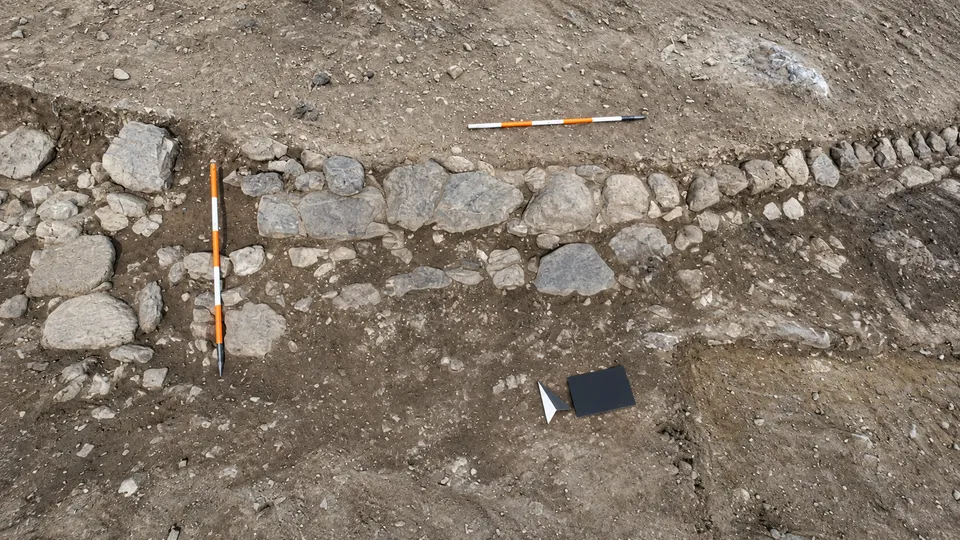
In April, archaeologists working on a hillside in the Italian Alps announced they had found an Iron Age house. Singular. One house, some pottery, a nice find. By September they had lost count of the houses — or rather, gained count, because the tally now stands at more than 30, and what was a lonely ruin has swollen into a village that flourished roughly 2,500 years ago.
The site is called Galgenbichl, near Niederrasen in South Tyrol, and it owes its excavation to that great patron of accidental archaeology, the road project. Trial digs began in late 2025 ahead of construction of new road access to the Antholz and Olang valleys; full excavations followed in February 2026, and as the hillside was peeled open, structures kept appearing across the construction area. According to the provincial Office for Archaeology, no Iron Age settlement of this size has previously been investigated so extensively in the region — a finding confirmed in coverage by Archaeology News Online Magazine.
First, flatten the mountain
Building a village on the south face of Galgenbichl required some preliminary landscaping, because the slope there is steep enough that the first construction material was the hill itself. The inhabitants cut terraces into it to manufacture level ground, then built houses against the hillside: stone foundations, wooden upper storeys, and wooden posts holding everything up on the downhill side — the Alpine stilt solution, circa 800 BC.
That date matters. The provincial archaeological office puts the settlement’s heyday between about 800 and 500 BC, its principal Early Iron Age phase, but people were still living there into the first century BC. A village occupied for the better part of a millennium is not a campsite; it is a going concern. And at some point it burned. Charcoal layers and scorched wooden beams show that parts of the settlement were consumed by fire, though what started it — accident, attack, domestic mishap with a hearth — the reporting does not say.
A village with good connections
Nobody builds on an awkward slope for the view alone. Galgenbichl sat above the Puster Valley, an important east-west route through the Alps, and its residents appear to have been in contact with communities in the Venetic cultural region of what is now northeastern Italy. The neighbourhood’s allegiances shifted around them over the centuries: the valley belonged to the Raetian cultural sphere in the settlement’s earlier phases, and by the end of its occupation it had become connected with the Celtic kingdom of Noricum. The villagers presumably just kept grinding their grain.
Which, in fact, is exactly what they did. The site’s real treasure is not one spectacular object but the quiet accumulation of ordinary ones: loom weights and spindle whorls for making thread and cloth, grinding stones for grain, fragments of household pottery, traces of bronze working. It is the archaeology of a Tuesday afternoon — bread being made, cloth being woven, something metal being repaired.
Then there are the animal bones, which amount to a menu and possibly a bank statement. Cattle show up with unusual frequency among the remains, and archaeologists have suggested that a herd that beefy may indicate a comparatively prosperous community. In the Iron Age, as now, you could learn a lot about a household from what was in the freezer.
The smallest graves stayed home
The most quietly devastating find lies between the houses: a small burial area used exclusively for very young children, their bodies inhumed right inside the settlement rather than cremated. That is not how the neighbours did it — at the nearby Iron Age cemetery at Windschnur, also in Niederrasen, cremation was the practice. The archaeological office has declined to attach a specific religious meaning to the difference, but the contrast suggests the community’s youngest members followed their own funerary custom, one that kept them within the inhabited space instead of sending them to the cemetery with everyone else.
There is a grim arithmetic underneath the tenderness. According to the provincial archaeological office, infant mortality at the time may have run between 20 and 35 percent, with many children not surviving their first year. A dedicated burial ground inside the village is, among other things, a piece of infrastructure that a community builds when it knows it will need it.
Galgenbichl was not unknown before this year, but the 2026 excavation has changed its scale entirely. Together with the Windschnur cemetery, it is now considered one of the most important sources of evidence for the Early Iron Age in the Alpine region — a hillside where, for reasons involving road access, the distant past finally got its building inspection. The villagers of 800 BC cut their terraces, hauled their stones and propped up their downhill corners on wooden posts, and two and a half millennia later the posts are gone but the homework survives.