
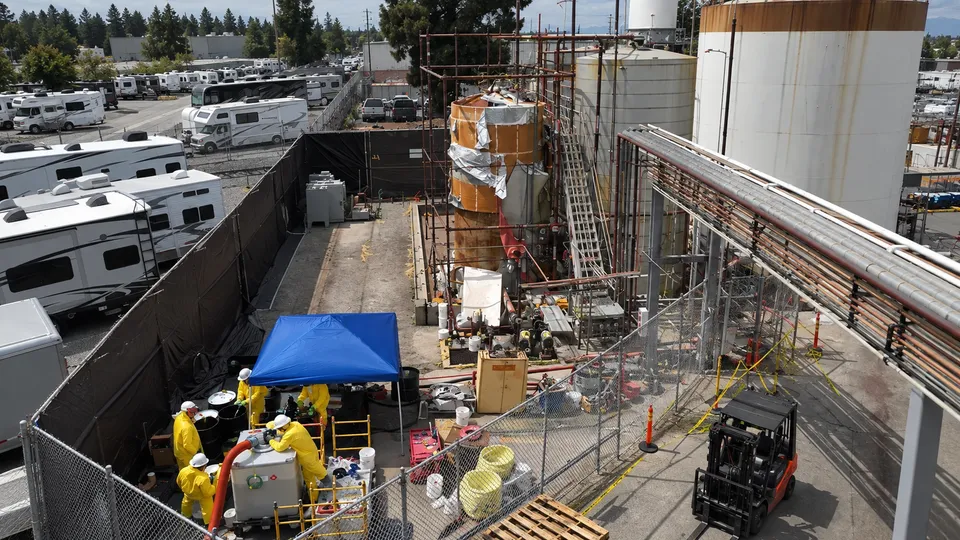
The tank held methyl methacrylate, a chemical that can explode under certain conditions, and over Memorial Day weekend it developed a crack. The crack released pressure; that, together with work by emergency responders, kept the tank at the GKN Aerospace plant in Garden Grove from failing. Thousands of Orange County residents evacuated anyway, and by the time they came home, the question had migrated from the fire line to the statehouse: why was a chemical like that not on California’s list of chemicals like that?
On Sunday, Governor Gavin Newsom signed a law that puts it on the list. Senate Bill by Tom Umberg, a Santa Ana Democrat, adds methyl methacrylate to the California Accidental Release Program, which requires facilities to keep detailed plans for preventing and responding to leaks and explosions, and it tightens building rules for sites that store explosive chemicals. CalMatters had reported in May that the state’s toughest accidental-release rules did not cover the chemical in the GKN tank; weeks later, Umberg amended an existing bill, and Assembly committee and floor analyses cited that reporting. Had the tank exploded, Umberg said at a June Assembly hearing, it “would have been perhaps the greatest catastrophe, certainly in the last several decades in California.”
What the law does, and what it does not
The final statute bars construction of new facilities that handle the chemical near homes and schools, requires backup cooling systems, and strips an exemption from environmental review that sites storing methyl methacrylate previously qualified for. Those siting rules, though, run only forward. They apply to facilities that do not yet exist, not to the one in Garden Grove.
That distinction is the heart of the local response. Garden Grove advocates call the bill a good step that offers the community little immediate recourse. “This is a much larger fight than just what’s happened in Garden Grove,” said Mai Do, research and policy manager for the Orange County advocacy group Harbor Institute for Immigrant and Economic Justice. “What we see in terms of the Lineage fire and other industrial crises is that this is a problem that is affecting a lot of different communities.” Umberg, in an interview with CalMatters, described the bill as a balancing act: “This is a net benefit for the state, a net benefit for the community.”
A broader bill, narrowed to one molecule
Umberg’s first draft was considerably wider. His office, noting the gap, initially proposed folding a whole category of reactive chemicals into the accidental-release program. Industry groups objected that the sweep was too broad without clearer evidence. Dawn Koepke, a lobbyist for the California Manufacturers and Technology Association and the California Council for Environmental and Economic Balance, said she does not believe a regulatory gap exists; such facilities, she said, are already heavily regulated under other federal and state laws, and she worried that “jumping to conclusions and over-regulating” could reach “a wider array of facilities.” Tim Shestek, a lobbyist for the American Chemistry Council and other groups, said by email the original proposal would have touched “far more facilities, substances and sectors than were in the original scope.”
On the next-to-last day of the legislative session, the bill was amended down. Nine industry groups stopped lobbying against it. Most provisions now cover only methyl methacrylate — the single chemical in the Garden Grove tank. Gone entirely was a requirement to map reactive-chemical sites in CalEnviroScreen, the state program that identifies heavily polluted communities.
Reopening on a deadline
Meanwhile the plant at the center of all this is preparing to go back to work. Steve Carlin, senior vice president for GKN Aerospace programs, said the company — which builds cockpits and windshields in Garden Grove — has worked with regulators and independent experts “to safely reset the remainder of the facility with the appropriate oversight,” including inspections, safety-equipment upgrades and additional monitoring. GKN plans to reopen within days, by the end of September, and has announced a $100 million program to compensate residents and businesses that lost money during the evacuations.
Some worker-safety advocates see the episode as a pattern rather than a fix. “It’s just unfortunate that it’s a piecemeal thing,” said Lisa Fu, director of the California Healthy Nail Salon Collaborative. “Is it worth it to go piece by piece in terms of trying to ban certain chemicals? It makes the work harder for us, and you can see who’s benefiting and who’s not.”
Newsom also signed a pair of bills responding to the Lineage fire, the June blaze at a Los Angeles cold-storage facility that briefly triggered a shelter-in-place order over fears that toxic anhydrous ammonia had been released. Those laws raise the fines agencies can levy on companies that endanger health and safety, and they bar building permits for cold-storage facilities that lack contingency funds or insurance to help communities through emergencies.
So the tank that started all this will hold its chemical under the old rules, grandfathered in, while the new rules wait for a facility that has not been built. What changed, in the end, is one line in one program: methyl methacrylate now has plans attached to it. The crack did the rest of the arguing.