
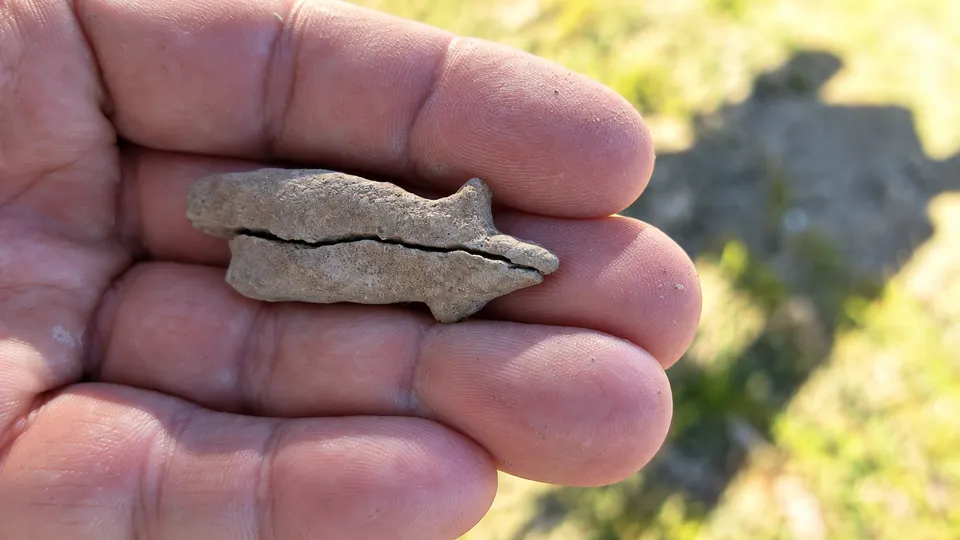
The ground at Dâmbul Cetății kept the archaeologists waiting no time at all. The prehistoric settlement sits on a rock outcrop near the village of Șoimeni, in the Păuleni-Ciuc commune of Romania’s Harghita County. On the first day of the 2026 season the excavators there lifted out a small woman of fired clay. She is roughly 6,500 years old.
The National Museum of the Eastern Carpathians (MNCR) announced the find on October 7, as Arkeonews reported in a piece by Leman Altuntaş, and Radio România Târgu Mureș carried the news the same day. The museum classifies the object as a female figurine of the Chalcolithic, or Copper Age, from the Cucuteni culture, and dates it to approximately 4500–4050 BC. It has not published her dimensions, and it has not said what she was for.
Two pieces of clay
What the museum has described is how she was made. The potter shaped her from two pieces of clay, joined them, and only then fired the figure. Over the millennia, conditions in the soil worked at that join until the figure cracked along it. The damage has given something away. The object opened exactly where its maker sealed it, and the break shows how it was built.
In announcing the find, the museum praised the Cucuteni as the most skilled makers of clay objects in Copper Age Europe, a remark picked up by the Romanian magazine Historia. That is a large claim from an institution with a stake in it. Still, this culture’s painted pottery, spiral patterns and female figurines have long been counted among the most remarkable artefacts of prehistoric Europe. The excavation is funded by Romania’s Ministry of Culture through its 2026 national programme for systematic archaeological research, according to the regional paper Informația Harghitei. So a state ministry pays for patient digging into the life of people who had no state at all.
The tall women of the burned houses
The small figure has distinguished company. The same hill had already produced female figures of unusual size, some more than 25 centimetres tall and among the finest examples of the figurative art of the Cucuteni-Ariușd culture. In 2015 Dan-Lucian Buzea of the MNCR and Adela Kovács, then at the Botoșani County Museum, studied them in the journal Acta Terrae Septemcastrensis and in the museum’s own journal, Angvstia. The figures had come out of the ground in fragments, from house floors and from the debris of ruined dwellings. X-ray computed tomography showed that some of the larger ones had also been assembled from separate masses of clay before firing. The new figurine repeats, on a small scale, a method already found inside the big ones. Kovács later took the question further with radiographs of other Cucuteni statuettes in a 2023 study.
Several figures lay in groups inside buildings that had been destroyed by fire. That context raises a question nobody has yet answered. Did particular houses serve as ceremonial spaces, or did the figures belong to rites that went with the burning or abandonment of a home? The museum has asked the question openly, under the heading whether Cucuteni temples dedicated to female deities stood at Păuleni-Ciuc.
A reflection may be allowed here. Each generation reaches for the clay women of the Copper Age and finds in them what it came looking for. The museum has pointed to a possible link with beliefs about female goddesses and fertility. Yet the meaning of these figures remains unclear, and archaeologists caution that not every image of a woman can automatically be read as a goddess. The people who made them left no writing to settle the matter.
A house with a hearth
Figurines are the glamour of Dâmbul Cetății, but the hill has given up far more: houses, hearths, pottery kilns, painted ceramics, stone tools, jewellery and objects associated with ritual. Taken together, they give an unusually detailed picture of prehistoric life. A reconstructed Cucuteni dwelling shows what such a home was like: rectangular, with wooden walls plastered in clay and a thatched roof. The hearth was used for cooking and for warmth. Grinding stones, pots and tools belonged to farming communities who also raised animals and worked stone, bone and copper.
Their world, the Cucuteni-Ariușd-Trypillia complex, spread across lands that now lie within Romania, Moldova and Ukraine. Those are modern frontiers drawn over people who knew nothing of them.
A hill between Transylvania and Moldavia
Archaeologists have known about the site since the late 19th century, but systematic research came much later. The MNCR resumed excavations in 1999 and has identified a succession of settlements belonging to the Cucuteni-Ariușd, Bodrogkeresztúr, Coțofeni, Costișa and Wietenberg cultures. One people after another came to the same outcrop, and each left its layer for the next to build on. The hill stands in the Eastern Carpathians with a commanding view, in country that linked prehistoric communities on either side of the mountains, between Transylvania and Moldavia. Its stacked occupation layers let researchers trace changes in architecture, material culture and daily habits over long stretches of time. Many of the finds are now in the museum’s permanent exhibition in Sfântu Gheorghe.
The newest arrival is smaller than the tall women from the burned houses, and she is broken. But she broke where she had been joined, and so after 6,500 years she has given the excavators one certain fact about the person who made her. On everything else she says nothing.