
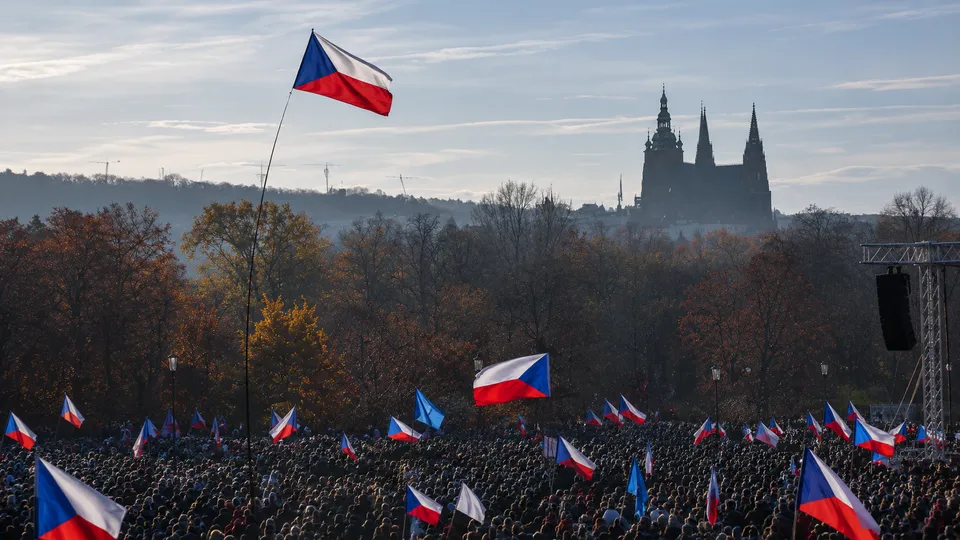
On Sunday afternoon, 15 November, crowds filled Letná, the broad plain above the Vltava in Prague, to defend a television station and a radio network. Al Jazeera, drawing on AFP and Reuters, put the crowd at tens of thousands. They were protesting a government plan to change how Czech public service media is paid for, which critics fear would leave the broadcasters weaker and less independent. Some came in pointed hats folded from newspaper, after the animated figure who has opened Czech Television’s children’s bedtime stories every night for decades.
The hats say something. People did not march for an abstraction called media freedom. They marched for the small man in the paper hat who has been putting their children to bed for longer than most of the country’s politicians have held office.
A fee and a favour
The cabinet of the billionaire prime minister Andrej Babiš, in power since December, brought in the proposal last month. It would abolish the monthly household fee of 205 crowns ($9.45) that funds Czech Television and Czech Radio and pay for both out of the state budget instead. The bill has passed a preliminary vote in parliament and is waiting for further debate. Around Prague reported that the plan also includes funding cuts of more than 15 percent. The coalition argues that the broadcasters need to cut costs. It says editorial independence and programming will not be touched.

Opponents see it differently. A fee is paid by the citizen straight to the institution. A budget line is granted by a minister each year, and what a minister grants he can also cut, delay or make conditional. That, at least, is the reasoning of the critics, who point to neighbouring Slovakia under Robert Fico and Hungary under Viktor Orbán, where populist governments brought public media to heel.
How many
The rally was called by the civic group Million Moments for Democracy, which said beforehand that it expected between 400,000 and 600,000 people and that the day might be “the largest public gathering in Czech history.” After the rally, Around Prague reported, the organisers claimed 350,000 to 450,000 people had come, which would make it the largest rally in Prague since 1989. Bloomberg also described the protest against the government’s funding overhaul as huge. Al Jazeera’s figure, tens of thousands, is far lower. No independent count has settled the difference.
The organisers’ charge sheet was blunt. “Babis and his government obviously think they will get away with anything,” the group said, accusing the cabinet of ignoring experts, silencing critics and treating democratic institutions as their own property. According to Around Prague, the rally was titled “Letná Against 4:36”, after the time the governing coalition set for the vote on the bill. The crowd wanted the bill withdrawn. It also wanted Babiš to dismiss the Speaker of the Chamber of Deputies, Tomio Okamura, and to take the defence ministry away from Okamura’s far-right party. Opposition leaders were in the crowd.

The calendar
The date was chosen with care. On 17 November the country marks the 1989 Velvet Revolution, which ended Communist rule and carried the dissident playwright Václav Havel to power. Letná belongs to that memory, and it is not the first time this year it has filled up against this government: a large anti-government demonstration was held there in March.
The resistance had been building for months. Al Jazeera reports that broadcast workers have been striking against the plan since June. Earlier this month, public media staff staged a one-day strike, and artists and students began boycotting the state broadcasters. On 3 November, Euronews reported, thousands protested in Prague, a few days after an earlier rally against swapping the licence fee for a government cheque.
The answer from above
The government’s reply came quickly and did not bend. “We will not withdraw the proposal under any circumstances, and we will abolish the fees,” Okamura said, according to Around Prague. As evidence he cited a STEM/MARK poll commissioned by Czech Television: 23 percent support the government’s plan as it stands, 31 percent favour moving funding into the state budget provided independence is kept, and 34 percent oppose abolishing the fees.

The Speaker read those numbers as support. Read another way, fewer than a quarter of respondents back the bill as written. The 31 percent who would accept budget funding attached a condition, and that condition is exactly what the people on Letná say the bill fails to guarantee. Foreign Minister Petr Macinka took a different line, accusing the organisers of turning demonstrations into a business model.
There is an irony here that the government might consider. Czechs do not trust their media much: overall trust stands at about 30 to 33 percent, according to the latest Reuters Institute Digital News Report. Yet public service journalism is among the most trusted news sources in the country, and Czech Television is the most-watched broadcaster across several age groups. The institution the cabinet says must tighten its belt is one of the few that a sceptical public still relies on.
Outside the country the bill has few friends. The European Broadcasting Union, the European Federation of Journalists, Reporters Without Borders and the International Press Institute have all criticised it. The bill now goes back to the Chamber of Deputies for further debate, and on Tuesday the country marks the anniversary of the revolution that began, in 1989, with crowds in the streets of Prague.