
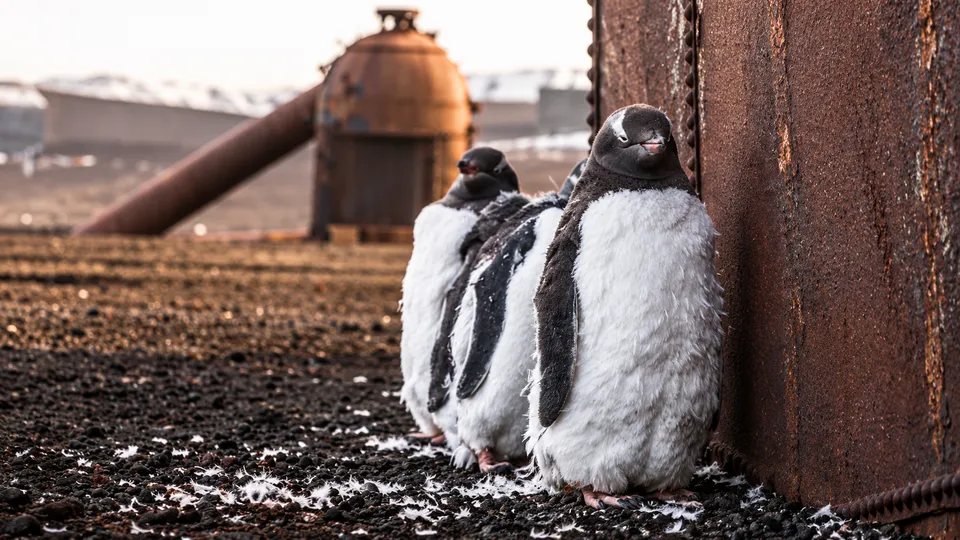
Deception Island is a doughnut-shaped sliver of Antarctica whose middle is the flooded caldera of an active volcano. The early 20th century filled its shore with a whaling and sealing industry; the industry left, and the rusting lopsided whale-oil tanks and slowly decaying wooden boats stayed. As Martha Henriques reported for the BBC, the island today is a place where the animals have moved back into the machinery — and one particular animal is doing conspicuously well at it.
The wildlife photographer Romain Barats captured the arrangement in a series of photographs, one of which — three gentoo penguins standing beside the ruins like, in his words, sentinels — was a finalist for Ocean Photographer of the Year 2026. In a purely visual sense, he says, “it’s like Chernobyl.” “They’re places where human activity suddenly receded and nature began moving through the structures we left behind.”
The three penguins in the frame are winning in a more literal sense than most Antarctic wildlife. Heather Lynch, a professor of ecology and evolution at Stony Brook University, puts it bluntly: “Gentoo penguins are what we call a climate change winner. Their abundance has just skyrocketed in this part of the Antarctic because they like it warmer, they can handle it wetter. They just keep moving south.” In some areas along the West Antarctic Peninsula, gentoo numbers are up by almost a quarter since 2013.
The birds in Barats’ photo happen to be demonstrating the point. They are moulting, which is a bad time to be a penguin: “They can’t get in the water when they’re moulting,” says Lynch. “It’s itchy and uncomfortable and they get cold very easily.” So they hauled themselves out of the sea to warm up on the island’s volcanic heat — the ground itself is, recall, an active volcano — while the rusting oil tanks break the wind. A ruined industrial site and a live volcano, repurposed as a spa.
The talents go beyond clever real-estate choices. Gentoos are unfussy eaters, switching between krill and fish depending on what is around, unlike their two closest relatives. If a sudden flood or a freak snowstorm — both, Lynch notes, growing more common with climate change — destroys their eggs, they simply lay more, a trick neither chinstraps nor Adélies can manage within one season. They can also radically shift their breeding season to track the climate. Add in the emerging taxonomic intrigue — whole-genome work recently indicated that the gentoo is really four species, with climate risk handed out unevenly among them — and you have a bird that treats upheaval as an occasion. “Everywhere we turn in the Antarctic on the peninsula here, we’re finding more gentoo penguins,” Lynch says. “It’s this gentoo penguin takeover.”
Deception Island itself, to be clear, is not part of the takeover yet. No penguins currently breed there; eruptions over the past 7,000 years have repeatedly decimated penguin populations in the region. The island remains a wildlife hotspot anyway — “the outside of Deception Island is one of the most stunning amphitheatres of penguinness that we have in the Antarctic,” says Lynch — and for Barats it is a collision of scales: “You can feel something very powerful. It’s like being confronted with something much larger than ourselves. Geological time, nature, maybe the impermanence of our civilisation.”
The impermanent civilization, meanwhile, has a prediction about the volcano’s interior. “If someone were to say, ‘Who would be the first to try breeding on the inside of Deception Island?’ It would be gentoos,” says Lynch. “It would be just so like them to show up and build a couple of nests inside the caldera.”