
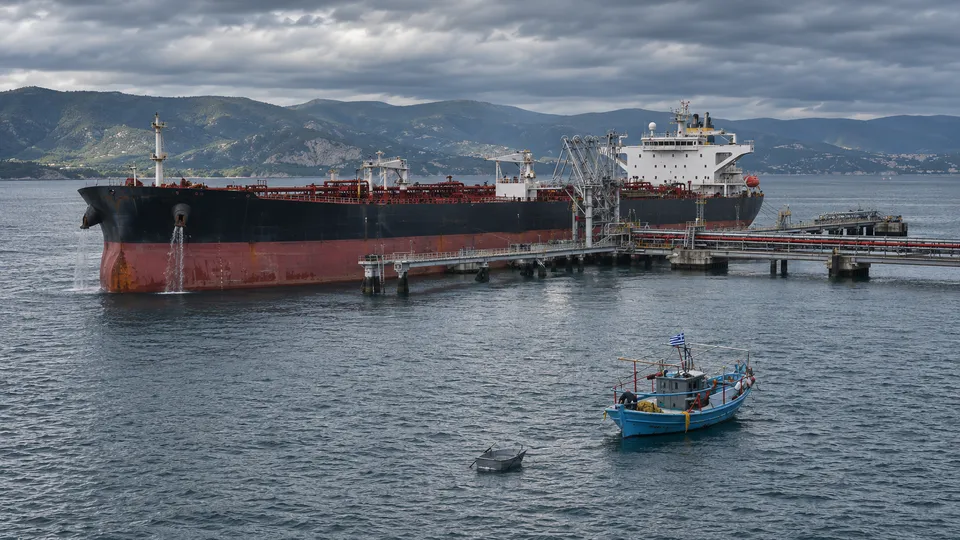
In late October a barrel of Brent crude, the benchmark the world uses to price its oil, reached $118, close to the highest price of the war. Traders were betting on fire. The American midterm elections were coming, and the market assumed that once the votes were counted the bombs would fall on Iran again and Iran would answer in the Gulf.
The bombs did not fall. The Democrats swept away the Republican majorities in Congress, and President Donald Trump has so far held back from new strikes. So through November the price came down the same way it had gone up: fast, and on a wager. At Friday’s close, as Spencer Kimball reported for CNBC, Brent stood at $95.44, about 20% below its peak. West Texas Intermediate, the American grade, had topped $104 and settled at $83.08, a fall of about 21%. At American pumps, gasoline has dropped well below $4 a gallon and diesel below $6.
The arithmetic of calm
The new bet has a name, and the name is surplus. In its November oil market report, the International Energy Agency said global supply had overtaken demand for the first time since the war began on February 28. The agency puts fourth-quarter supply at 105 million barrels a day, 1.7 million more than the demand it forecasts, and it has dropped its earlier call for a deficit. For 2027 it expects a surplus of about 3.8 million barrels a day, according to Xinhua’s account. Nine months ago the war set off the largest supply disruption the oil market has ever seen. A forecast of plenty now is a real turn.
The banks and the ship-trackers agree on the direction. Goldman Sachs expects a crude surplus of 2 million barrels a day in 2027 as Gulf producers keep adapting their supply chains to the war. Kpler, which tracks commodities and ships, expects 3 million. JPMorgan assumes the glut lasts and sees Brent in the high $70s in the first half of 2027, then in the $60s. Goldman is more cautious about the price than about the volume: it puts Brent around $88 next year and WTI at about $78.
“If the recovery in the Arabian Gulf region continues, we’re going to have oversupply,” said Bob McNally, president of Rapidan Energy and a former energy adviser to President George W. Bush. The whole structure rests on the first word of his sentence.
If pigs had wings
David Goldwyn, who was the State Department’s special envoy for international energy under President Barack Obama, put his view of the surplus forecast plainly: “If pigs had wings, they’d fly.”
Even the IEA adds a warning: downside risks “persist as attacks on shipping undermine maritime security.” Middle East crude exports have recovered since the summer, but they have drifted lower in recent weeks. In the week ended Wednesday they averaged 12.8 million barrels a day, according to Kpler, about 24% below the pre-war 17 million. Fuel shipments were 3.2 million barrels a day, down about 49% from 6.3 million. All of this moves under a U.S. blockade that Secretary of State Marco Rubio has told the G7 could continue with no clear end.

A surplus is a figure in a report. A tanker is steel on water, and in and around the Strait of Hormuz the steel is being hit almost every day. Maritime security agencies have reported at least 20 attacks on commercial ships this month and 35 in October, the most of any month in the war. Counts differ. ABC News reported that the UK Maritime Trade Operations centre logged 31 attacks in October and about 19 in November as of November 18. The centre publishes only incidents it has verified and says it knows of others, so the true number may be higher.
Kpler warns that the surplus could easily turn back into a deficit if Iran or its Houthi allies strike the United Arab Emirates’ export terminal at Fujairah, or Saudi Arabia’s facilities at Ras Tanura and Yanbu, or the kingdom’s East-West Pipeline. Most of the forecast glut has to pass through those few places.
Trump recently told Fox News he might launch new strikes on Iran after the new year, the option his generals have kept ready since October. Goldwyn said a major escalation would push prices structurally higher, because Iran would likely retaliate against ports, refineries or processing facilities. McNally expects a wide trading range for the rest of Trump’s term: $70 to $80 a barrel in quiet periods, and well above $100 when the conflict flares. “We think there will be more disruptions, more risk and that those surpluses won’t materialize next year,” he said.
The empty cellar
Goldwyn says part of November’s softness came from elsewhere. Output has risen in the Americas, and demand has eased for seasonal reasons: the summer driving season is over and refineries are shut for maintenance. The deeper problem is what would happen if the Gulf were hit again. The world’s inventory buffers have already been drawn down to historic lows, he said, and there has been no time to refill them. The chief executives of ExxonMobil and Chevron have been warning for months that the world’s stockpiles are running down.
There is still room, Goldwyn said, for another 100 million barrels from the U.S. Strategic Petroleum Reserve and for Europe to release more refined products. Neither side will be keen to do it. “If this looks like it’s going to be a chronic situation, I think both the U.S and Europeans are going to be reluctant to draw on those reserves just to provide price relief,” he said.
A reflection, not a fact: governments like to keep their reserves for the emergency still to come, so the people at the pump pay for the emergency they already have.
China is also returning to the market. Earlier this year Beijing sharply cut its crude imports, one of the main reasons prices did not climb even higher during the war. Now, Giovanni Staunovo of UBS wrote to clients, it is buying more again while the Middle East stays fragile. He thinks the market has become “too comfortable with the supply outlook” and that November’s selloff has probably gone too far. “The rebound in Gulf exports should not be mistaken for a normalization of the oil market,” he wrote. “Together, these developments are contributing to a decline in oil on water and a tightening physical market. This supports our view that oil prices should recover from here.”