
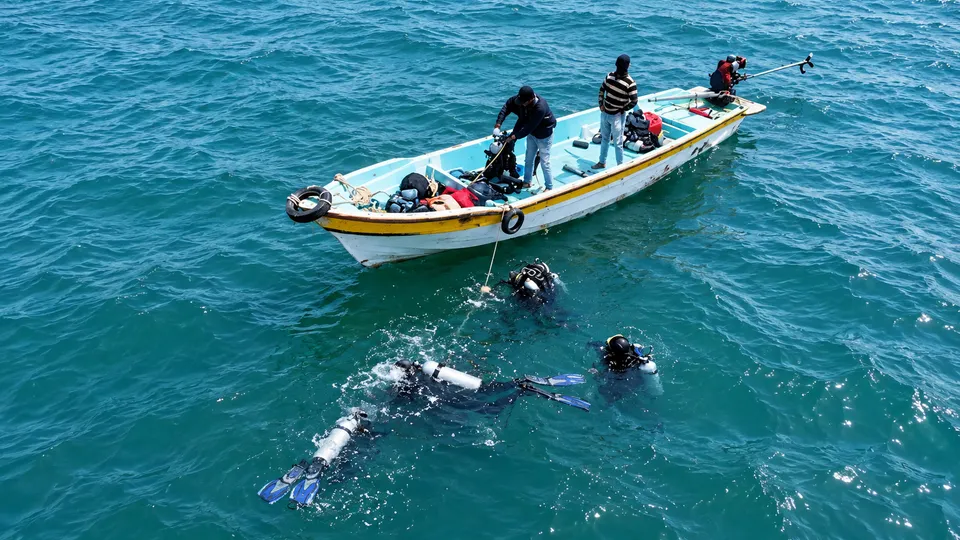
The basic difficulty of doing underwater archaeology off the coast of Tamil Nadu is a proof problem. Ships lose things. A ceramic fragment on the seabed might mean people lived there, or it might mean somebody’s cargo took a shortcut to the bottom in 100 BC. So the news that archaeologists have recovered four ancient ring wells, more than 250 ceramic fragments and part of a West Asian torpedo jar from the submerged landscape of Poompuhar, as Arkeonews reports, matters in descending order of glamour. The jar is the headline. The wells are the evidence.
Poompuhar — also known as Kaveripoompattinam or Kaveripattinam — stood where the Cauvery River meets the Bay of Bengal, and Tamil literary tradition remembers it as one of the great ports of the ancient Chola world, a city divided into harbour, residential and market districts. Land archaeology has turned up wharves, brick structures, imported pottery and coins. The open question, which the 2026 project is explicitly trying to answer, is how much of the city now lies underwater, and how sea-level change, shifting river channels and erosion redrew the map.
This is where the ring wells do their work. A ring well is a vertical shaft built by stacking circular baked-clay sections into the ground, used to supply water or manage drainage in populated areas. The decisive thing about a well, evidentiarily speaking, is that nobody builds one on a passing ship. You dig wells where you live. Officials from the Tamil Nadu State Department of Archaeology say the four new examples may also mark the course of an ancient palaeochannel, and only about 10 percent of the planned underwater exploration has been completed.
The torpedo jar fragment is the trade story. The complete vessel would have measured roughly 30 to 35 centimetres across, and it is the first such jar reported from underwater exploration at Poompuhar. Torpedo jars were long, narrow transport containers associated with Mesopotamia and Persian Gulf commerce; many had pointed bases and bitumen-lined interiors so merchants could move liquids such as wine or oil by sea, though nobody has established what this one carried. The useful way to think about a bitumen-lined jar is as packaging: it exists because somebody expected to move the same kind of cargo repeatedly, over distance, at a profit. Standardised containers are what recurring trade routes look like after two thousand years.
The same season produced glazed ceramics, on top of earlier finds of amphorae, rouletted ware and other imports. And the port’s reputation was never only local: scholars have long linked Kaveripattinam to the Kaberis Emporium named by the second-century geographer Ptolemy, with later sources mentioning a place called Caber on the same coast. A river mouth gave ships access to inland markets; the Bay of Bengal opened routes toward Sri Lanka and Southeast Asia; westward connections reached Arabia, the Persian Gulf and the Mediterranean.
Underneath all this sits the weirder inventory. Earlier surveys identified substantial offshore stone structures, including a large U-shaped feature at roughly 23 metres depth, and more recent work has found an elliptical structure close to it, other buried anomalies and a possible shipwreck. What any of these structures were for remains unknown. National Institute of Oceanography research had already shown that habitation extended beyond the present coast; the current campaign is adding precision to a landscape earlier teams could only sample.
There is also context worth keeping in the back of the mind: recent research in Tamil Nadu has pushed evidence for iron use far earlier than scholars once expected. Poompuhar was not an isolated fishing settlement that stumbled into wealth; it sat in a region with long-established technical and economic traditions.
The Tamil Nadu State Department of Archaeology plans to resume underwater work after the monsoon, with the next phase expected in January 2027. With only a fraction of the target area explored, no one can yet say how far the drowned settlement extends or what the large offshore structures did.
Anyway. The jars tell you where the money came from. The wells tell you where the rent got paid. The second fact is harder to come by, which is why everyone should be more excited about the plumbing.