

As of Monday the petition to reinstate Jensen Huang as Nvidia’s chief executive had drawn roughly 180,000 signatures, according to CNBC, up from 115,000 four days earlier by TechPowerUp’s count of the same standwithjensen.com tally. The number that actually moves anything is smaller: zero. Nvidia’s board is not discussing a Huang comeback, a person familiar with its thinking told CNBC on Monday; it is focused on an investigation into whether Huang’s conduct put national security or company secrets at risk, and it is already interviewing search firms for a permanent — and by implication different — chief executive.
The petition claims about 9,000 current Nvidia employees among its signers, a figure PC Gamer notes would be roughly a fifth of the company. Nvidia’s most recent 10-K puts headcount at 42,000, which makes the self-reported employee share 21%. None of the affiliations are verified; the campaign itself says it cannot confirm who its signatories really are. The letter’s three demands, per PC Gamer, are reinstatement, an independent investigation with a fair hearing, and a timely public explanation — not quite the same as the open letter two Nvidia shareholders, Altimeter Capital’s Brad Gerstner and Atreides Management’s Gavin Baker, published on Friday, which asked only that the board leave “all options on the table, including the potential return of Jensen Huang,” as Ars Technica reported.
Nvidia retained Wachtell, Lipton, Rosen & Katz the day Huang resigned to run that inquiry, later adding Joon Kim, a former top federal prosecutor in Manhattan, as previously reported — an arrangement PC Gamer calls independent only “under the pretense of it being independent,” since there is no commitment to publish its findings. The question for Kim’s team: whether Huang’s affair with Alice Huang, a Megaspeed executive the FBI has investigated for at least a year as a possible Chinese intelligence asset, according to Mother Jones, exposed Nvidia to blackmail or compromised its export-control decisions. Ars Technica also reported that Nvidia’s board had approached Arm chief executive Rene Haas as a possible successor, a process the board said was not yet “formal” — and that even Huang’s own allies concede the basic problem: “Having an affair with a subordinate is a fireable offense,” one person involved in the reinstatement push told the Financial Times.

The Singapore numbers
Nvidia’s own SEC filings show billings to Singapore-registered customers rising from 15.5% of total revenue in the quarter ending April 2024 to 21.7% in the quarter ending July 2025 — climbing even as revenue attributed to China fell under export restrictions, according to filing data compiled by mlq.ai. Nvidia’s stated position, in the same filings, is that over 99% of that Singapore-billed “controlled Data Center compute revenue” was ordered by US-based customers who arrange delivery elsewhere, and that chips physically shipped into Singapore came to under 2% of revenue. Nvidia stopped breaking out the Singapore figure last year, after, as Fortune put it, “it became obvious that an unusually large number of sales were going through the small city-state.”
One of the resellers routed through that billing address was Megaspeed, a Singapore operator co-founded and run until 2025 by Alice Huang. Records reviewed by the Wall Street Journal show Megaspeed arranged close to $12 billion in Nvidia chip orders between March 2024 and June 2025 for customers including Chinese firms — several hundred thousand chips the export controls were meant to keep out of China. That figure covers orders, not confirmed deliveries. Megaspeed has told Reuters it hired outside counsel to check whether its supply chain was used to evade the controls and denies wrongdoing; Singapore’s Ministry of Home Affairs said on November 12 that its investigation into the company and six other individuals remains open, and that Alice Huang — who left Megaspeed on August 30, 2025 — was not investigated for espionage but was barred from re-entering the country after giving investigators “inaccurate information about her role in the company.”
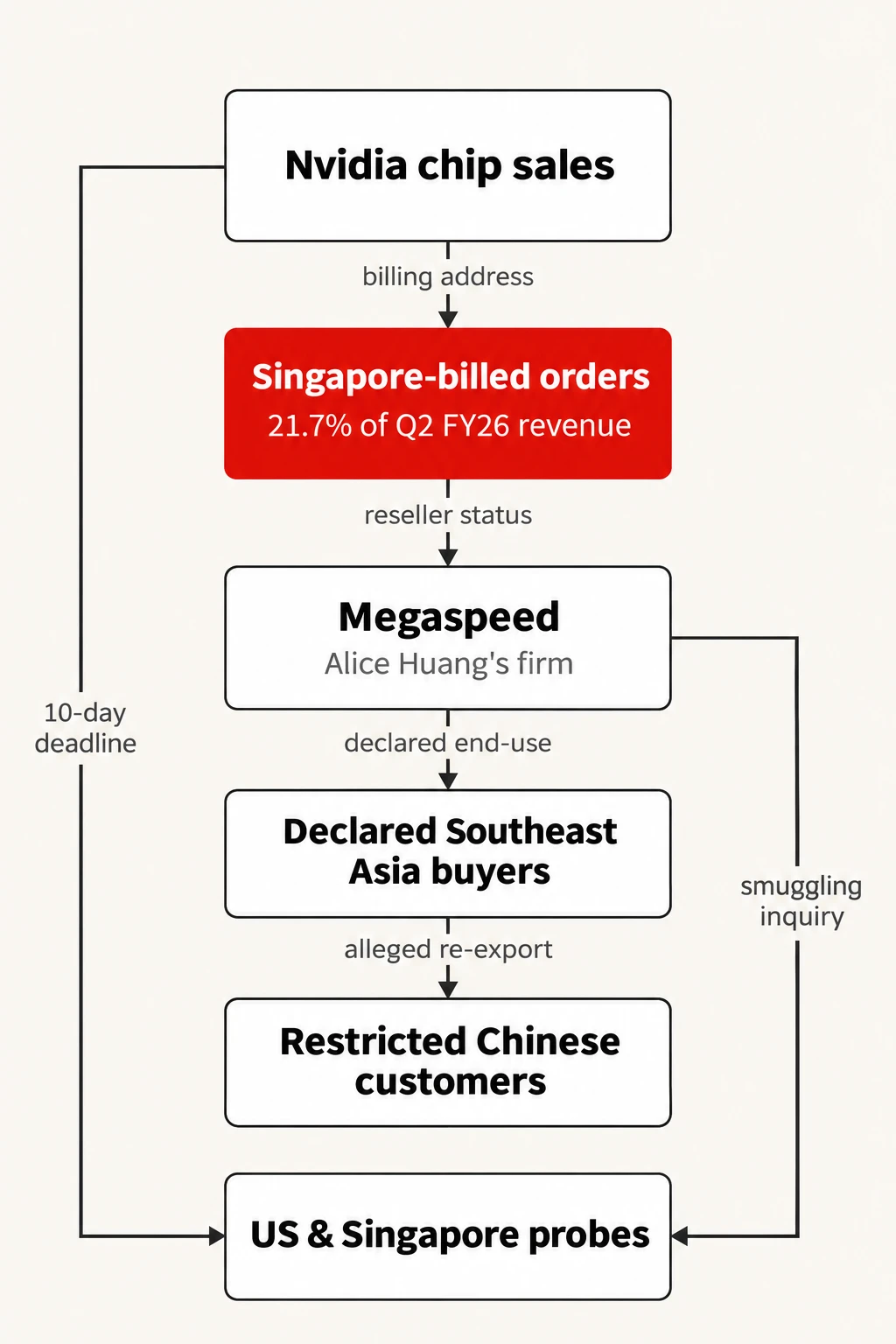
| From | To | How |
|---|---|---|
| Nvidia chip sales | Singapore-billed orders (21.7% of Q2 FY26 revenue) | billing address |
| Singapore-billed orders (21.7% of Q2 FY26 revenue) | Megaspeed (Alice Huang's firm) | reseller status |
| Megaspeed (Alice Huang's firm) | Declared Southeast Asia buyers | declared end-use |
| Declared Southeast Asia buyers | Restricted Chinese customers | alleged re-export |
| Megaspeed (Alice Huang's firm) | US & Singapore probes | smuggling inquiry |
| Nvidia chip sales | US & Singapore probes | 10-day deadline |
Based on Nvidia SEC filings and Wall Street Journal reporting, as compiled by mlq.ai
On Sunday, Treasury Secretary Scott Bessent used that billing-versus-destination gap to put the board on a clock. “I think we need answers in the next 10 days from the board and from the outside counsel,” he told Fox News’s Sunday Morning Futures, a deadline running to about November 25. He said Trump had drawn the export line at the H200, which he called a mid-tier chip: “Nothing above the H200s can be sold to the Chinese.” And he asked the question any auditor would ask of a company whose Singapore revenue grew six points in five quarters while its China revenue shrank: were Nvidia executives “pressing these seemingly illicit sales to goose their revenues and their earnings?” Bessent also told the board to recruit from outside Nvidia, which would rule out both Huang’s return and interim CEO Colette Kress’s permanent elevation.

The administration isn’t speaking with one voice. Trump told reporters Monday he “would not mind” if Huang were reinstated, saying Huang had “learned a big lesson,” per Mother Jones. Wedbush analyst Dan Ives, one of Huang’s most consistent bulls, read the odds the other way: “Any talk of a damaged Jensen coming back to Nvidia is ridiculous in our view given the legal/board/DC scrutiny/moral compass/China tentacles.”
What a Kress-led Nvidia spends
Part of the fight over Huang is a fight over Nvidia’s checkbook. Its 10-Q for the quarter ended July 26 showed $530.5 billion in commitments and guarantees on top of a $99 billion portfolio of equity stakes, plus $25 billion in additional committed equity and $36 billion in AI-cloud purchase commitments, by a tally TheStreet cites. UBS analyst Timothy Arcuri puts Nvidia’s free cash flow at $50 billion to $60 billion a quarter — meaning the guarantee book alone equals nine to eleven quarters of cash generation. Huang ran that book personally and, per the Wall Street Journal, pushed to have Nvidia backstop up to $250 billion of OpenAI’s Stargate data-center campus in Ohio; Kress, as CFO, argued the figure down, and what Nvidia eventually filed was $105 billion.
If Kress runs the company with a tighter checkbook, Arcuri estimates more than $50 billion could leave the AI financing ecosystem — probably the single biggest reason some financiers want Huang’s discretion back rather than Huang himself. Neocloud operator Nscale, for one, is counting on $45 billion in financing, some of it hoped-for from Nvidia, to build a data center for Anthropic in West Virginia, the Wall Street Journal has reported.
Congress adds a separate pressure, unrelated to the money. Representative John Moolenaar, who chairs the House select committee on the Chinese Communist Party, has called it outrageous to treat Huang’s affair as anything less than a national-security risk. Bessent has also accused Commerce Secretary Howard Lutnick of sitting on a decision to blacklist Megaspeed despite the smuggling suspicions — a charge with an odd wrinkle, since Lutnick’s sons, who now run Cantor Fitzgerald, arranged billions of dollars in financing for companies that do business with Nvidia, CNBC has reported, per Fortune.
Nvidia reports fiscal third-quarter results Tuesday, Kress’s first earnings call as interim chief, against company guidance of $108 billion in revenue, plus or minus 2%, and roughly $109 billion in analyst consensus. Nothing on that call will overturn the board’s internal verdict on Huang, which CNBC’s sourcing says has already been reached. The open question is whether Kress uses the same call to say out loud what Arcuri is already pricing in: that Nvidia writing nine-figure checks to its own customers to keep the AI boom self-funding — Huang’s signature move — is a policy, and policies can be changed by whoever holds the pen.