

US intelligence agencies have a tool called “unmasking.” When agencies monitor a foreign national under a counterintelligence warrant, any American who shows up in the intercepted traffic is anonymized in the resulting report, unless an official with the right authority asks to see the name. According to the original account in The New York Times, that is how officials learned that the American in frequent contact with Alice Huang, a Chinese national and an executive at the Singapore firm Megaspeed, was Jensen Huang, the founder and chief executive of Nvidia. US officials concluded Alice Huang was passing information to China’s Ministry of State Security.
Nvidia’s board said on Sunday it was opening an “independent investigation” into whether its $4.5 trillion-market-cap founder had been the target of a “foreign intelligence effort,” to be run by a committee of independent directors with outside counsel. Hours earlier Huang had sent Nvidia employees a note admitting he had been “unfaithful” to his wife of 41 years, Lori Huang, without naming the other person. “My actions hurt her and our children. There is no excuse for what I did,” he wrote, adding that he would “work to earn back your confidence” and was “committed to protecting NVIDIA and supporting America’s national security,” as Business Insider reported. The board said it had “no reason to believe” that national security or company secrets had been compromised, and that Huang would keep running the company “without interruption.”
The company at the other end of the line
Alice Huang, who also goes by Huang Le and shares no relation to the Nvidia CEO, is not accused of any crime; neither is Megaspeed. What is documented, in Singapore’s own corporate registry, is a sequence of ownership changes that moved control of the company through a chain of shell entities in the months before she became its public face, as Business Insider laid out from the filings.
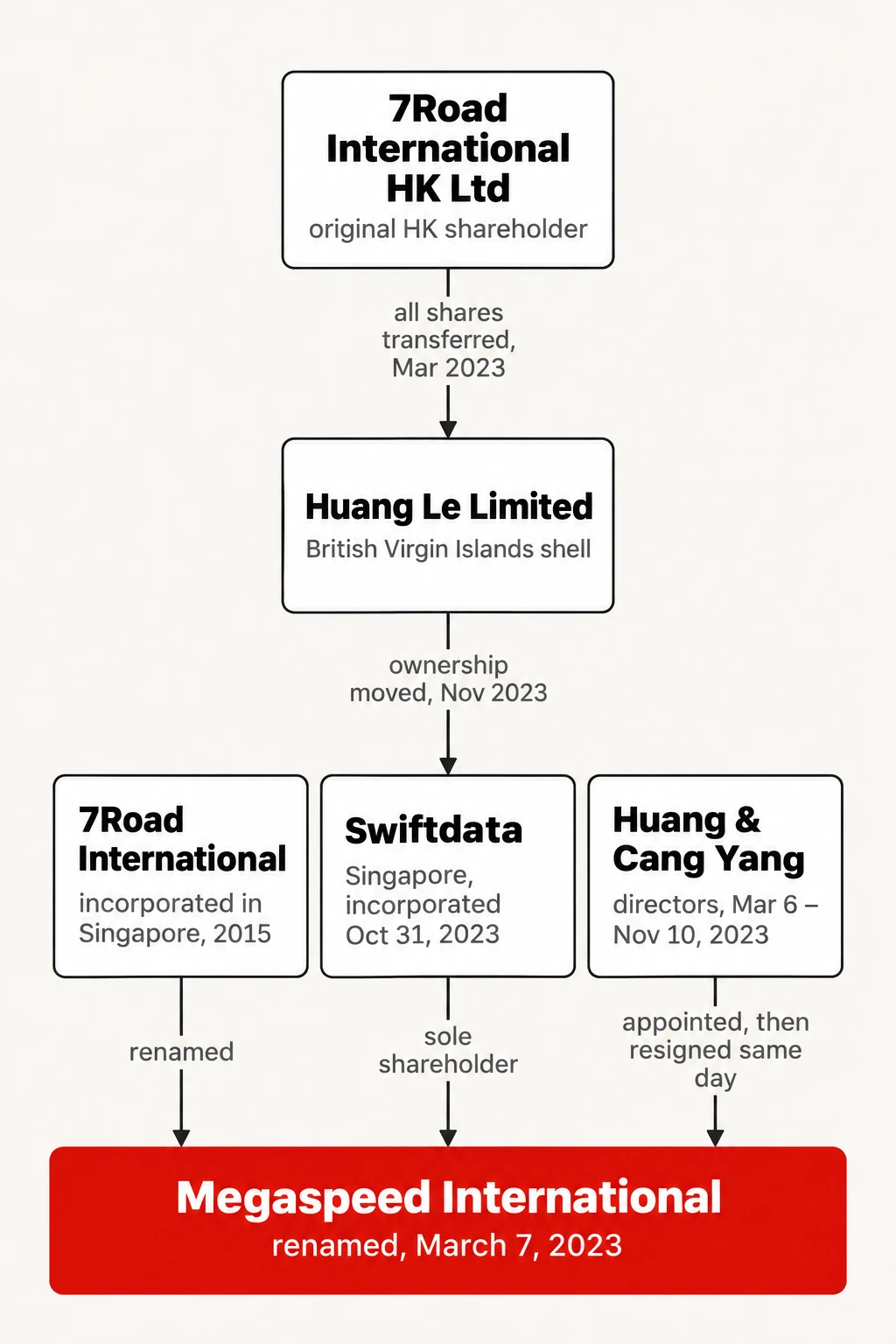
| From | To | How |
|---|---|---|
| 7Road International (incorporated in Singapore, 2015) | Megaspeed International (renamed, March 7, 2023) | renamed |
| 7Road International HK Ltd (original HK shareholder) | Huang Le Limited (British Virgin Islands shell) | all shares transferred, Mar 2023 |
| Huang Le Limited (British Virgin Islands shell) | Swiftdata (Singapore, incorporated Oct 31, 2023) | ownership moved, Nov 2023 |
| Swiftdata (Singapore, incorporated Oct 31, 2023) | Megaspeed International (renamed, March 7, 2023) | sole shareholder |
| Huang & Cang Yang (directors, Mar 6 – Nov 10, 2023) | Megaspeed International (renamed, March 7, 2023) | appointed, then resigned same day |
The day before the rename, Huang and a second Chinese national, Cang Yang, were appointed director and managing director of what was still 7Road International. Both resigned on November 10, 2023, the same day a Singapore company called Swiftdata — incorporated ten days earlier — became Megaspeed’s sole shareholder. The Times reported that 7Road itself was a Chinese online gaming company that spun off its Singapore subsidiary; before Megaspeed, Huang had worked at a Shanghai investment fund that had backed 7Road and had ties to state-owned firms.
Megaspeed matters to this story because of what it buys, not who runs it on paper. A Malaysian affiliate bought at least $4.8 billion of equipment built around Nvidia chips between June 2024 and February 2026, according to the Times, making Megaspeed one of Nvidia’s largest customers in Southeast Asia, part of its Nvidia Cloud Partner network, and — per Bloomberg’s December 2025 investigation — a company whose chip inventory at times ran roughly 50,000 units ahead of what Nvidia’s own audits found in its data centers. Bloomberg reported a subsidiary, Speedmatrix, was suspected of routing about $2 billion of restricted chips to China through an affiliate of Inspur, a company already under US sanctions, and that Megaspeed rented Nvidia capacity to Alibaba at facilities in Southeast Asia. Megaspeed has called the reporting “misleading” and says a joint inspection by the Commerce Department’s Bureau of Industry and Security, Malaysia’s trade ministry and Nvidia itself “found no evidence of any violations.” None of that joint inspection’s underlying data has been made public.
What Congress wants, and when
Three House committee chairmen — Brian Mast of Foreign Affairs, John Moolenaar of the Select Committee on the Chinese Communist Party, and Rick Crawford of the Intelligence Committee — wrote to Huang on November 4, before his admission, asking him to appear for a closed-door briefing, as detailed in the committees’ joint statement.

We are writing to request that you appear before our committees for a joint, closed-door briefing on NVIDIA’s security protocols against foreign adversary espionage and your interactions with a publicly reported People’s Republic of China (PRC) intelligence asset: Megaspeed executive Alice Huang.
The letter proposed November 18 and asked Huang to confirm or counter-propose by November 11; that date now sits a day after Nvidia’s next quarterly earnings call on November 17. Texas Republican Michael McCaul has separately called for an “immediate pause” on advanced AI chip shipments to China until the matter is resolved, as an earlier rews story detailed. China’s foreign ministry spokesperson Guo Jiakun called the entire premise “groundless” and “nothing but a smear against China,” according to PBS NewsHour. Singapore’s Ministry of Home Affairs told The Wall Street Journal it had not itself investigated Alice Huang’s alleged intelligence ties, though Singapore police’s separate inquiry into Megaspeed continues.
What the stock did
Nvidia shares opened Monday down 7.3 percent from Friday’s close and traded in a $170.24-to-$179.92 range during the session, against a 52-week band of $164.27 to $243.37 — the top of that band set in early October, the bottom set during an unrelated sell-off in late March, according to The Motley Fool’s intraday coverage. At the day’s low, Nvidia was down roughly 30 percent from its October peak; its reported $4.5 trillion market capitalization was still enough to rank it the world’s second-largest listed company, behind Apple. The broader Nasdaq rose that same morning, and rival chipmakers AMD, Marvell, Arm, Intel and Qualcomm all gained — the sell-off was specific to Nvidia’s governance risk, not to chip demand.
The research firm Bernstein told clients it saw no change to Nvidia’s chip demand from the affair itself, but flagged what it called key-man risk: Huang has roughly 60 direct reports and no designated successor, a structure common at founder-led companies but one that makes a governance investigation a bigger swing factor for the stock than it would be at a company with a deep bench of named deputies. Dan Ives of Yorkville Ives called the episode “a black eye moment for Jensen” likely to “spark multiple congressional inquiries at a minimum,” while Shaun Maguire of Sequoia Capital called the affair “incredibly dumb” and “bad for America” but said he doubted bad intent and considered Huang “irreplaceable for America’s AI leadership.” Bill Ackman of Pershing Square posted that “even incredible humans make mistakes” and that Huang “takes full responsibility as he should,” as detailed in Business Insider’s roundup of reaction from investors.

President Trump, who said he had not spoken with Huang, told reporters Sunday he thought Huang was “an honourable guy” who “probably has an excuse,” and should stay on as CEO; the Times had reported separately that Trump was briefed on the intelligence findings about a year earlier and did not act on them. Chris McGuire, a senior fellow at the Council on Foreign Relations, argued the Commerce Department bears its own share of responsibility, writing that officials “knew that Jensen was sleeping with a Chinese spy and that Megaspeed was a Chinese cutout, but still actively opposed any policies to tighten export controls,” and that Commerce has left unenforced a licensing requirement that could already stop large AI-chip shipments to “untrusted entities” — a requirement that predates this scandal and that nothing in Sunday’s statements changes.
Nvidia’s board has not said when its inquiry will conclude, only that it will “examine all available information.” The congressional briefing is scheduled for November 18, one day after the earnings call where analysts will ask what, if anything, the Huang-Megaspeed relationship changed about which chips reach which buyers in Southeast Asia.