
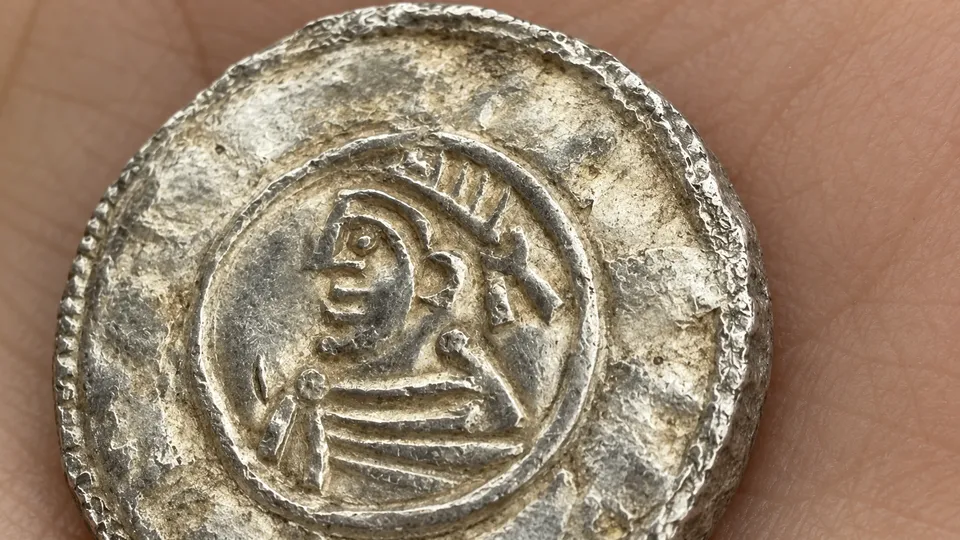
Norway’s largest known Viking Age coin hoard has passed the 5,000-coin mark and now stands at about 5,200, months after archaeologists believed they had recovered the main concentration from a field in eastern Norway.
The metal detectors are still picking up signals, and coin number 5,000 was recovered over the weekend. It was an Otto-Adelheid penny of a type already common in the find, lifted from the ground by the detectorists Rune Sætre and Vegard Sørlie together with the farmer who owns the land, Ole Erik Hørstad.
The search had effectively stopped at 4,886 coins before the summer. Excavation and ground-penetrating radar turned up no sign of more, so the field went back to the farmer and was sown with grain. Only after the harvest could the team return. Then the coins started coming up again.
The hoard, known as the Mørstad Hoard, first surfaced in April, when Mr. Sætre and Mr. Sørlie set out for what they expected to be an ordinary detecting season. May-Tove Smiseth, the Innlandet county archaeologist, initially thought the find might run to a few hundred coins. Only when the count passed 4,000 did she begin to wonder whether it could reach 5,000. It now has, she said, with county archaeologists still working the field beside the detectorists.
What is left appears to lie deep. Ms. Smiseth said the detectors keep sounding, though less often and at greater depths, according to a report by Arkeonews. Archaeologists are now stripping away soil layers so the machines can reach those targets. The slowing pace may mean the search is nearing the hoard’s outer edge, but the field hasn’t gone quiet, and no one is offering a final number.
The coins give a narrow window for the burial. Four Norwegian issues struck under Harald Hardrada place the deposit around 1046-47, near the end of the Viking Age.
Most of the hoard still awaits close study. Specialists at the Museum of Cultural History are cataloguing the thousands of coins, Scandinavian and foreign alike, a job expected to take at least a year. Anne Skogsfjord, a coin specialist, has already picked out English coins naming moneyers called Beorn, Aslac and Cetil, names that sound Scandinavian and raise the question of Vikings at work in English mints, Science Norway reported. The evidence doesn’t say who those men were.
The biggest question is why anyone buried that much silver in that field and never came back. No structure, grave or other feature has turned up to explain the spot, and the sheer weight of the deposit rules out simple loss. The archaeologist Kjetil Loftsgarden put it plainly when the count was still below today’s total: a person would hardly forget where nearly 5,000 silver coins lay. Whoever owned it never returned. A thousand years on, the field is handing the silver back a coin at a time.