
Order a coffee in Copenhagen with the one word every phrasebook gives you for politeness, and you will not find it. Danish has no single lexical item that does what English “please” does across a question, a command and a plea. Neither does Swedish, Norwegian, Icelandic or Finnish. That is not an absence of politeness. It is politeness built into a different layer of the sentence — mood, particle, intonation, or a second word stapled on after the fact — and the mechanism is worth taking apart piece by piece, because the same split shows up, in different places, in most of the world’s languages.
The claim comes from the BBC’s Laura Hall, reporting from a Copenhagen bakery queue. She cites Dr James Puchowski, a linguist at the Nynorsk Kultursentrum (the Norwegian Museum of Written Culture), and the Danish-language teacher Daniela Hummelgren, on how the five main Nordic languages patch the gap: Danish speakers front a request with må jeg bede om (“may I ask for”); Swedish speakers often append tack (“thank you”) to the end of the sentence; Norwegian politeness leans on a rising intonation and a smile rather than any added word; and Icelandic presses takk into the same service that “please” and “thank you” split in English. Finnish, from an entirely separate language family — Finno-Ugric, not Germanic — follows the same social pattern anyway, using kiitos (“thanks”) rather than a please-equivalent, and conditional verb forms to soften a request.
The mechanism, not the vocabulary
What’s actually happening grammatically is that politeness marking migrates to wherever a language already has a slot for it. English happens to have a free-floating adverb that attaches to almost any speech act — a request, an order, an offer — and layers deference on top without changing anything else about the sentence. That is an unusual design, not a universal one. Languages without that slot instead reuse existing machinery: a verb mood that marks indirectness (Finnish conditionals), a politeness particle borrowed from “thank you” (Swedish tack, Icelandic takk), a full embedded question that reframes the demand as a request for permission (Danish må jeg bede om), or prosody alone (Norwegian). None of this is an improvised workaround. Each is a stable, rule-governed part of the grammar, which is why native speakers don’t experience any gap at all — the gap is only visible from the outside, to someone holding an English checklist.
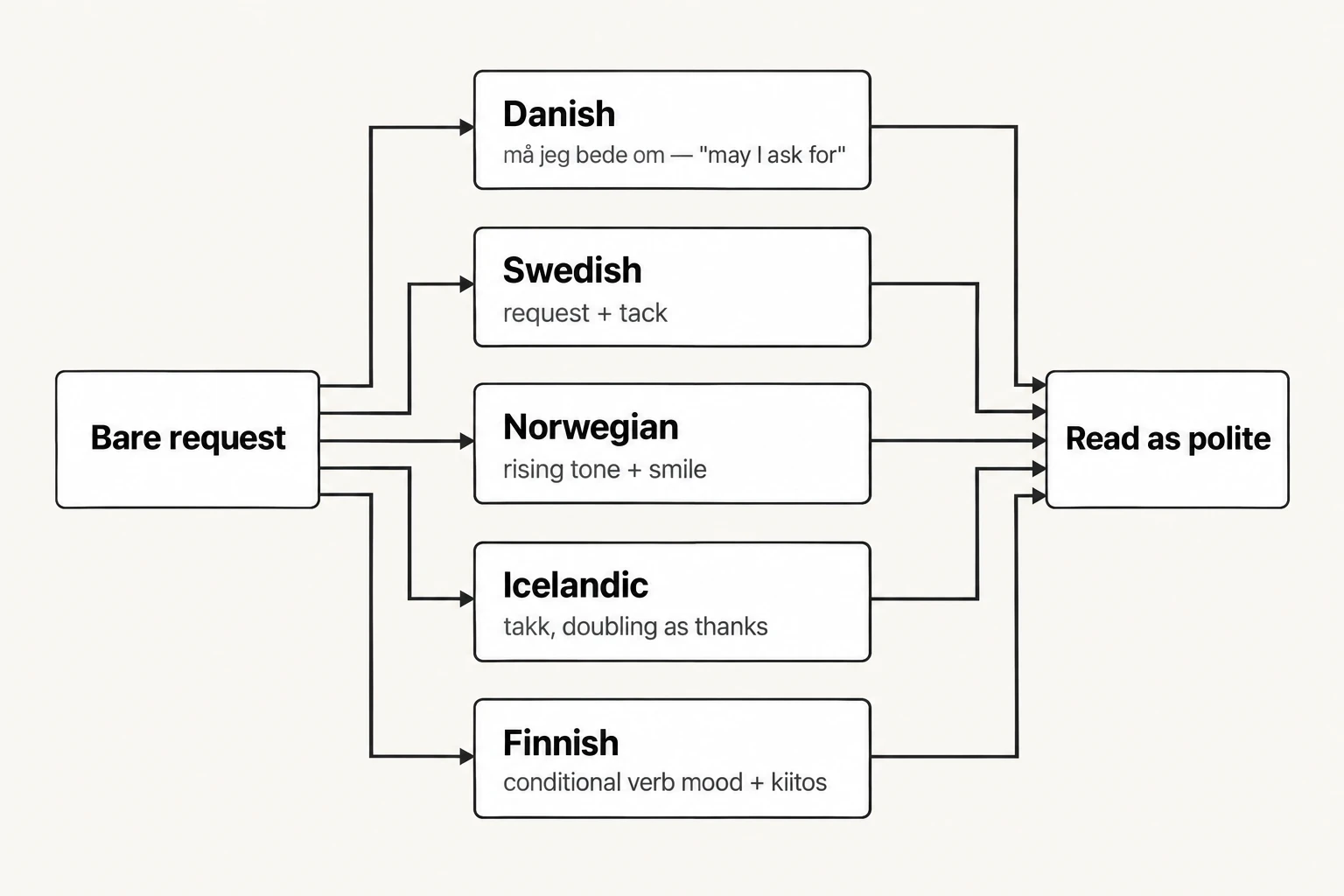
| From | To | How |
|---|---|---|
| Bare request | Danish (må jeg bede om — "may I ask for") | |
| Bare request | Swedish (request + tack) | |
| Bare request | Norwegian (rising tone + smile) | |
| Bare request | Icelandic (takk, doubling as thanks) | |
| Bare request | Finnish (conditional verb mood + kiitos) | |
| Danish (må jeg bede om — "may I ask for") | Read as polite | |
| Swedish (request + tack) | Read as polite | |
| Norwegian (rising tone + smile) | Read as polite | |
| Icelandic (takk, doubling as thanks) | Read as polite | |
| Finnish (conditional verb mood + kiitos) | Read as polite |
Based on Laura Hall, BBC Travel
The egalitarianism argument
Puchowski’s explanation for why Nordic languages route around a dedicated please-word rather than just inventing one is sociolinguistic, not grammatical: egalitarian societies mark status distinctions less in everyday speech. Formal address terms like Herr and Frue (Sir and Madam) have mostly dropped out of Danish; a deferential catch-all word would do a similar job of signalling that the speaker is beneath the listener, which is precisely the signal Nordic speech habits tend to avoid. He links this to Jante’s Law, the informal Scandinavian social code that nobody should act as though they are better than anyone else. Hummelgren’s version of the same point is practical rather than theoretical: “Efficiency is valued here and communication is generally direct.” Overdoing the courtesy can read as suspicious rather than warm — she notes that sending a physical thank-you card after a job interview in Denmark “would read as a bit over the top and perhaps like you are looking for favours.”
Checking the claim against the record
The “no word for X” framing is a known trap, and linguists have been flagging it for years. Mark Liberman at Language Log took apart a nearly identical claim about Icelandic in a 2010 post — a British newspaper had asserted Iceland’s language made “British manners impossible to impart” because it had no word for please. Liberman calls this an instance of a recurring meme, and lists the languages that, by his count, turn up online carrying the same claim: Danish, Hawaiian, Finnish, Ingush, Hindi, Swedish, French, Wolof, Munsee, Mursi, Malayalam, Dutch, Somali, Ojibway, Hungarian, Urdu and Mongolian, among others. His objection is structural: no language maps its vocabulary onto English word-for-word, and the absence of an exact one-to-one match for please tells you nothing on its own — “the same thing could be said about nearly any common word in nearly any language.” He points out that Icelandic in fact has takk, which does real politeness work across roughly the territory that English splits between please and thank you — making the original British newspaper’s claim, in his words, “apparently bogus.”
That caution is worth applying here too. Several of the languages on Liberman’s list are poor fits for the claim once you look closer. Polish is one: proszę, the first-person present form of the verb prosić (“to ask, to request”), functions as a general-purpose politeness marker almost exactly where French uses s’il vous plaît — it fronts a polite imperative (“proszę usiąść”, please sit), answers a knock at the door (“here you go”), and softens an order. It is not identical to English please in distribution, but it is a dedicated, routinised word doing the same job, which undercuts any claim that Polish lacks one outright. French’s own fix, s’il vous plaît, is a frozen multi-word phrase — literally “if it pleases you” — rather than a single token, which is also how English please itself started out, as a contraction of “if you please.”
Boxes: the mechanism elsewhere
Japanese splits the job by grammatical category rather than collapsing it into one word at all. Kudasai (ください), from the honorific verb kudasaru (“to give”), is used when the request is phrased as asking someone to give an object or perform an action; onegaishimasu (お願いします), built on the verb negau (“to request” or “to desire”), is used for favours and services and carries more deference. Both translate loosely as “please,” and the distinction between them tracks exactly the kind of social-register system — keigo, Japanese honorific speech — that English handles with tone and context instead of a dedicated grammar.
Mandarin’s 请 (qǐng) looks more like a direct equivalent but isn’t quite one. It always precedes the verb rather than trailing a sentence the way English please can (qǐng zuò, “please sit”; qǐng jìn, “please come in”), and it carries an underlying sense of “to invite” — the same character that produces 我请你, “I’ll treat you,” meaning the speaker is picking up the bill. For casual everyday requests among friends, speakers more often reach for 麻烦你 (“sorry to trouble you”) than for qǐng, which reads as comparatively formal — so even a language with an apparent one-word fit for “please” doesn’t use that word the way English speakers assume.
Hindi and Urdu have kripya and براہ کرم, both formal and used mainly in writing or official announcements rather than conversation, where speakers instead rely on verb-ending honorifics that mark deference directly into the grammar of the sentence — closer to the Japanese model than to the English one. The pattern across all of this, including the Nordic case the BBC describes, is that politeness is a function a language has to perform somewhere, not a word every language is obliged to have. Where the word is missing, look at the verb mood, the particle, or the pitch contour, and it is usually sitting right there.
None of this tells a traveller anything they can act on faster than Hummelgren’s actual advice: watch how the people around you phrase a request, and match it. The word will not be there to copy. The grammar will.