
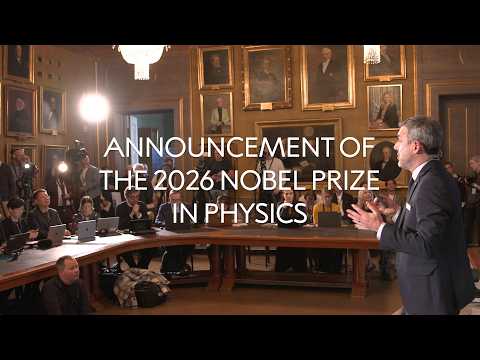
The Royal Swedish Academy of Sciences gave Francis Halzen the 2026 Nobel Prize in Physics on Tuesday “for decisive contributions to the IceCube Neutrino Observatory and the discovery of high-energy neutrinos of astrophysical origin,” according to the academy’s citation. The prize money is 12 million Swedish kronor, about $1.2 million at this year’s exchange rate, up from 11 million kronor in 2025 to mark the award’s 125th anniversary. The instrument that earned it: a cubic kilometer of Antarctic ice, from 1,450 to 2,450 meters below the South Pole, strung with 5,160 light sensors on 86 cables sunk into the ice on a 125-meter grid, built for $279 million, $242 million of it from the US National Science Foundation, per the project’s public specifications. Halzen, 82, is a professor at the University of Wisconsin–Madison and IceCube’s principal investigator.
Neutrinos are what Al Jazeera’s coverage of the award calls “ghost particles”: no electric charge, almost no interaction with ordinary matter, so most pass through an entire planet without touching an atom. Scientific American reported that neutrinos are the least understood of the seventeen known fundamental particles, which is why catching them at all requires a detector the size of a mountain. IceCube doesn’t see a neutrino directly. On the rare occasion one does strike a nucleus in the ice, the collision throws off a charged particle moving faster than light travels in that medium — not a violation of relativity, light just slows down in ice — and that particle sheds a cone of blue light called Cherenkov radiation as it goes. The 5,160 photomultiplier tubes record when and how brightly that light arrives; software then works backward from the timing pattern to the neutrino’s energy and direction of origin. At 60 modules per string over a 1,000-meter depth range, the vertical spacing between sensors works out to roughly 17 meters.
| From | To | How |
|---|---|---|
| Cosmic source (e.g. a flaring blazar jet) | Neutrino crosses space (passes through matter unimpeded) | |
| Neutrino crosses space (passes through matter unimpeded) | Rare collision in ice (strikes a nucleus 1.4–2.45 km deep) | |
| Rare collision in ice (strikes a nucleus 1.4–2.45 km deep) | Cherenkov light cone (charged particle outruns light in ice) | |
| Cherenkov light cone (charged particle outruns light in ice) | 5,160 light sensors (86 strings, record timing and brightness) | photons |
| 5,160 light sensors (86 strings, record timing and brightness) | Software reconstruction (computes energy and direction) | hit pattern |
| Software reconstruction (computes energy and direction) | Alert broadcast (sent worldwide within 1 minute) | |
| Alert broadcast (sent worldwide within 1 minute) | Telescope follow-up (Fermi, MAGIC, VERITAS and others) |
Based on IceCube Collaboration, Science
Halzen started on this in 1987, after concluding that an earlier Soviet attempt to catch neutrinos with radio antennas in Antarctic ice would be too weak to register, per his career record. That became AMANDA, a pilot array of sensors in the ice, which folded into the larger IceCube design in 2005. Workers bored 86 holes with jets of hot water and lowered a sensor string down each one; the last string went in on December 18, 2010, after seven Antarctic summers of drilling, and the array went fully operational the following year.
Francis Halzen has led an international team of researchers and engineers who have provided us with a fantastic instrument. His tenacity and scientific vision has paved the way for a new kind of astronomy.
That quote, from Mark Pearce, chair of the Nobel Committee for Physics, points at the result that made the prize possible. In November 2013 the IceCube Collaboration published 28 extremely high-energy events in Science, the first solid evidence of astrophysical neutrinos from beyond the solar system. Two of them, nicknamed Bert and Ernie after the Sesame Street characters, exceeded one quadrillion electron volts, or one petaelectronvolt (PeV); Ernie, detected on January 3, 2012, measured 1.14 PeV, the highest-energy neutrino recorded at the time. For scale, the Large Hadron Collider’s Run 3 beams, the highest-energy proton beams ever produced on Earth, run at 6.8 TeV each — Ernie carried roughly 170 times the energy of a single LHC beam, in one particle, made by something no human accelerator can touch. Halzen called the find, in reporting at the time, “the dawn of a new age of astronomy.” Science named it that year’s Breakthrough of the Year.
The clearer demonstration came on September 22, 2017, when IceCube caught a 290 TeV neutrino, designated IceCube-170922A, and broadcast an automated alert within a minute. About 20 observatories pointed at the source direction; the Fermi Large Area Telescope found it coincided, within 0.1 degrees, with a known gamma-ray source, the blazar TXS 0506+056, then in a flaring state. Follow-up by the MAGIC and VERITAS telescopes confirmed gamma-ray emission from the same point. That’s the kind of triangulation researchers call multimessenger astronomy: a cosmic event seen simultaneously in light and in neutrinos. The engineering caveat is in the statistics. The real-time coincidence came out to 3 standard deviations of significance; a second look at nine and a half years of archived data found an earlier, unrelated flare from the same blazar’s direction at 3.5 standard deviations. Particle physics normally sets its “discovery” threshold at 5 standard deviations, the point past which a chance coincidence becomes implausible. Both TXS 0506+056 results, published in Science, sit below that bar — evidence, in the field’s own vocabulary, not proof.
Halzen is only the second person since 1992 to take the physics prize alone; the last was the French physicist Georges Charpak, per Scientific American’s accounting. Every physics Nobel since has gone to two or three laureates, including the past three years: attosecond pulses for studying electron motion in 2023, the statistical-physics techniques underlying modern machine learning in 2024, and macroscopic quantum effects in electrical circuits in 2025. Michael Moloney, CEO of the American Institute of Physics, told Scientific American the award recognizes “big, publicly funded science” of a kind now under financial pressure in the US, where IceCube itself was built with NSF money. The US has another flagship neutrino project underway: the Deep Underground Neutrino Experiment, whose far detector caverns a mile beneath South Dakota’s Sanford Underground Research Facility finished excavation in February 2024, with first beam still pending.
IceCube itself isn’t finished growing. A $37 million expansion, $23 million of it from the NSF, added seven new strings and more than 700 upgraded optical modules to the original 86 strings and 5,160 sensors; the University of Wisconsin–Madison says that Upgrade was completed in 2026. The next step, IceCube-Gen2, would instrument eight cubic kilometers of ice instead of one — an eightfold jump in detection volume — plus a surface air-shower array and a 500-square-kilometer radio array for even higher-energy neutrinos. Project physicists, including UW-Madison’s Albrecht Karle, have said Gen2 would cost roughly $350 million, a Universe Today account of the proposal reports, comparable to the original IceCube’s $279 million. Run the arithmetic: that’s about $44 million per cubic kilometer against the original’s $279 million per cubic kilometer, a sixfold efficiency gain the collaboration attributes to wider sensor spacing, 240 meters instead of 125. Whether that spacing still catches enough Cherenkov light to reconstruct events reliably is a design bet that hasn’t been tested at this scale; Gen2 is still in federal review, not under construction.
The number worth watching next isn’t in Stockholm. It’s whatever figure the NSF puts on Gen2’s budget line once that review concludes, against the funding climate for large US physics projects that Moloney flagged on the day Halzen’s prize was announced.