
On December 23, 2022, the House passed a $1.7 trillion government-funding bill 225 to 201, with one member voting present. Of the 427 votes cast, 226 were cast by a member who was not in the Capitol, standing in for a colleague who had designated them a proxy. Subtract the proxies and only 201 members were physically on the floor. On Friday, nine judges on the full U.S. Court of Appeals for the Fifth Circuit, voting 9-8, held that those 201 bodies were not enough to do business under the Constitution, so the House never had a quorum, so the bill’s passage was unconstitutional.
The practical result, in the court’s own description and as CNN reported, is narrow: the federal government cannot enforce the Pregnant Workers Fairness Act, a provision of that same bill requiring employers to accommodate pregnant workers, against the state of Texas. The legal theory behind it is not narrow at all, and that gap between the remedy and the reasoning is the story.
What a quorum is for
Article I’s Quorum Clause says a majority of each chamber constitutes a quorum “to do Business.” For the House that means 218 of 435 seats. The clause does two different jobs that are easy to conflate: it sets the threshold for the House to act at all, and it is silent on how the House proves that threshold was met. The 1892 case the dissent leans on, United States v. Ballin, addressed only the second question — it held Congress can use “any method which shall be reasonably certain to ascertain the fact” of a quorum, and courts should not second-guess the method. The House’s own journal, Ballin said, settles it.
The House’s 2020 proxy rule, adopted as H.Res. 965 on a 217-189 vote once the pandemic made floor attendance a health risk, let an absent member sign a letter designating a colleague to cast their vote and, under the rule’s text, count as present. It was tied to a Speaker-declared public-health emergency, renewable in blocks of up to 45 days, and the House carried a version of it (H.Res. 8) into the 117th Congress, which is what was in effect on December 23, 2022.
| Members (members) | |
|---|---|
| In person | 201 |
| By proxy | 226 |
Source: U.S. Court of Appeals for the Fifth Circuit. Of 427 recorded votes (225 yea, 201 nay, 1 present) on the House Clerk's Roll Call 549
The chart is the whole dispute. Judge Cory Wilson, writing for the majority, treated the method question Ballin settled and the threshold question as the same thing: a proxy letter cannot make an absent body present, so counting proxies toward the 218-member threshold is itself unconstitutional, whatever rule the House wrote to allow it. “‘Proxy presence’ does not count,” Wilson wrote, and “the Quorum Clause’s constraints on congressional power cannot be circumvented by congressional fiat.” Judge James Graves Jr., dissenting, argued the majority was answering a question Ballin already closed and inventing a physical-presence requirement the text never states; he called the result “illogical, inexplicable, and invalid,” as Law Dork reported. Judge Catharina Haynes dissented separately, in a footnote, saying she did not think it her place to “throw out the Federal House of Representatives in this arena.”
The majority also found a second, narrower defect: even taking the House’s own rule at face value, the government never established that the “existence of an emergency” required to invoke it still held on the day of that vote, CNN reported. That ground alone would have let the court rule for Texas without touching the broader presence question — which makes the majority’s choice to reach the bigger constitutional holding a choice, not a necessity.
A four-year trip for one injunction
Texas’s then-attorney general, Ken Paxton, sued in 2023 to keep the Pregnant Workers Fairness Act from applying to the state as an employer. U.S. District Judge James “Wes” Hendrix, in the Northern District of Texas, agreed in February 2024, in a ruling that ran past 100 pages working through why the enrolled-bill doctrine — the rule that courts normally take an authenticated, signed bill at face value and don’t reopen how it was passed — doesn’t block a constitutional quorum challenge. A three-judge Fifth Circuit panel reversed him 2-1 in 2025, finding the House acted within its own rulemaking authority. The full court vacated that panel ruling to rehear the case en banc, and Friday’s 9-8 judgment restores Hendrix’s injunction.
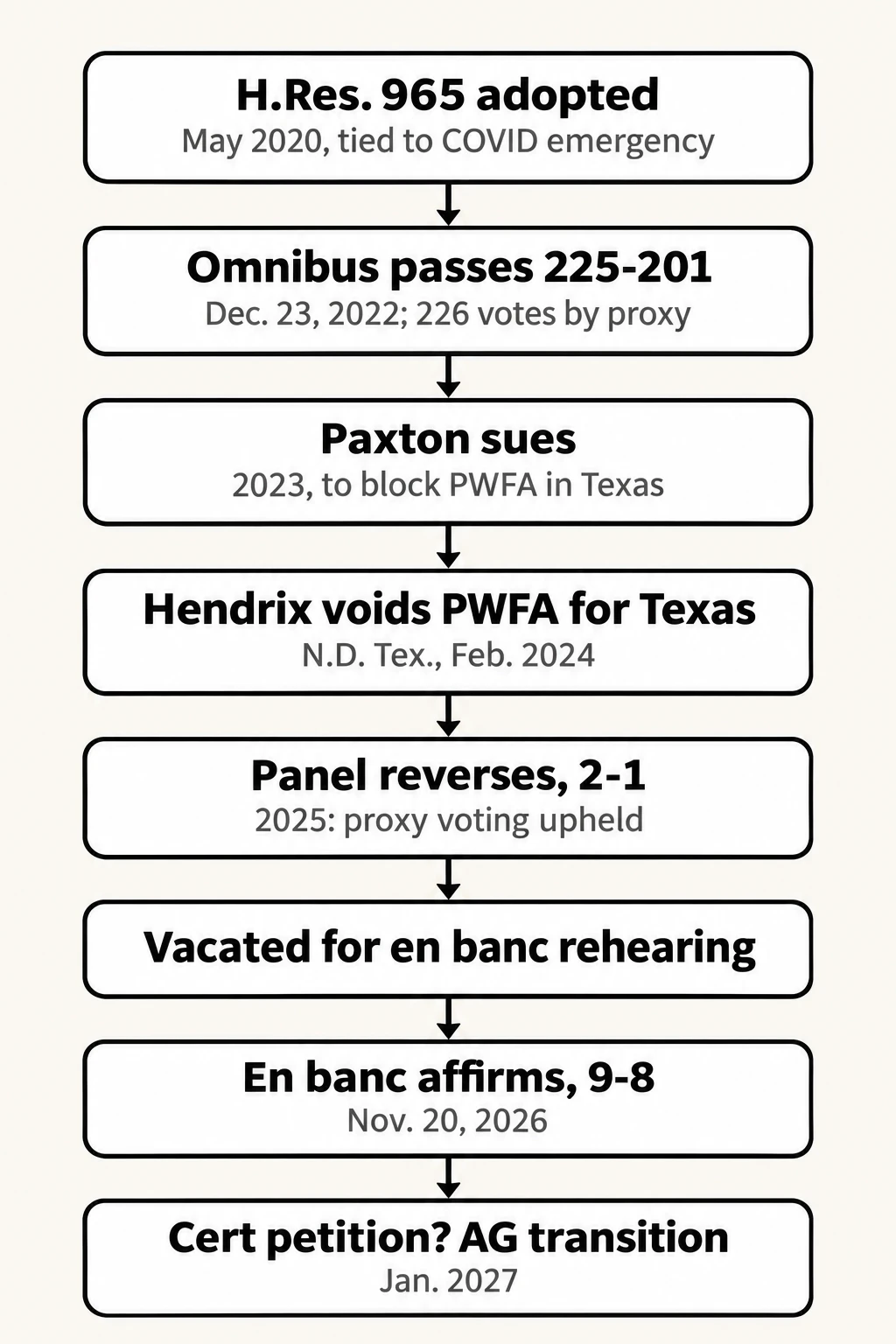
| From | To | How |
|---|---|---|
| H.Res. 965 adopted (May 2020, tied to COVID emergency) | Omnibus passes 225-201 (Dec. 23, 2022; 226 votes by proxy) | |
| Omnibus passes 225-201 (Dec. 23, 2022; 226 votes by proxy) | Paxton sues (2023, to block PWFA in Texas) | |
| Paxton sues (2023, to block PWFA in Texas) | Hendrix voids PWFA for Texas (N.D. Tex., Feb. 2024) | |
| Hendrix voids PWFA for Texas (N.D. Tex., Feb. 2024) | Panel reverses, 2-1 (2025: proxy voting upheld) | |
| Panel reverses, 2-1 (2025: proxy voting upheld) | Vacated for en banc rehearing | |
| Vacated for en banc rehearing | En banc affirms, 9-8 (Nov. 20, 2026) | |
| En banc affirms, 9-8 (Nov. 20, 2026) | Cert petition? AG transition (Jan. 2027) |
Based on U.S. Court of Appeals for the Fifth Circuit, No. 24-10386
Both sides, oddly, agree the enrolled-bill doctrine doesn’t apply here, as Reason’s Josh Blackman noted: Wilson and Graves both treat a quorum defect as a question about whether Congress had constitutional authority to act at all, which the doctrine was never meant to shield. Their fight is only about whether that defect exists.
The majority wrote that its holding is confined to “whether the Quorum Clause allows proxy presence to be included in the quorum count,” and that the injunction reaches only PWFA enforcement against Texas. Nothing else in the same bill — not the roughly $45 billion in aid to Ukraine and NATO allies, not the roughly $40 billion in disaster relief, not the Electoral Count Reform Act, not the ban on TikTok on federal devices, all passed on the identical 225-201 vote with the identical 226 proxies — is touched by Friday’s order. Graves’s dissent, as Bloomberg Law quoted it, called that line arbitrary: “There is no explanation offered to explain why... this court’s judgment should be limited only to one small sliver of the multi-trillion dollar bill.”
There is no explanation offered to explain why... this court’s judgment should be limited only to one small sliver of the multi-trillion dollar bill.
Graves’s point is the engineering question underneath the politics: if 201 physically present members genuinely could not constitute a quorum, that is a defect in the session, not in any one line of the bill that session produced. The majority’s narrow scope holds only because no other plaintiff has yet sued over a different provision of the same bill, in the same circuit, with standing to challenge it. Texas’s lawsuit happened to be about pregnant workers. It could as easily have been about the Electoral Count Reform Act — the law governing how Congress certifies presidential elections — which election-law scholar Rick Hasen flagged on his Election Law Blog as sitting in the same bill, passed on the same vote, exposed to the same reasoning.

Who is left to appeal it
The case is captioned Texas v. Blanche because the named federal defendant is whoever runs the Justice Department, and that is now Todd Blanche, confirmed as attorney general on August 8, 2026 after President Trump fired Pam Bondi in April. Blackman predicts a certiorari petition “writes itself” given the circuit split this creates with ordinary quorum practice elsewhere, but whether DOJ files one is a political call for an administration with no particular stake in defending a Biden-era House’s pandemic procedure.
The Texas side of the case is less settled still. Paxton left the attorney general’s office to run for the U.S. Senate and lost; Texas voters elected Democrat Nathan Johnson, a Dallas state senator, to succeed him, 52.3 percent to 46 percent, the Texas Tribune reported — the first Democrat in the office since 1999. Johnson takes over in January 2027 and could simply drop the suit his predecessor built, which under the Munsingwear doctrine Blackman cites could vacate the Fifth Circuit’s judgment entirely without the Supreme Court ever ruling on the Quorum Clause question. Whether a four-year-old fight over pregnancy accommodations ends with the biggest open question in congressional procedure in decades, or just evaporates when the plaintiff changes its mind, is now down to one newly elected official who hasn’t been sworn in yet.