
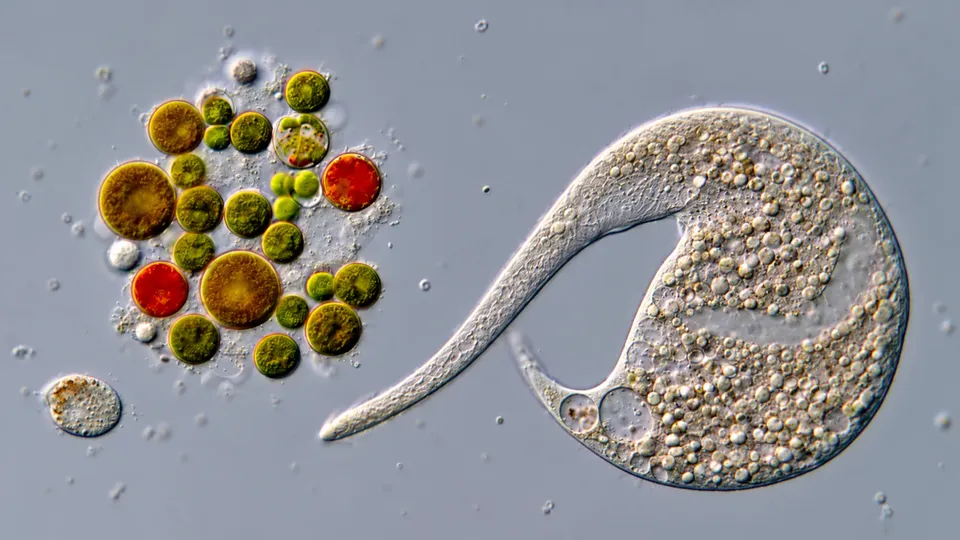
Nikon took 16 days to unwind a prize it had already handed out. On October 9 it disqualified the first-place winner of its 16th annual Small World in Motion video competition and promoted the second-place entry to first, after an investigation found the winning footage broke a rule printed plainly in the contest’s own terms: “AI generated videos are not permitted,” with Nikon reserving “the right to request the original video for verification,” per the competition’s official rules.
The disqualified video, announced as the winner in September, showed what was captioned as the abnormal beating of airway cilia — the hair-like projections that line human airways and beat in coordinated waves to clear mucus — from a child with primary ciliary dyskinesia (PCD), a genetic disorder that disables that beating. PCD is rare: clinical surveys put its prevalence at roughly 1 in 10,000 to 1 in 20,000 live births, while newer genetic-database analyses suggest the true rate may be closer to 1 in 7,500, with likely underdiagnosis baked into both figures. The entrant was Ning Xu, described by Nikon at the time of the award as a researcher at Tsinghua University; Nikon has since said he has joined the National University of Singapore as a research fellow.
The mechanism that unraveled the win was not a single smoking gun but three independent lines of evidence converging within about three weeks of the September announcement.
What reviewers found
Edward Phelps, a bioengineering researcher at the University of Florida, flagged three sets of structures in the footage that do not correspond to known airway cell biology, as Gizmodo reported: purple objects the size of cell nuclei that resembled mitochondria, despite mitochondria of that size not occurring outside cells in real tissue; blue nodules shaped like nuclei that did not behave like nuclei; and red structures he said he could not identify at all. Melanie White, a developmental biologist at the University of Queensland, put the underlying problem in general terms: scientific images are data, and researchers “need to be able to trust that what we are seeing is grounded in the underlying measurement.” Andrew Moore, a former contest judge whose own entry later moved up to third place, compared the footage to AI photo restoration, telling the Telegraph that “if it was your grandma who was face-swapped, it’s going to be unsettling.”
The second line of evidence was a digital fingerprint. Ian Donovan, an MD/PhD student at UT Southwestern Medical Center, ran the video through Google Gemini and reported that it came back carrying an embedded SynthID watermark — the invisible marker Google DeepMind embeds in content its generative models produce or touch, designed to be detectable by DeepMind’s own tools even after recompression or editing. A watermark of that kind does not appear in footage untouched by Google’s generative systems; its presence was, on its own, close to dispositive.
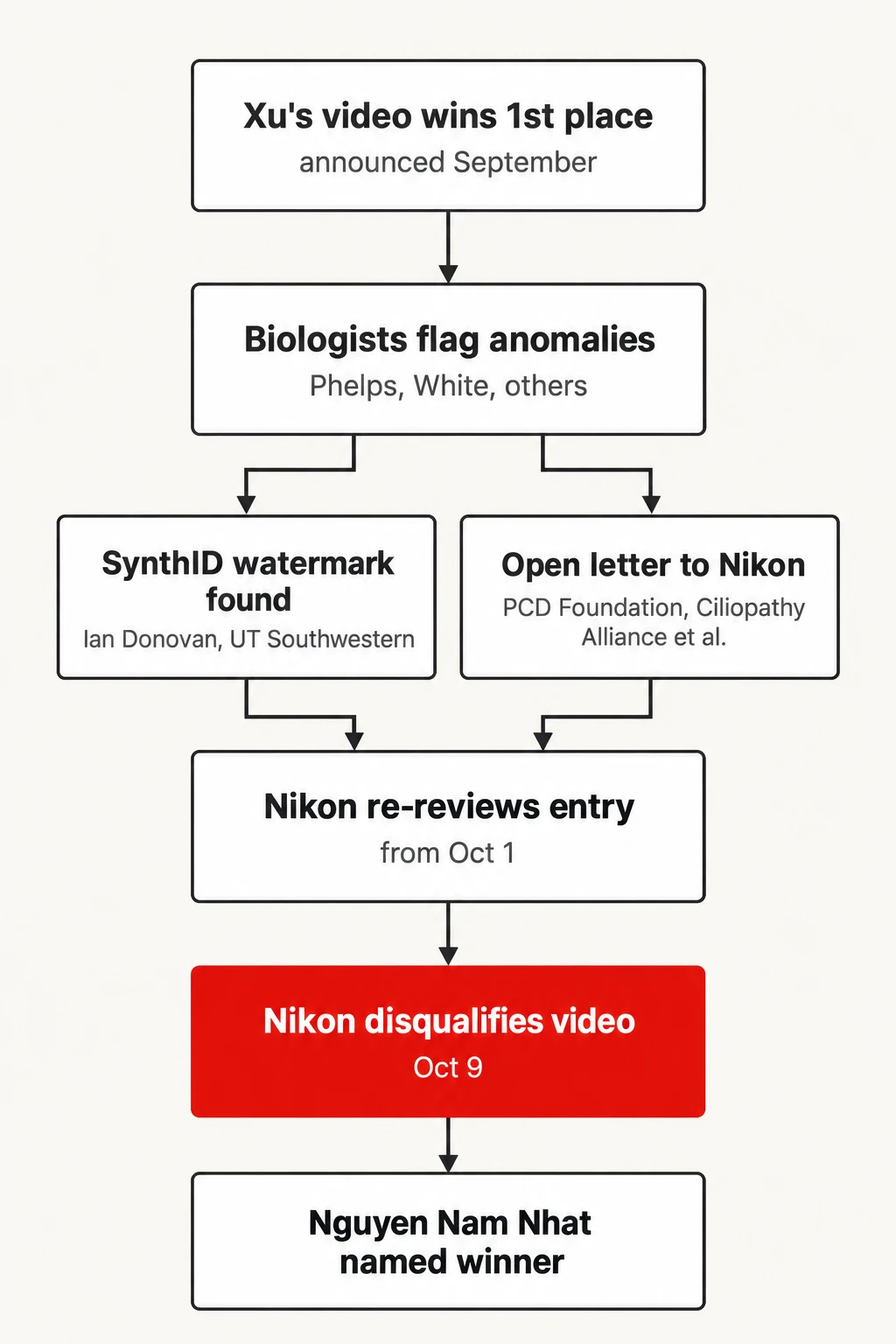
| From | To | How |
|---|---|---|
| Xu's video wins 1st place (announced September) | Biologists flag anomalies (Phelps, White, others) | |
| Biologists flag anomalies (Phelps, White, others) | SynthID watermark found (Ian Donovan, UT Southwestern) | |
| Biologists flag anomalies (Phelps, White, others) | Open letter to Nikon (PCD Foundation, Ciliopathy Alliance et al.) | |
| SynthID watermark found (Ian Donovan, UT Southwestern) | Nikon re-reviews entry (from Oct 1) | |
| Open letter to Nikon (PCD Foundation, Ciliopathy Alliance et al.) | Nikon re-reviews entry (from Oct 1) | |
| Nikon re-reviews entry (from Oct 1) | Nikon disqualifies video (Oct 9) | |
| Nikon disqualifies video (Oct 9) | Nguyen Nam Nhat named winner |
The third pressure came from the patient-advocacy side of the field. A coalition led by the researcher Pleasantine Mill, including the PCD Foundation, PCD Support UK, the Ciliopathy Alliance, the European Reference Network for rare lung diseases (ERN-LUNG PCD), and scientists from UCSF, the University of Geneva, the University of Leicester, King’s College London and Washington University in St. Louis, circulated an open letter, as FocalPlane reported. The letter noted that despite the contest’s own rule letting Nikon demand the raw footage, “three weeks on the original recording has still not been made available for scrutiny,” and argued the delay was “unfair to the hundreds of entrants who submitted real footage” and risked misinforming the public about a disease most people have never heard of. The group asked Nikon to publish its findings, pull the award if the footage failed review, and set explicit AI rules for future contests — while stressing the letter was not anti-AI, citing the technology’s legitimate role in denoising, segmentation and image reconstruction.
Xu’s own account, repeated across his statements and unchanged through the review, drew a line between generating a video and merely processing one. He said AI was used only “to distinguish and visualize features in the reconstructed grayscale images,” not “to generate the experimental movie, the cilia, or their motion,” and framed his defense around a distinction between using an image to make a scientific claim versus using visualization to communicate data’s beauty. That distinction does not survive contact with the SynthID finding: a watermark tied to generative output does not care whether the operator believes the underlying motion is real. Nikon’s own statement sidestepped the factual dispute over what exactly the AI did, saying only that the video “did not comply with the competition rules regarding generative AI” and that the ruling “should not be interpreted as a judgment of the entrant’s professional reputation, scientific contributions, or intent,” according to Nikon’s published statement.
The new ranking
The revised results, confirmed on Nikon’s own results page, move every remaining entrant up one place. First place now goes to Nguyen Nam Nhat, working independently in Chu Se, Gia Lai, Vietnam, for a video of a roundworm and a single-celled Dileptus shot with differential interference contrast at 40x magnification, as Ars Technica reported. Second place goes to Benedikt Pleyer of Kirchberg, Bavaria, for jellyfish larvae suspended in water droplets, shot in darkfield at 25x. Third goes to Andrew Moore of the Howard Hughes Medical Institute’s Janelia Research Campus, for synchronized division in neighboring cells under confocal imaging at 63x. Fourth goes to Patrick Hickey of Hypha Research in Edinburgh, for mitochondria and chloroplast dynamics in Turtle Vine leaf cells, confocal at 40x. Fifth goes to Igor Adameyko of the Medical University of Vienna, for a sea slug, Cyerce kikutarobabai, shot in darkfield from 0.9x zoomed to 40x, listed in Nikon’s updated 2026 gallery.
Nikon’s statement conceded that its rulebook, written for a contest that has run for 16 years on the premise that a microscope lens is the only camera in the room, has not kept pace with what a neural network can now do to raw sensor output after the fact: “this event has shown the need for Nikon Small World and Nikon Small World in Motion to revisit rules and evaluation procedures for future competition entries.” The company has not said whether it will publish Xu’s original, unprocessed recording, the single piece of evidence the open letter’s signatories say would settle the dispute outright rather than by inference from a watermark and a biologist’s eye for an organelle that shouldn’t exist.