
A fine is supposed to make breaking the law more expensive than following it. That gets complicated when the defendant is Meta. According to Ashley Belanger at Ars Technica, a judge ordered the company to pay New Mexico $25 billion on Wednesday after a jury found nearly 44 million violations of the state’s consumer-protection law. Meta plans to appeal. The dispute is partly about whether a penalty can be large enough to change the company’s behavior without becoming constitutionally excessive.
New Mexico Attorney General Raúl Torrez declined to join an $18 billion settlement Meta reached earlier this year with attorneys general in nearly all states. His state instead sought as much as $40 billion. Torrez argued that Meta’s conduct harmed New Mexico’s entire population of 2 million and questioned whether a penalty would produce meaningful changes unless it affected the company’s stock price. One state has now obtained an order exceeding the multistate settlement by $7 billion. There is an incentive here for other attorneys general considering whether to settle.
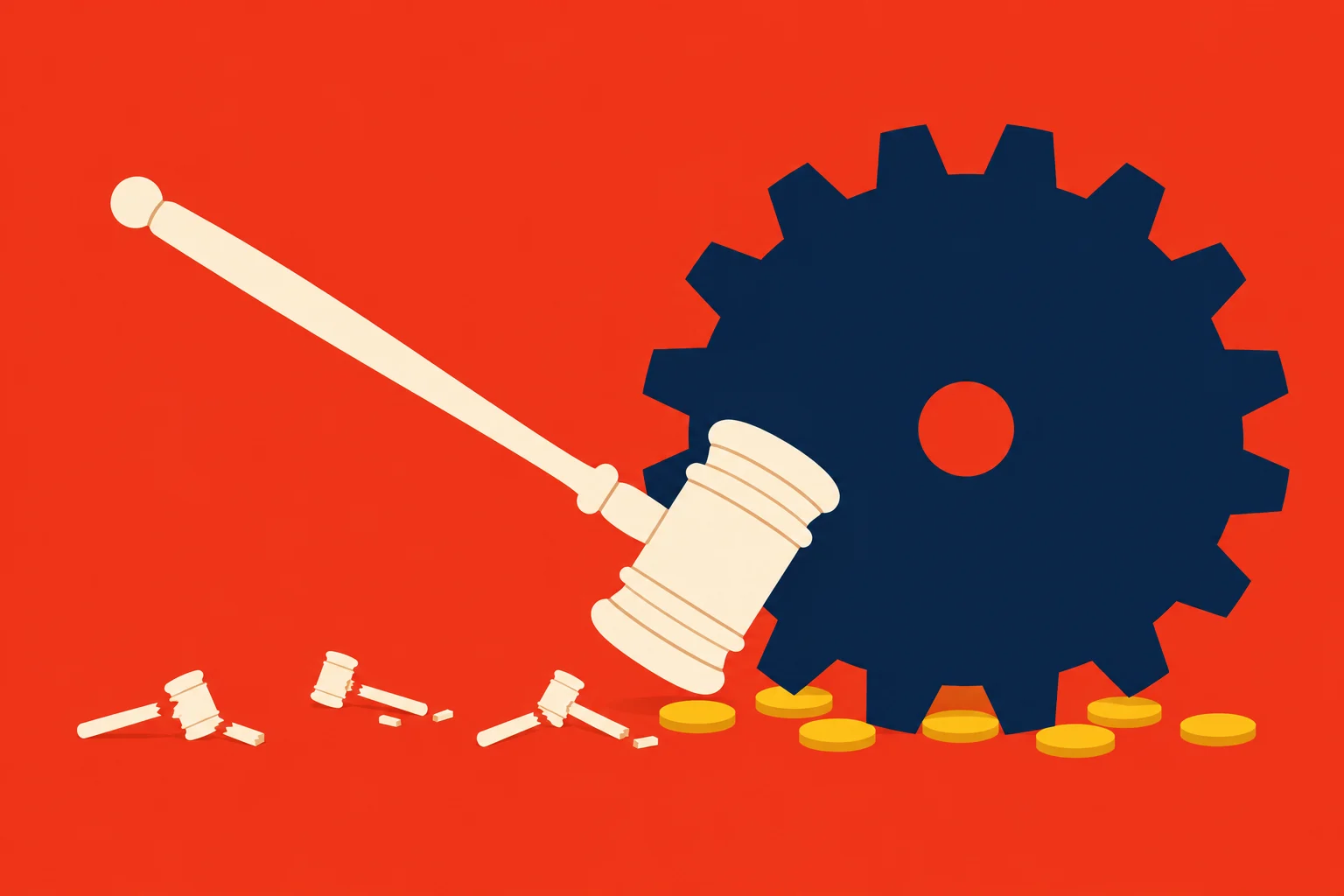
Judge Francis J. Mathew’s reasoning, as reported by Ars, was that the deception was sustained and deliberate. The jury’s findings concerned representations beginning in 2010 about users’ control over their data, third-party misuse, misinformation, hate speech and equal enforcement of platform rules. Mathew said there was no “bright line rule” for choosing the appropriate penalty, but found that the trial record supported the highest penalty level permitted by the state’s Unfair Practices Act. Leadership, including Mark Zuckerberg, knew the company was making misleading public representations, the judge found.
The business mechanism is fairly straightforward. Users deciding what to share need some understanding of who will see it and what will happen to it. If the company knows more than they do, it can explain the arrangement—or profit from their misunderstanding. Mathew concluded that Facebook chose the latter, capitalizing on information users did not realize they were sharing while trying to compete with the platform then known as Twitter. He cited a Zuckerberg message: “Give them a chance to change their privacy settings but obviously don’t encourage it.” A control can exist without the business particularly wanting you to use it.

The notification system presented another version of that problem. According to Mathew’s findings, Facebook flagged only two of 2,000 distinct apps associated with data misuse. The company deliberately narrowed its internal definition of misuse to reduce the operational burden of notifying people. Notice the accounting: informing users is an expense, while leaving them uninformed can preserve a commercial advantage. Consumer-protection enforcement is supposed to put an additional expense on the other side of that calculation.
The judge also found that Facebook knowingly continued earning money from pages carrying misinformation and hate speech. Internal research identified substantial misleading, false and possibly false political, health and science content, with false material more concentrated among top-performing advertising content than among top-performing Facebook content. Mathew said the company concealed that research. Meanwhile, promises of equal treatment coexisted with special treatment for celebrities and influencers: some received warnings before penalties and had content decisions reversed in circumstances where ordinary users would not.
Meta wanted a substantially smaller bill. Ars, citing Associated Press reporting, says the company argued for a maximum of $3.4 billion and called anything larger unconstitutional. It also pointed to its $5 billion Federal Trade Commission settlement over the Cambridge Analytica scandal. Mathew’s response was that earlier penalties and agreements had not stopped deceptive practices. The same settlement can therefore support opposite arguments: Meta can call it a benchmark for an appropriate sanction; the judge can call it evidence that the benchmark did not work.

At $25 billion divided by nearly 44 million violations, the order works out to roughly $568 per violation. That is an approximation, because the reported violation count is rounded. It nevertheless shows the constitutional argument’s basic tension: a penalty attached to each instance of conduct can become enormous when the conduct happens millions of times. Legal experts cited by Reuters, according to Ars, thought Meta had a reasonable chance of reducing the award on constitutional grounds. The order is not the last word on what Meta will pay.
The earnings comparisons require care, too. Ars reports that Meta’s third-quarter results included close to $10 billion paid for the multistate settlement, while also saying operating income would have been $22 billion higher without that expense. Those figures do not reconcile on their face, and the account does not explain the difference. Neither figure should be treated as establishing the new order’s accounting impact.
Meta’s spokesperson said the ruling and Torrez’s enforcement approach made doing business in New Mexico all but impossible, and described the lawsuit as seeking “to impose a tax on speech.” Torrez called the order a historic result demonstrating that large companies must obey state law. Nidhi Hegde of the American Economic Liberties Project urged stronger enforcement as AI products expand, pointing to Meta’s Muse assistant and the sensitive banking and medical information people might entrust to it. That is the next version of the same commercial question: how much trust a company can ask for, and what happens when its promises cost less to break than to keep.