

Early Māori at a coastal settlement on New Zealand’s South Island took roughly 70 to 110 years to move from hunting giant moa to fishing and gathering shellfish, according to new radiocarbon dates reported this month.
Archaeologists had long read the site, Shag River Mouth, also known as Waihemo, as a camp used for only 20 to 50 years in the 14th century. A study led by Fiona Petchey of the University of Waikato and published in the Journal of Pacific Archaeology found instead that people came back to the site in several phases between about 1320 and 1440.
The team didn’t dig new trenches. As Arkeonews reported, the researchers went back to samples collected decades ago and kept in scientific and university collections, choosing material that lived only briefly: charcoal, charred seeds, moa eggshell and bird bones. The two sites had last been dated more than 30 years ago.
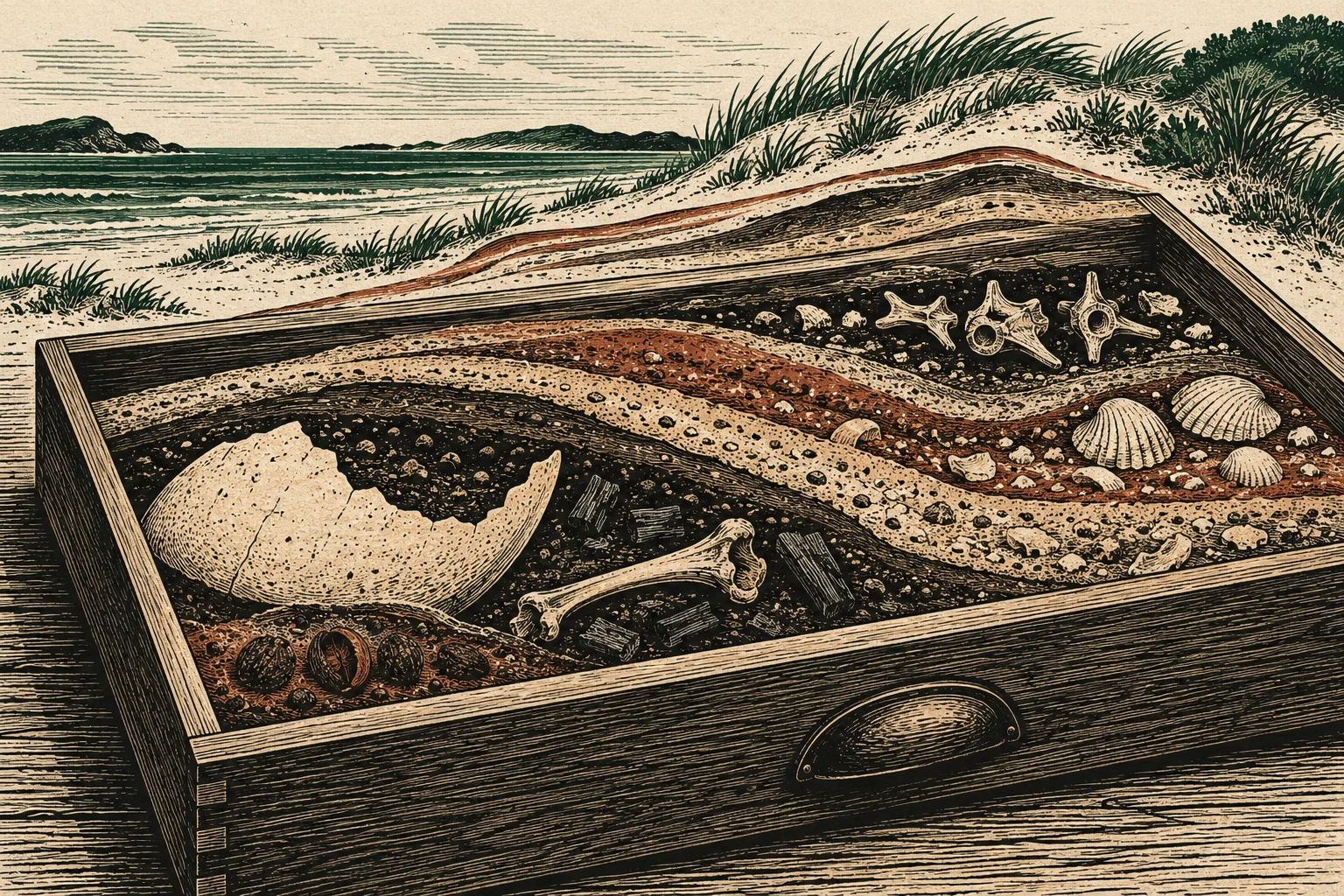
The older dates were a problem. Some had error margins of plus or minus 45 years, and some were “completely inaccurate due to built-in age, heirloom storage, and/or stratigraphic displacement,” according to the paper’s abstract.
New Zealand is a hard place to do this work. In an article for The Conversation, republished by NZCity on Oct. 15, Dr. Petchey wrote that radiocarbon dates are difficult to pin down between 1290 and 1400, and especially between 1480 and 1640, when atmospheric levels “changed very little.” Her team paired high-precision measurements with statistical models of the order in which layers were laid down, along with a technique called wiggle-matching.
At Waihemo, the oldest layers, from about 1320 to 1410, are full of butchered moa and seal. The deposits from roughly 1400 to 1440 hold more fish, shellfish, dogs and birds from open country, along with a large cooking oven. Sand between the layers probably marks pauses. The researchers can’t tell whether people left the settlement or just moved their work off the excavated dune.
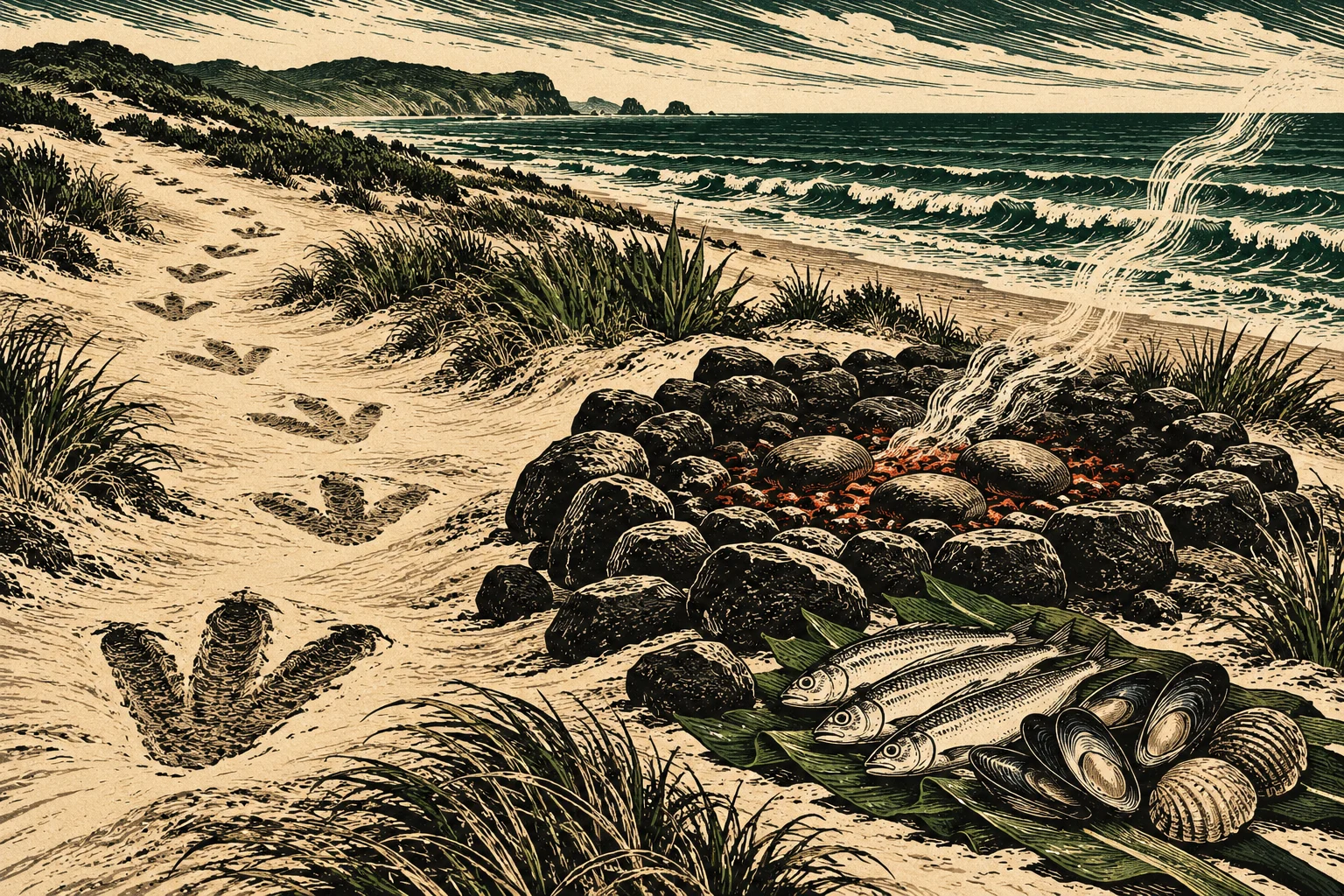
The longer timeline also clears up an old puzzle. Excavators had found objects from both early East Polynesian culture and the later transitional phase at a site supposedly occupied for a few decades. A century is enough time for one style to give way to the other.
The second site, Kokohuia, sits on the southern shore of Hokianga Harbour in Northland. Earlier dates there conflicted, with some archaeologists arguing for a brief occupation and others for centuries of use. The new model puts the first activity at about 1410 to 1440 and the end at about 1590 to 1630, a record spanning 160 to 220 years, though not continuously.
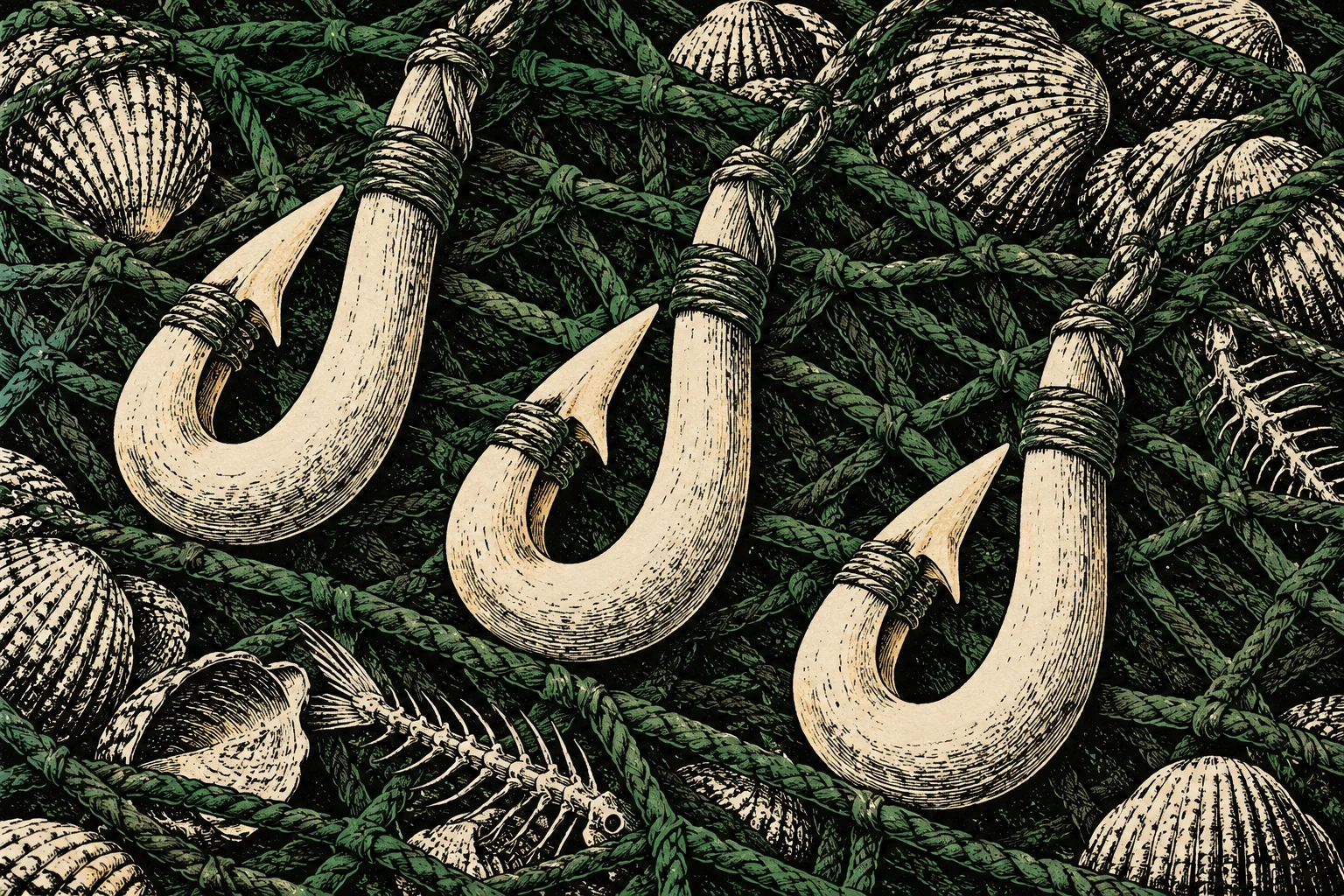
Charred seeds and ovens from the lowest layer belong to that early period. The main heaps of fish bone and shell came much later, around 1600, and may have built up in less than 90 years. Two-piece shell fishhooks from those heaps vary little in style, which fits a short window. Small bits of moa bone turned up in the lower deposits, but nothing shows they came from cooking or toolmaking, so the researchers can’t say moa were hunted there.
Archaeologists usually divide early Māori history into three periods: settlement and moa hunting from about 1250 to 1400, a transitional phase from 1400 to 1600 and Classic Māori society after that, with intensive food production and fortified settlements. Dr. Petchey wrote that labels like the “Māori Middle Ages” show how little is known about the middle stretch.
At Waihemo, diet and material culture were already changing before 1450. The paper says the results show those changes “began much earlier than orthodox chronologies suggest.” The authors also say some sharp breaks in the record may come from crude dating, not sudden shifts in daily life.
Two sites can’t stand in for every community in New Zealand, and the researchers have called for more high-resolution studies. The co-authors include Atholl Anderson, Louise Furey, Simon Bickler, Gerard O’Regan, Matthew Schmidt, Roderick Wallace and Peter Sheppard, and the work was funded by the Marsden Fund of the Royal Society Te Apārangi, Dr. Petchey wrote.
The methods can narrow events down to “just 20 or 30 years,” about a generation, she wrote, bringing research “closer to connecting archaeological evidence with Māori oral traditions.”