
Prime Minister Benjamin Netanyahu wants three of Israel’s top legal and security officials — army chief of staff Eyal Zamir, Shin Bet director David Zini, and Attorney-General Gali Baharav-Miara — to open a criminal investigation into 24 people. Their offense, in Netanyahu’s telling: talking to documentary filmmakers, anonymously, about how the Israeli military picks bombing targets in Gaza. In a letter posted to X on Saturday and reported by Al Jazeera, Netanyahu asked the three to prosecute the film’s sources for information-security offenses, criminal defamation and damage to Israel’s diplomatic and security interests.
The film is NAZA, an 80-minute documentary made in partnership with Britain’s Guardian, directed by Israeli journalist Yuval Abraham and filmmaker Rachel Szor — the pair behind No Other Land, which won the 2025 Oscar for best documentary feature. NAZA premiered at the Venice Film Festival last month as the only documentary in the festival’s main competition, took the Special Jury Prize, and got a 25-minute standing ovation, according to the Times of Israel. Its title comes from a Hebrew military acronym for the civilian deaths expected from a strike — the number the army is willing to accept before it fires.
What the 24 sources describe
Abraham built NAZA from conversations with 24 anonymous Israeli military and intelligence personnel, filmed in secret on Tel Aviv rooftops over three years. That is four times the six sources he used for his original report on the same subject, published in April 2024 in +972 Magazine under the headline “Lavender: the AI machine directing Israel’s bombing spree in Gaza.” The film and the 2024 report describe the same pipeline, from raw surveillance data to an authorized strike.
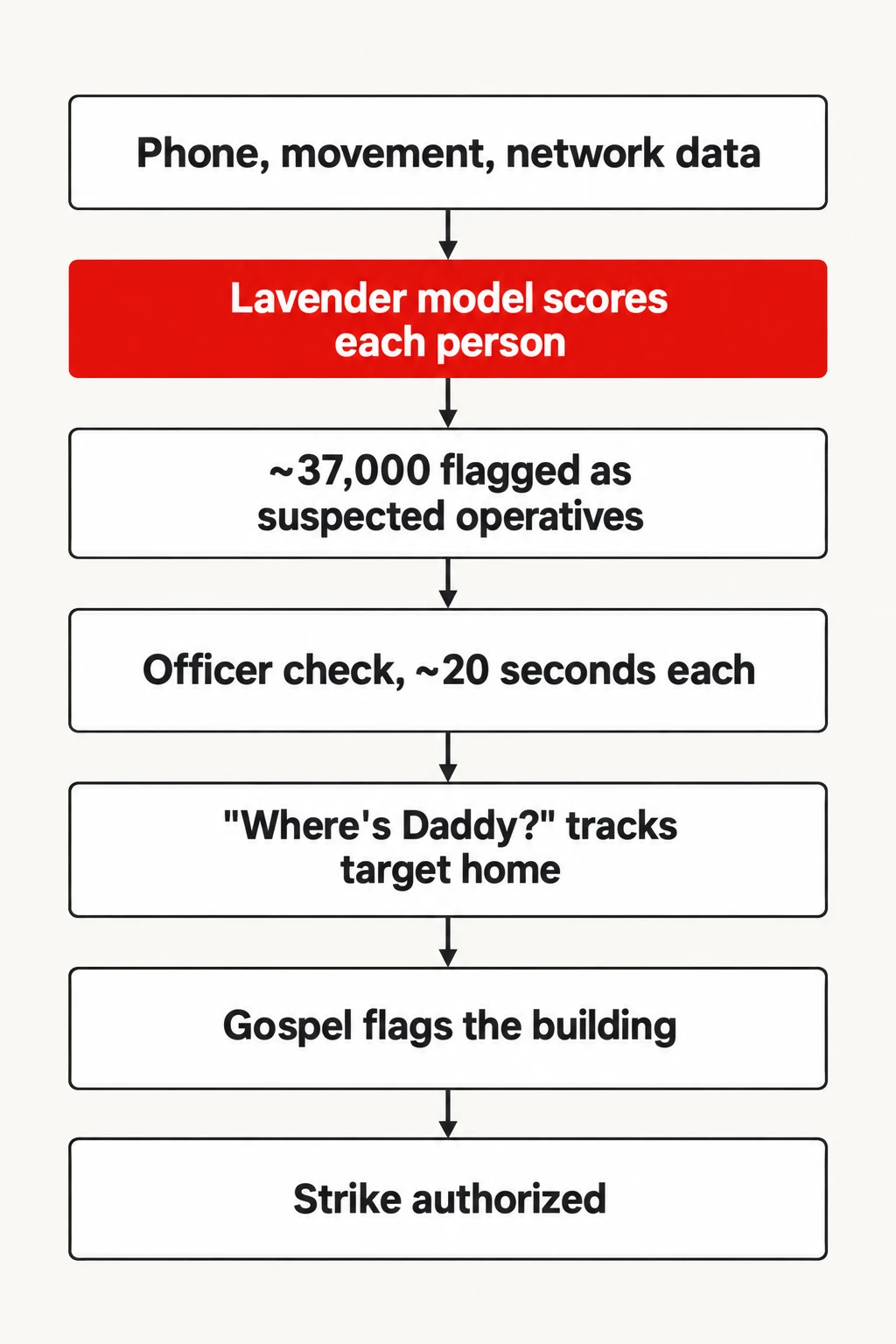
| From | To | How |
|---|---|---|
| Phone, movement, network data | Lavender model scores each person | |
| Lavender model scores each person | ~37,000 flagged as suspected operatives | |
| ~37,000 flagged as suspected operatives | Officer check, ~20 seconds each | |
| Officer check, ~20 seconds each | "Where's Daddy?" tracks target home | |
| "Where's Daddy?" tracks target home | Gospel flags the building | |
| Gospel flags the building | Strike authorized |
Based on +972 Magazine's 2024 Lavender investigation, cited in NAZA
The 2024 reporting put numbers on each step. Lavender scored roughly 37,000 Palestinians as suspected Hamas or Palestinian Islamic Jihad operatives, most of them low-ranking, by running phone, movement and association data through a model trained to flag militant traits. The army adopted Lavender’s output as a kill list after manually checking a sample of only a few hundred of its calls, according to the sources who spoke to Abraham. After that, an officer’s review of each name took about 20 seconds, and the system was wrong roughly one time in ten. For every junior operative Lavender flagged, strikes were authorized to kill five to 20 civilians, those sources said — a different figure from the two to three civilians per combatant that unnamed Israeli military officials later gave the Times of Israel as the war’s overall ratio. The two numbers measure different things: one a permitted ceiling for strikes on junior militants early in the war, the other a claimed average across the whole campaign. Neither has been independently verified.
From a citizenship bill to a criminal probe
Government pressure built for a month before Saturday’s letter. Culture Minister Miki Zohar asked the Interior Ministry in mid-September to examine stripping Abraham and Szor of their citizenship, calling them traitors on social media, Al Jazeera reported at the time. Netanyahu followed by announcing two Knesset bills: one revoking citizenship from anyone who defames IDF soldiers abroad, another multiplying defamation damages by a factor of 20. “We will revoke citizenship from anyone who defames IDF soldiers abroad — and hit them hard in the pocket,” he said. The push lands as Netanyahu’s governing coalition leans harder on security messaging ahead of Israel’s next election.
Saturday’s letter goes further than legislation: it asks for prosecutions, and it names the film’s 24 anonymous sources, not just its two directors, as targets. Netanyahu described the film as spinning “a false, misleading, and biased narrative that defames the State of Israel and the IDF globally.”
The army calls the film’s claims absurd and contradictory and insists strike decisions are made by human personnel only, under its own protocols — not by an algorithm. Zamir, one of the three officials Netanyahu wrote to, has separately ordered an investigation into suspected leaks of classified material used in making the film.

A government-aligned response has already shipped. NAZA: The Real Story, a counter-documentary by Roy Danino, Hagai Gutman and Ariel Orbuch built around soldiers who dispute the original’s account, was released with English subtitles within weeks of the Venice premiere. Its makers received certificates of appreciation from Tzipi Hotovely, head of Israel’s National Public Diplomacy Directorate, whose office said the film “refutes the blood libels against IDF soldiers and commanders.”
Not every reaction inside Israel has run the government’s way. Forty-three Israeli rights groups came out in defense of the filmmakers and against the threats against them, according to Channel 12. A street mural of Abraham and Szor, first painted with the word “traitors,” was altered by a second artist to read “heroes.”
Gaza’s health ministry puts the war’s overall toll at more than 73,500 people killed, including more than 1,330 since the October 2025 ceasefire, in a count that does not separate combatants from civilians — destruction mapped building by building in earlier reporting on the territory’s physical toll. Abraham, accepting the Venice prize, said six Palestinian children had been killed in Gaza during the ten days of the festival alone.
Abraham has said the film will stream free on the Guardian’s website from November, after its theatrical run. Whether Baharav-Miara, Israel’s attorney-general, opens the investigation Netanyahu wants is the open question: she has resisted direction from his office in other cases, and a prosecution built on unmasking 24 anonymous soldiers would need to clear that same desk first.