
The Nasdaq Composite opened November 25 down as much as 4 per cent, and the Nasdaq 100 fell as much as 4.7 per cent, which put it roughly 20 per cent below its October record — the standard definition of a bear market, as the AFR’s live markets blog reported. If that reading holds into next week, it would be the index’s first bear market since the tariff shock of April 2025. US markets close Thursday for Thanksgiving and reopen Friday with an abbreviated 1pm close, so the next full session is Monday.
By 1pm in New York the opening panic had roughly halved. The Dow Jones, down 1.5 per cent at its low, finished that stretch up 0.05 per cent. The S&P 500 pared a loss of near 3 per cent to 1 per cent. The Nasdaq Composite, down more than 4 per cent at the open, was off 1.8 per cent at 1.04pm. The VIX, Wall Street’s volatility gauge, spiked to near 35 before settling at 29.66 — a peak that, Bloomberg noted, hadn’t been touched since March’s turmoil.
| Session low (at the open) (%) | Near 1pm New York time (%) | |
|---|---|---|
| Nasdaq Composite | -4 | -1.8 |
| S&P 500 | -3 | -1 |
| Dow Jones | -1.5 | 0.05 |
Source: AFR live markets blog. Open-of-day losses for the S&P 500 and Nasdaq Composite were reported as 'near' or 'more than' the figures shown
The Huang whiplash
Wednesday’s rout built on a week of corporate theatre at Nvidia. Its board accepted Jensen Huang’s resignation on November 12 after revelations of extramarital affairs, one with a woman the US government suspects of being a Chinese intelligence asset; board chair Harvey Jones said at the time the board “does not intend to reinstate Jensen as CEO.” A public campaign from Elon Musk, Travis Kalanick, Garry Tan and others, plus repeated interventions from President Trump, reversed that: the board voted unanimously to reinstate Huang on November 23, as Nvidia’s investor-relations site announced. The stock rose 31 per cent that Monday, a single-day gain CNBC said added nearly $1 trillion to Nvidia’s market value. By Wednesday it had given back more than half of that, falling as much as 8.3 per cent and trading below $145, according to stockanalysis.com.
Credit markets flash red
The mechanism connecting Huang’s return to Wednesday’s stock rout runs through debt. Nvidia disclosed $118 billion in guarantees outstanding as of October 25 in its November 17 earnings release — credit support for land, power and chip financing extended to GPU buyers, the largest piece a $105 billion backstop for a 4.25-gigawatt, nine-building Ohio data-centre campus leased to OpenAI for 20 years. Nvidia says it has paid out nothing on any guarantee so far. But those guarantees sit behind companies like CoreWeave, which reported $35.6 billion of debt at mid-year against planned 2026 capital spending of $35 billion to $39 billion. The five-year credit-default swap on CoreWeave debt widened 2.09 percentage points on the day — the most ever in one session — to 15.34 percentage points, per ICE Data Services figures Bloomberg cited, implying more than a 70 per cent chance of default within five years. S&P Global Market Intelligence put the same spread at 1,314 basis points, implying about 68 per cent; the gap reflects different dealer quotes, but both sit deep in what credit traders call distressed territory. CoreWeave’s 9.75 per cent bond due 2031 now yields above 17 per cent. Swaps on Oracle widened 7 per cent and on Nvidia itself 3.4 per cent, CNBC reported.
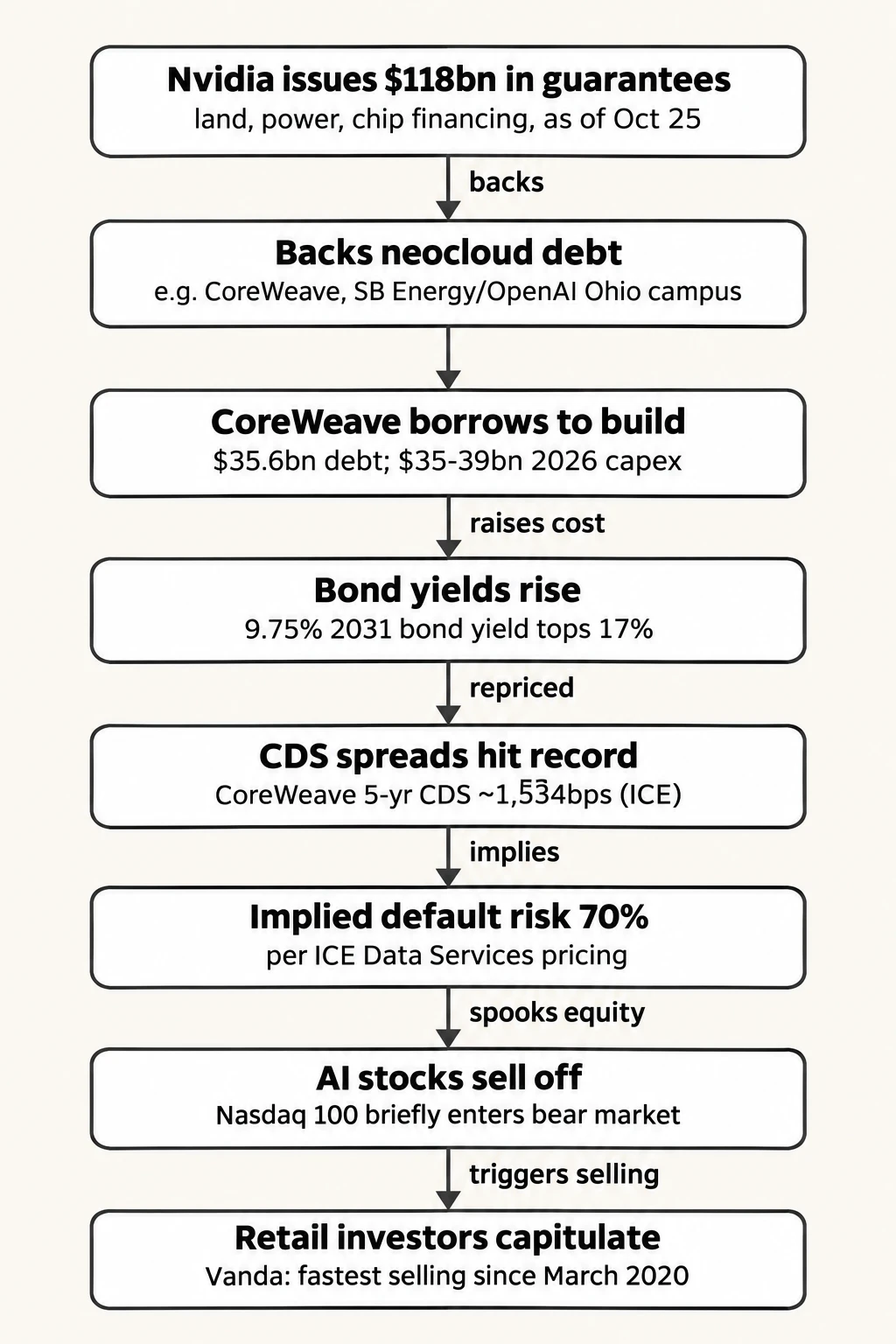
| From | To | How |
|---|---|---|
| Nvidia issues $118bn in guarantees (land, power, chip financing, as of Oct 25) | Backs neocloud debt (e.g. CoreWeave, SB Energy/OpenAI Ohio campus) | backs |
| Backs neocloud debt (e.g. CoreWeave, SB Energy/OpenAI Ohio campus) | CoreWeave borrows to build ($35.6bn debt; $35-39bn 2026 capex) | |
| CoreWeave borrows to build ($35.6bn debt; $35-39bn 2026 capex) | Bond yields rise (9.75% 2031 bond yield tops 17%) | raises cost |
| Bond yields rise (9.75% 2031 bond yield tops 17%) | CDS spreads hit record (CoreWeave 5-yr CDS ~1,534bps (ICE)) | repriced |
| CDS spreads hit record (CoreWeave 5-yr CDS ~1,534bps (ICE)) | Implied default risk >70% (per ICE Data Services pricing) | implies |
| Implied default risk >70% (per ICE Data Services pricing) | AI stocks sell off (Nasdaq 100 briefly enters bear market) | spooks equity |
| AI stocks sell off (Nasdaq 100 briefly enters bear market) | Retail investors capitulate (Vanda: fastest selling since March 2020) | triggers selling |
Based on Bloomberg, Nvidia SEC filings
Michael Burry, who built his reputation shorting mortgage debt in 2008 and more recently shorting the Nasdaq, used the rout to flip positioning. In a post on his Substack newsletter, Cassandra Unchained, he said he had sold his remaining Nasdaq 100 index puts, as Bloomberg reported.
Globally, my portfolio is more long, and less short, than it has been in some time. In fact, when I say less short, right now apart from Palantir puts and MetLife puts, I am temporarily almost entirely long.
He kept far-out-of-the-money Nvidia call options bought the previous Friday, which he said had already doubled in value, and about a quarter of his portfolio in cash. His longer-term view on Nvidia hasn’t changed: he says he plans to short it again near $200 a share — about 38 per cent above Wednesday’s price — once he judges the market has returned to optimism.
Retail investors, who spent the post-pandemic years buying every tech dip, stopped. Vanda Research data show individual investors sold a net $338 million of single stocks on November 5 — the heaviest one-day selling since $502 million in March 2020 — and, over the following two weeks excluding Nvidia and Anthropic, were net sellers in 13 of 17 sessions, pulling $1.4 billion from the rest of the market while pouring $4.4 billion into those two names, Vanda’s data showed via TradingView. That bet has soured too: retail buyers of last week’s Nvidia dip paid an average $148 a share; the stock closed Monday at $165 and has since fallen below $145, erasing nearly all of that paper gain.
Anthropic, which went public on November 18 at $83 a share and briefly carried a $2 trillion valuation, fell to an intraday low of $73.85 on Wednesday — 36 per cent below last week’s post-listing high of $115.10 — pushing its market capitalisation to roughly $999.5 billion, briefly under the trillion-dollar line for the first time since it listed.

Bitcoin fell as much as 4.2 per cent to around $57,280, within reach of the $55,254 low it set on November 21 and its lowest level in more than two years. The token is down about 24 per cent this month, its worst November since June 2022, and more than 30 per cent since January; from its October 2025 record of $126,080, the drawdown is roughly 55 per cent. Total crypto market capitalisation hit a two-year low near $2.08 trillion, and Bloomberg reported spot bitcoin ETFs have shed about $4.94 billion in November through November 24 — their worst month since the funds launched in January 2024.
The immediate trigger for Wednesday’s selling was October’s personal-consumption-expenditures price index, which rose 0.3 per cent on the month and 3.8 per cent on the year, with the core measure up 3.3 per cent — hot enough to firm up bets on a Federal Reserve rate increase in December rather than the cut investors had been pricing in alongside the AI-spending boom. A Trump administration proposal for new tariffs on 14 trading partners added to the gloom hours before markets closed for Thanksgiving.
Not everything in US equities is exposed to this. Berkshire Hathaway keeps setting records while the AI trade it mostly avoided tears itself apart around it — a reminder that Wednesday’s multi-trillion-dollar hit to Nasdaq 100 market value is concentrated in one specific balance-sheet structure: chipmaker guarantees backing neocloud debt backing data-centre leases to AI labs still burning cash. Whether that structure survives a Fed that still won’t cut, and whether CoreWeave can roll its debt at a 17 per cent yield, are the numbers to watch when trading resumes Friday.